
Legendary Species · Trout
Brown trout
Salmo trutta[1]
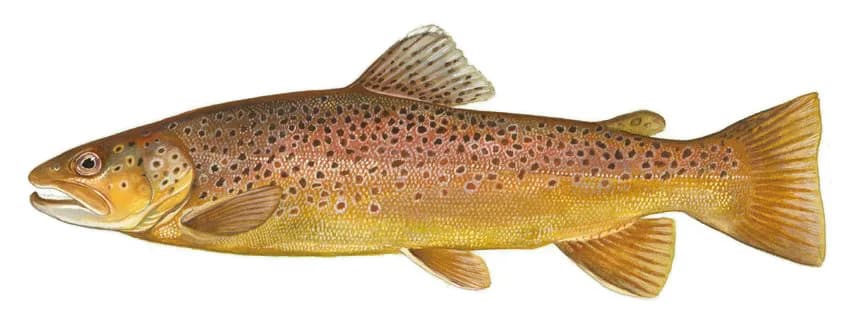
In California, the brown trout is the only trout with both red and black spots on its body. The dark spots on its sides usually have a pale halo.[2]
- 489waters list it
- 71states and regions
- 4agency sources
Identification
- In California, the brown trout is the only trout with both red and black spots on its body. The dark spots on its sides usually have a pale halo.[2]
What the source says
“Only trout in California with both red and black spots on body. Dark spots on the sides typically surrounded by a pale halo. Coloration is usually dark to olive brown on the back, shading to yellow on the sides, and yellow or white on the belly.”
- Michigan DNR points to a broad, square tongue with 11 to 12 large teeth, light pectoral fins and a square tail. Lake-run browns are mostly silver, and their spots can be hard to see.[1]
What the source says
“Dorsal and adipose fin, broad square tongue with 11 to 12 large teeth, light pectoral fins, square tail, and nine to 10 rays in the anal fin. Lake-run browns are predominately silver in color and the body spots are often obscured in lake-dwellers compared to the resident stream dwellers.”
Habitat and range
- Brown trout are not native to North America. Their native range is Europe, northern Africa and western Asia.[3]
What the source says
“Native Range: Europe, northern Africa, and western Asia (Page and Burr 1991).”
- Brown trout are native to Europe and parts of Asia and were brought to Michigan in 1883. They tolerate warmer water better than other trout species.[1]
What the source says
“Native to Europe and parts of Asia, brown trout were introduced to Michigan in 1883 — one of the first states to import them into North America — they now thrive statewide. Brown trout are more tolerant of warmer water temperatures than other trout species”
- Water temperature limits where brown trout live. CDFW gives their preferred range as 12-20°C.[2]
What the source says
“Water temperature is an important factor limiting brown trout distribution (preferred temperatures are 12-20ºC).”
Life history
- Brown trout spawn in tributary streams in September and October. The female digs a shallow nest (redd) in gravel and covers the eggs afterward.[1]
What the source says
“Since brown trout spawn in tributary streams in September and October, they begin to take up residence near stream outlets in late summer to early fall. After ascending a particular stream, brown trout spawners choose shallow, gravelly or rocky areas. The female creates a shallow depression (redd) in the gravel”
- Adult brown trout eat insects and their larvae, crustaceans, mollusks, amphibians, small rodents and other fish.[1]
What the source says
“The diet of adult brown trout includes insects and their larvae, crustaceans, mollusks, amphibians, small rodents and other fish.”
Status, protections and rules
Legal status and rules as the agency stated them on the date read. Rules change: check the current regulations for the water.
- The U.S. Geological Survey reports that brown trout have been linked to declines in native fish, including other trout and salmon, through predation, displacement and competition for food.[3]
What the source says
“Brown Trout have been implicated in reducing native fish populations (including other salmonids) through predation, displacement, and food competition (Taylor et al. 1984).”
- Yellowstone National Park rule: in the Firehole River, Madison River and lower Gibbon River (below Gibbon Falls), all rainbow and brown trout must be released.[4]
What the source says
“Firehole River, Madison River, lower Gibbon River (downstream of Gibbon Falls)—possession of up to five brook trout is allowed. Catch and release all rainbow and brown trout.”
Fishing for it: what the agencies say
What agencies and extension services say about catching it, with the source for each line.
- Michigan DNR says brown trout are a favourite of fly anglers, many of whom fish after dark during big insect hatches. Large streamers and splashy surface flies such as mouse patterns also work.[1]
What the source says
“brown trout are a favorite of fly fishers, many of whom pursue them after dark during notable insect hatches, especially the giant Michigan mayfly (Hexagenia limbata). But large streamers and big splashy surface flies, such as mouse patterns, produce well, too.”
- Ask the nearest fly shop what is hatching on the water this week; it is the most current information there is.
- Match the size and colour of the insects you see on the water before changing anything else.
- Read the water page's gauge before you go: flow and water temperature change by the day.
Water temperature
Warm water stresses trout, char and salmon. These are the published temperature lines we show on every gauge, chosen state first: the state agency's own where it publishes one, otherwise federal guidance (said so). Each water page applies them to the gauge's live reading; the flow and temperature checker does the same for any gauge.
| State | Whose lines | Sources |
|---|---|---|
| Pennsylvania | Pennsylvania Fish and Boat Commission (the state's own) | Pennsylvania Fish and Boat Commission |
| Iowa | Federal guidance (the National Park Service); no Iowa line found | National Park Service · U.S. Fish and Wildlife Service · Iowa Department of Natural Resources |
| Wyoming | Wyoming Game and Fish (the state's own) | Wyoming Game and Fish Department · Wyoming Game and Fish Department · National Park Service |
| Idaho | Idaho Fish and Game (the state's own) | Idaho Department of Fish and Game · Idaho Department of Fish and Game |
| Utah | Federal guidance (the National Park Service); no Utah line found | National Park Service · U.S. Fish and Wildlife Service |
| Arizona | Arizona Game and Fish (the state's own) | Arizona Game and Fish Department |
| New York | New York DEC (the state's own) | New York State Department of Environmental Conservation |
| Montana | Montana FWP (the state's own) | Montana Fish, Wildlife & Parks · Montana Fish, Wildlife & Parks · Montana Fish, Wildlife & Parks |
| Oregon | ODFW (the state's own) | Oregon Department of Fish and Wildlife · Oregon Department of Fish and Wildlife |
| Indiana | Federal guidance (the National Park Service); no Indiana line found | National Park Service · U.S. Fish and Wildlife Service |
| Michigan | Federal guidance (the National Park Service); no Michigan line found | National Park Service · U.S. Fish and Wildlife Service |
| Tennessee | Federal guidance (the National Park Service); no Tennessee line found | National Park Service · U.S. Fish and Wildlife Service |
| Arkansas | Arkansas Game and Fish (the state's own) | Arkansas Game and Fish Commission |
| Delaware | Federal guidance (the National Park Service); no Delaware line found | National Park Service · U.S. Fish and Wildlife Service · Delaware Department of Natural Resources and Environmental Control |
| Wisconsin | Federal guidance (the National Park Service); no Wisconsin line found | National Park Service · U.S. Fish and Wildlife Service |
| Colorado | Colorado Parks and Wildlife (the state's own) | Colorado Parks and Wildlife |
| Maryland | Maryland DNR (the state's own) | Maryland Department of Natural Resources |
| Oklahoma | Oklahoma Wildlife Conservation (the state's own) | Oklahoma Department of Wildlife Conservation |
| Virginia | Virginia DWR (the state's own) | Virginia Department of Wildlife Resources |
| California | CDFW (the state's own) | California Department of Fish and Wildlife |
| Georgia | Federal guidance (the National Park Service); no Georgia line found | National Park Service · U.S. Fish and Wildlife Service · Georgia Department of Natural Resources, Wildlife Resources Division |
| Kentucky | Federal guidance (the National Park Service); no Kentucky line found | National Park Service · U.S. Fish and Wildlife Service |
| Maine | Maine IF&W (the state's own) | Maine Department of Inland Fisheries and Wildlife |
| Massachusetts | Federal guidance (the National Park Service); no Massachusetts line found | National Park Service · U.S. Fish and Wildlife Service |
| Minnesota | Federal guidance (the National Park Service); no Minnesota line found | National Park Service · U.S. Fish and Wildlife Service · Minnesota Department of Natural Resources |
| Missouri | Federal guidance (the National Park Service); no Missouri line found | National Park Service · U.S. Fish and Wildlife Service · Missouri Department of Conservation |
| North Dakota | Federal guidance (the National Park Service); no North Dakota line found | National Park Service · U.S. Fish and Wildlife Service |
| South Carolina | South Carolina DNR (the state's own) | South Carolina Department of Natural Resources |
| Texas | Texas Parks and Wildlife (the state's own) | Texas Parks and Wildlife Department · Texas Parks and Wildlife Department |
| Vermont | Vermont Fish and Wildlife (the state's own) | Vermont Fish and Wildlife Department |
Where to fish for brown trout
Our 489 water pages whose agency species list names brown trout (each list links to the agency page it comes from). A species missing from a list does not mean it is absent: many agencies publish no list for a water.
United States 346 waters
Pennsylvania 62
Brown trout in PennsylvaniaAll Pennsylvania waters
- Penns CreekAgency list: Pennsylvania Fish and Boat Commission
- Spring CreekAgency list: Pennsylvania Fish and Boat Commission
- Falling Spring BranchAgency list: Pennsylvania Fish and Boat Commission
- Allegheny RiverAgency list: Pennsylvania Fish and Boat Commission
- Little Lehigh CreekAgency list: Pennsylvania Fish and Boat Commission
- Little Juniata RiverAgency list: Pennsylvania Fish and Boat Commission
- Kettle CreekAgency list: Pennsylvania Fish and Boat Commission
- Driftwood Branch Sinnemahoning CreekAgency list: Pennsylvania Fish and Boat Commission
- Yellow CreekAgency list: Pennsylvania Fish and Boat Commission
- Big Spring CreekAgency list: Pennsylvania Fish and Boat Commission
- Francis BranchAgency list: Pennsylvania Fish and Boat Commission
- Little Sandy CreekAgency list: Pennsylvania Fish and Boat Commission
- Slate RunAgency list: Pennsylvania Fish and Boat Commission
- Pine CreekAgency list: Pennsylvania Fish and Boat Commission
- Lackawanna RiverAgency list: Pennsylvania Fish and Boat Commission
- East Branch Tunungwant CreekAgency list: Pennsylvania Fish and Boat Commission
- Bushkill CreekAgency list: Pennsylvania Fish and Boat Commission
- Cedar RunAgency list: Pennsylvania Fish and Boat Commission
- Cross ForkAgency list: Pennsylvania Fish and Boat Commission
- Germania BranchAgency list: Pennsylvania Fish and Boat Commission
- Grays RunAgency list: Pennsylvania Fish and Boat Commission
- Valley CreekAgency list: Pennsylvania Fish and Boat Commission
- West Branch Susquehanna RiverAgency list: Pennsylvania Fish and Boat Commission
- Lick RunAgency list: Pennsylvania Fish and Boat Commission
- Trout RunAgency list: Pennsylvania Fish and Boat Commission
- Hickory RunAgency list: Pennsylvania Fish and Boat Commission
- Little Valley CreekAgency list: Pennsylvania Fish and Boat Commission
- Monocacy CreekAgency list: Pennsylvania Fish and Boat Commission
- Rauchtown CreekAgency list: Pennsylvania Fish and Boat Commission
- Roaring BrookAgency list: Pennsylvania Fish and Boat Commission
- Cherry RunAgency list: Pennsylvania Fish and Boat Commission
- Hunts RunAgency list: Pennsylvania Fish and Boat Commission
- Toms CreekAgency list: Pennsylvania Fish and Boat Commission
- West Branch Caldwell CreekAgency list: Pennsylvania Fish and Boat Commission
- Codorus CreekAgency list: Pennsylvania Fish and Boat Commission
- Honey CreekAgency list: Pennsylvania Fish and Boat Commission
- Saucon CreekAgency list: Pennsylvania Fish and Boat Commission
- Pohopoco CreekAgency list: Pennsylvania Fish and Boat Commission
- Laurel RunAgency list: Pennsylvania Fish and Boat Commission
- East Fork Sinnemahoning CreekAgency list: Pennsylvania Fish and Boat Commission
- Elk CreekAgency list: Pennsylvania Fish and Boat Commission
- Freeman RunAgency list: Pennsylvania Fish and Boat Commission
- Wapwallopen CreekAgency list: Pennsylvania Fish and Boat Commission
- Aquashicola CreekAgency list: Pennsylvania Fish and Boat Commission
- Beaver RunAgency list: Pennsylvania Fish and Boat Commission
- Big Moores RunAgency list: Pennsylvania Fish and Boat Commission
- Cedar CreekAgency list: Pennsylvania Fish and Boat Commission
- Clearfield CreekAgency list: Pennsylvania Fish and Boat Commission
- Devils Hole CreekAgency list: Pennsylvania Fish and Boat Commission
- English RunAgency list: Pennsylvania Fish and Boat Commission
- Huntington CreekAgency list: Pennsylvania Fish and Boat Commission
- Logan BranchAgency list: Pennsylvania Fish and Boat Commission
- Marsh CreekAgency list: Pennsylvania Fish and Boat Commission
- Oswayo CreekAgency list: Pennsylvania Fish and Boat Commission
- Paddy RunAgency list: Pennsylvania Fish and Boat Commission
- Perkiomen CreekAgency list: Pennsylvania Fish and Boat Commission
- Pocono CreekAgency list: Pennsylvania Fish and Boat Commission
- Shirley RunAgency list: Pennsylvania Fish and Boat Commission
- Wallace RunAgency list: Pennsylvania Fish and Boat Commission
- West Branch Genesee RiverAgency list: Pennsylvania Fish and Boat Commission
- West Branch Perkiomen CreekAgency list: Pennsylvania Fish and Boat Commission
- Yellow CreekAgency list: Pennsylvania Fish and Boat Commission
Iowa 58
Brown trout in IowaAll Iowa waters
- Casey SpringsAgency list: Iowa Department of Natural Resources
- French CreekAgency list: Iowa Department of Natural Resources
- Hewett CreekAgency list: Iowa Department of Natural Resources
- Pine Spring CreekAgency list: Iowa Department of Natural Resources
- South Pine CreekAgency list: Iowa Department of Natural Resources
- Waterloo CreekAgency list: Iowa Department of Natural Resources
- West Branch French CreekAgency list: Iowa Department of Natural Resources
- Bloody RunAgency list: Iowa Department of Natural Resources
- Spring BranchAgency list: Iowa Department of Natural Resources
- Maquoketa RiverAgency list: Iowa Department of Natural Resources
- Turkey RiverAgency list: Iowa Department of Natural Resources
- Yellow RiverAgency list: Iowa Department of Natural Resources
- Arner BranchAgency list: Iowa Department of Natural Resources
- Bear CreekAgency list: Iowa Department of Natural Resources
- Bear CreekAgency list: Iowa Department of Natural Resources
- Bear CreekAgency list: Iowa Department of Natural Resources
- Bigalk CreekAgency list: Iowa Department of Natural Resources
- Bohemian CreekAgency list: Iowa Department of Natural Resources
- Brush CreekAgency list: Iowa Department of Natural Resources
- Buck CreekAgency list: Iowa Department of Natural Resources
- Burr Oak CreekAgency list: Iowa Department of Natural Resources
- Canoe CreekAgency list: Iowa Department of Natural Resources
- Catfish CreekAgency list: Iowa Department of Natural Resources
- Chihak CreekAgency list: Iowa Department of Natural Resources
- Clear CreekAgency list: Iowa Department of Natural Resources
- Clear CreekAgency list: Iowa Department of Natural Resources
- Coon CreekAgency list: Iowa Department of Natural Resources
- Elk CreekAgency list: Iowa Department of Natural Resources
- Fountain Springs CreekAgency list: Iowa Department of Natural Resources
- Glovers CreekAgency list: Iowa Department of Natural Resources
- Grannis CreekAgency list: Iowa Department of Natural Resources
- Hickory CreekAgency list: Iowa Department of Natural Resources
- Joy SpringsAgency list: Iowa Department of Natural Resources
- Little Mill CreekAgency list: Iowa Department of Natural Resources
- Little Paint CreekAgency list: Iowa Department of Natural Resources
- Little Turkey RiverAgency list: Iowa Department of Natural Resources
- Middle Bear CreekAgency list: Iowa Department of Natural Resources
- Mill CreekAgency list: Iowa Department of Natural Resources
- Mink CreekAgency list: Iowa Department of Natural Resources
- Monastery CreekAgency list: Iowa Department of Natural Resources
- North Bear CreekAgency list: Iowa Department of Natural Resources
- North Canoe CreekAgency list: Iowa Department of Natural Resources
- North Cedar CreekAgency list: Iowa Department of Natural Resources
- Otter CreekAgency list: Iowa Department of Natural Resources
- Paint CreekAgency list: Iowa Department of Natural Resources
- Patterson CreekAgency list: Iowa Department of Natural Resources
- Richmond SpringsAgency list: Iowa Department of Natural Resources
- Sny Magill CreekAgency list: Iowa Department of Natural Resources
- South Bear CreekAgency list: Iowa Department of Natural Resources
- South Cedar CreekAgency list: Iowa Department of Natural Resources
- Spring CreekAgency list: Iowa Department of Natural Resources
- Ten Mile CreekAgency list: Iowa Department of Natural Resources
- Trout RiverAgency list: Iowa Department of Natural Resources
- Trout RunAgency list: Iowa Department of Natural Resources
- Turtle CreekAgency list: Iowa Department of Natural Resources
- Twin SpringsAgency list: Iowa Department of Natural Resources
- West Canoe CreekAgency list: Iowa Department of Natural Resources
- Wexford CreekAgency list: Iowa Department of Natural Resources
Wyoming 48
Brown trout in WyomingAll Wyoming waters
- North Platte RiverAgency list: Wyoming Game and Fish Department
- New Fork RiverAgency list: Wyoming Game and Fish Department
- Green RiverAgency list: Wyoming Game and Fish Department
- Salt RiverAgency list: Wyoming Game and Fish Department
- Bighorn RiverAgency list: Wyoming Game and Fish Department
- Shoshone RiverAgency list: Wyoming Game and Fish Department
- North Fork Powder RiverAgency list: Wyoming Game and Fish Department
- Sand CreekAgency list: Wyoming Game and Fish Department
- Middle Fork Powder RiverAgency list: Wyoming Game and Fish Department
- Clarks Fork Yellowstone RiverAgency list: Wyoming Game and Fish Department
- Sybille CreekAgency list: Wyoming Game and Fish Department
- Deer CreekAgency list: Wyoming Game and Fish Department
- Clear CreekAgency list: Wyoming Game and Fish Department
- Laramie RiverAgency list: Wyoming Game and Fish Department
- Bates CreekAgency list: Wyoming Game and Fish Department
- Big CreekAgency list: Wyoming Game and Fish Department
- Canyon CreekAgency list: Wyoming Game and Fish Department
- la Prele CreekAgency list: Wyoming Game and Fish Department
- Middle Crow CreekAgency list: Wyoming Game and Fish Department
- Tensleep CreekAgency list: Wyoming Game and Fish Department
- Pine CreekAgency list: Wyoming Game and Fish Department
- Brush CreekAgency list: Wyoming Game and Fish Department
- Medicine Lodge CreekAgency list: Wyoming Game and Fish Department
- Alkali Creek PatchAgency list: Wyoming Game and Fish Department
- Blue CreekAgency list: Wyoming Game and Fish Department
- Brandel CreekAgency list: Wyoming Game and Fish Department
- Buffalo CreekAgency list: Wyoming Game and Fish Department
- Cedar CreekAgency list: Wyoming Game and Fish Department
- Duck CreekAgency list: Wyoming Game and Fish Department
- Elk Hollow CreekAgency list: Wyoming Game and Fish Department
- Horse CreekAgency list: Wyoming Game and Fish Department
- Jakeys ForkAgency list: Wyoming Game and Fish Department
- la Bonte CreekAgency list: Wyoming Game and Fish Department
- Little Canyon CreekAgency list: Wyoming Game and Fish Department
- Little Laramie RiverAgency list: Wyoming Game and Fish Department
- Little Popo Agie RiverAgency list: Wyoming Game and Fish Department
- North Sybille CreekAgency list: Wyoming Game and Fish Department
- Pine CreekAgency list: Wyoming Game and Fish Department
- Popo Agie RiverAgency list: Wyoming Game and Fish Department
- Shell CreekAgency list: Wyoming Game and Fish Department
- Medicine Bow RiverAgency list: Wyoming Game and Fish Department
- Big Sandy RiverAgency list: Wyoming Game and Fish Department
- Rock CreekAgency list: Wyoming Game and Fish Department
- Sweetwater RiverAgency list: Wyoming Game and Fish Department
- Duck CreekAgency list: Wyoming Game and Fish Department
- Forty Rod CreekAgency list: Wyoming Game and Fish Department
- Hams ForkAgency list: Wyoming Game and Fish Department
- West Tensleep CreekAgency list: Wyoming Game and Fish Department
Idaho 34
Brown trout in IdahoAll Idaho waters
- South Fork of the Snake RiverAgency list: Idaho Department of Fish and Game
- Big Wood RiverAgency list: Idaho Department of Fish and Game
- Silver CreekAgency list: Idaho Department of Fish and Game
- Clark Fork RiverAgency list: Idaho Department of Fish and Game
- Little Wood RiverAgency list: Idaho Department of Fish and Game
- Lake Pend OreilleAgency list: Idaho Department of Fish and Game
- Spokane RiverAgency list: Idaho Department of Fish and Game
- Henry's ForkAgency list: Idaho Department of Fish and Game
- Pend Oreille RiverAgency list: Idaho Department of Fish and Game
- Portneuf RiverAgency list: Idaho Department of Fish and Game
- Priest RiverAgency list: Idaho Department of Fish and Game
- Billingsley CreekAgency list: Idaho Department of Fish and Game
- Chesterfield ReservoirAgency list: Idaho Department of Fish and Game
- Sublett ReservoirAgency list: Idaho Department of Fish and Game
- Warm RiverAgency list: Idaho Department of Fish and Game
- Bear RiverAgency list: Idaho Department of Fish and Game
- Camas CreekAgency list: Idaho Department of Fish and Game
- Rock CreekAgency list: Idaho Department of Fish and Game
- American Falls ReservoirAgency list: Idaho Department of Fish and Game
- Ashton ReservoirAgency list: Idaho Department of Fish and Game
- Cocolalla CreekAgency list: Idaho Department of Fish and Game
- Cocolalla LakeAgency list: Idaho Department of Fish and Game
- Cub RiverAgency list: Idaho Department of Fish and Game
- Grove CreekAgency list: Idaho Department of Fish and Game
- Hoodoo CreekAgency list: Idaho Department of Fish and Game
- Horsethief ReservoirAgency list: Idaho Department of Fish and Game
- Loving CreekAgency list: Idaho Department of Fish and Game
- Magic ReservoirAgency list: Idaho Department of Fish and Game
- McTucker CreekAgency list: Idaho Department of Fish and Game
- Montpelier CreekAgency list: Idaho Department of Fish and Game
- Montpelier ReservoirAgency list: Idaho Department of Fish and Game
- Palisades ReservoirAgency list: Idaho Department of Fish and Game
- Stalker CreekAgency list: Idaho Department of Fish and Game
- Toponce CreekAgency list: Idaho Department of Fish and Game
Utah 32
Brown trout in UtahAll Utah waters
- Provo RiverAgency list: Utah Division of Wildlife Resources
- Weber RiverAgency list: Utah Division of Wildlife Resources
- East Fork Sevier RiverAgency list: Utah Division of Wildlife Resources
- Logan RiverAgency list: Utah Division of Wildlife Resources
- Ogden RiverAgency list: Utah Division of Wildlife Resources
- Strawberry RiverAgency list: Utah Division of Wildlife Resources
- West Fork Duchesne RiverAgency list: Utah Division of Wildlife Resources
- Fish CreekAgency list: Utah Division of Wildlife Resources
- Jordanelle ReservoirAgency list: Utah Division of Wildlife Resources
- Lower Stillwater PondsAgency list: Utah Division of Wildlife Resources
- Starvation ReservoirAgency list: Utah Division of Wildlife Resources
- Straight Canyon CreekAgency list: Utah Division of Wildlife Resources
- Beaver RiverAgency list: Utah Division of Wildlife Resources
- Fremont RiverAgency list: Utah Division of Wildlife Resources
- Huntington CreekAgency list: Utah Division of Wildlife Resources
- Mammoth CreekAgency list: Utah Division of Wildlife Resources
- Price RiverAgency list: Utah Division of Wildlife Resources
- Salt CreekAgency list: Utah Division of Wildlife Resources
- American Fork CreekAgency list: Utah Division of Wildlife Resources
- Asay CreekAgency list: Utah Division of Wildlife Resources
- Blacksmith Fork RiverAgency list: Utah Division of Wildlife Resources
- Causey ReservoirAgency list: Utah Division of Wildlife Resources
- Diamond Fork RiverAgency list: Utah Division of Wildlife Resources
- Echo ReservoirAgency list: Utah Division of Wildlife Resources
- Grantsville ReservoirAgency list: Utah Division of Wildlife Resources
- Hobbs ReservoirAgency list: Utah Division of Wildlife Resources
- Hyrum ReservoirAgency list: Utah Division of Wildlife Resources
- Mill Meadow ReservoirAgency list: Utah Division of Wildlife Resources
- Rockport ReservoirAgency list: Utah Division of Wildlife Resources
- Sevier River In Marysvale CanyonAgency list: Utah Division of Wildlife Resources
- Spanish Fork RiverAgency list: Utah Division of Wildlife Resources
- Vernon ReservoirAgency list: Utah Division of Wildlife Resources
Arizona 26
Brown trout in ArizonaAll Arizona waters
- Canyon CreekAgency list: Arizona Game and Fish Department / Arizona Game and Fish Commission (2025-2026 Arizona Fishing Regulations, official eRegulations edition)
- Chevelon CreekAgency list: Arizona Game and Fish Department / Arizona Game and Fish Commission (2025-2026 Arizona Fishing Regulations, official eRegulations edition)
- Oak CreekAgency list: Arizona Game and Fish Department / Arizona Game and Fish Commission (2025-2026 Arizona Fishing Regulations, official eRegulations edition)
- Little Colorado RiverAgency list: Arizona Game and Fish Department / Arizona Game and Fish Commission (2025-2026 Arizona Fishing Regulations, official eRegulations edition)
- Becker LakeAgency list: Arizona Game and Fish Department / Arizona Game and Fish Commission (2025-2026 Arizona Fishing Regulations, official eRegulations edition)
- Elk TankAgency list: Arizona Game and Fish Department / Arizona Game and Fish Commission (2025-2026 Arizona Fishing Regulations, official eRegulations edition)
- Hayground CreekAgency list: Arizona Game and Fish Department / Arizona Game and Fish Commission (2025-2026 Arizona Fishing Regulations, official eRegulations edition)
- Horton CreekAgency list: Arizona Game and Fish Department / Arizona Game and Fish Commission (2025-2026 Arizona Fishing Regulations, official eRegulations edition)
- J D Dam LakeAgency list: Arizona Game and Fish Department / Arizona Game and Fish Commission (2025-2026 Arizona Fishing Regulations, official eRegulations edition)
- Lower Goldwater LakeAgency list: Arizona Game and Fish Department / Arizona Game and Fish Commission (2025-2026 Arizona Fishing Regulations, official eRegulations edition)
- Middle TankAgency list: Arizona Game and Fish Department / Arizona Game and Fish Commission (2025-2026 Arizona Fishing Regulations, official eRegulations edition)
- Perkins TankAgency list: Arizona Game and Fish Department / Arizona Game and Fish Commission (2025-2026 Arizona Fishing Regulations, official eRegulations edition)
- River ReservoirAgency list: Arizona Game and Fish Department / Arizona Game and Fish Commission (2025-2026 Arizona Fishing Regulations, official eRegulations edition)
- West Fork Black RiverAgency list: Arizona Game and Fish Department / Arizona Game and Fish Commission (2025-2026 Arizona Fishing Regulations, official eRegulations edition)
- Ashurst LakeAgency list: Arizona Game and Fish Department (AZGFD)
- Bunch ReservoirAgency list: Arizona Game and Fish Department (AZGFD)
- Christopher CreekAgency list: Arizona Game and Fish Department (AZGFD)
- East Clear CreekAgency list: Arizona Game and Fish Department (AZGFD)
- Haigler CreekAgency list: Arizona Game and Fish Department (AZGFD)
- Kinnikinick LakeAgency list: Arizona Game and Fish Department (AZGFD)
- Lynx LakeAgency list: Arizona Game and Fish Department (AZGFD)
- Mule CreekAgency list: Arizona Game and Fish Department (AZGFD)
- Riggs Flat LakeAgency list: Arizona Game and Fish Department (AZGFD)
- Rose Canyon LakeAgency list: Arizona Game and Fish Department (AZGFD)
- Tunnel ReservoirAgency list: Arizona Game and Fish Department (AZGFD)
- Chevelon Canyon LakeAgency list: Arizona Game and Fish Department / Arizona Game and Fish Commission (2025-2026 Arizona Fishing Regulations, official eRegulations edition)
New York 18
Brown trout in New YorkAll New York waters
- Salmon RiverAgency list: New York State Department of Environmental Conservation
- West Branch Delaware RiverAgency list: New York State Department of Environmental Conservation
- Upper Delaware RiverAgency list: National Park Service
- BeaverkillAgency list: New York State Department of Environmental Conservation
- Genesee RiverAgency list: New York State Department of Environmental Conservation (NYSDEC), Bureau of Fisheries
- Black RiverAgency list: New York State Department of Environmental Conservation (NYSDEC), Bureau of Fisheries
- East Branch Delaware RiverAgency list: New York State Department of Environmental Conservation
- Neversink RiverAgency list: New York State Department of Environmental Conservation
- Oak Orchard CreekAgency list: New York State Department of Environmental Conservation (NYSDEC), Bureau of Fisheries
- Irondequoit CreekAgency list: New York State Department of Environmental Conservation (NYSDEC), Bureau of Fisheries
- Lindsey CreekAgency list: New York State Department of Environmental Conservation (NYSDEC), Bureau of Fisheries
- Sandy CreekAgency list: New York State Department of Environmental Conservation (NYSDEC), Bureau of Fisheries
- Johnson CreekAgency list: New York State Department of Environmental Conservation (NYSDEC), Bureau of Fisheries
- Keg CreekAgency list: New York State Department of Environmental Conservation (NYSDEC), Bureau of Fisheries
- Twelve Mile CreekAgency list: New York State Department of Environmental Conservation (NYSDEC), Bureau of Fisheries
- Esopus CreekAgency list: New York State Department of Environmental Conservation
- Grindstone CreekAgency list: New York State Department of Environmental Conservation (NYSDEC), Bureau of Fisheries
- Marsh CreekAgency list: New York State Department of Environmental Conservation (NYSDEC), Bureau of Fisheries
Montana 16
Brown trout in MontanaAll Montana waters
- Madison RiverAgency list: Montana Fish, Wildlife & Parks
- Yellowstone RiverAgency list: Montana Fish, Wildlife & Parks
- Blackfoot RiverAgency list: Montana Fish, Wildlife & Parks
- Clark Fork RiverAgency list: Montana Fish, Wildlife & Parks
- Bitterroot RiverAgency list: Montana Fish, Wildlife & Parks
- Rock CreekAgency list: Montana Fish, Wildlife & Parks
- Beaverhead RiverAgency list: Montana Fish, Wildlife & Parks
- Jefferson RiverAgency list: Montana Fish, Wildlife & Parks
- Big Hole RiverAgency list: Montana Fish, Wildlife & Parks
- Smith RiverAgency list: Montana Fish, Wildlife & Parks
- Ruby RiverAgency list: Montana Fish, Wildlife & Parks
- Gallatin RiverAgency list: Montana Fish, Wildlife & Parks
- Boulder RiverAgency list: Montana Fish, Wildlife & Parks
- Bighorn LakeAgency list: National Park Service (Bighorn Canyon National Recreation Area)
- Ennis LakeAgency list: Montana Fish, Wildlife & Parks
- DePuy Spring CreekAgency list: Montana Fish, Wildlife & Parks
Oregon 8
Brown trout in OregonAll Oregon waters
- Deschutes RiverAgency list: Oregon Department of Fish and Wildlife
- Rogue RiverAgency list: Oregon Department of Fish and Wildlife
- Fall RiverAgency list: Oregon Department of Fish and Wildlife
- Lake Billy ChinookAgency list: Oregon Department of Fish and Wildlife
- East LakeAgency list: Oregon Department of Fish and Wildlife
- Haystack ReservoirAgency list: Oregon Department of Fish and Wildlife
- Paulina LakeAgency list: Oregon Department of Fish and Wildlife
- Suttle LakeAgency list: Oregon Department of Fish and Wildlife
Indiana 6
Brown trout in IndianaAll Indiana waters
- Whitewater RiverAgency list: Indiana Department of Natural Resources, Division of Fish & Wildlife
- Martin LakeAgency list: Indiana Department of Natural Resources, Division of Fish & Wildlife
- Olin LakeAgency list: Indiana Department of Natural Resources, Division of Fish & Wildlife
- Oliver LakeAgency list: Indiana Department of Natural Resources, Division of Fish & Wildlife
- Pigeon RiverAgency list: Indiana Department of Natural Resources, Division of Fish & Wildlife
- Cedar CreekAgency list: Indiana Department of Natural Resources, Division of Fish & Wildlife
Michigan 5
Brown trout in MichiganAll Michigan waters
- Manistee RiverAgency list: USDA Forest Service, Huron-Manistee National Forests
- Pere Marquette RiverAgency list: USDA Forest Service, Huron-Manistee National Forests
- Muskegon RiverAgency list: Michigan Department of Natural Resources
- Black RiverAgency list: Michigan Department of Natural Resources
- Boardman RiverAgency list: Michigan Department of Natural Resources
Tennessee 5
Brown trout in TennesseeAll Tennessee waters
- Caney Fork RiverAgency list: Tennessee Wildlife Resources Agency
- Hiwassee RiverAgency list: Tennessee Wildlife Resources Agency
- Elk RiverAgency list: Tennessee Wildlife Resources Agency (official Tennessee Fishing Guide, eRegulations edition)
- Holston RiverAgency list: Tennessee Wildlife Resources Agency (official Tennessee Fishing Guide, eRegulations edition)
- Obey RiverAgency list: Tennessee Wildlife Resources Agency (official Tennessee Fishing Guide, eRegulations edition)
Arkansas 3
Delaware 3
- Red Clay CreekAgency list: Delaware Department of Natural Resources and Environmental Control (DNREC), Division of Fish and Wildlife
- White Clay CreekAgency list: Delaware Department of Natural Resources and Environmental Control (DNREC), Division of Fish and Wildlife
- Pike CreekAgency list: Delaware Department of Natural Resources and Environmental Control (DNREC), Division of Fish and Wildlife
Wisconsin 3
Colorado 2
Maryland 2
Oklahoma 2
Virginia 2
California 1
Georgia 1
Kentucky 1
Maine 1
Massachusetts 1
Missouri 1
North Dakota 1
South Carolina 1
Texas 1
Vermont 1
New Zealand 49 waters
Otago 8
Brown trout in OtagoAll Otago waters
- Upper Clutha River / Mata-AuAgency list: Fish & Game New Zealand
- Lower Clutha River / Mata-AuAgency list: Fish & Game New Zealand
- Lake WakatipuAgency list: Fish & Game New Zealand
- Lake WānakaAgency list: Fish & Game New Zealand
- Lake HāweaAgency list: Fish & Game New Zealand
- Pomahaka RiverAgency list: Fish & Game New Zealand
- Taieri RiverAgency list: Fish & Game New Zealand
- Waipahi RiverAgency list: Fish & Game New Zealand
Canterbury 7
Brown trout in CanterburyAll Canterbury waters
- Hurunui RiverAgency list: Fish & Game New Zealand
- Rakaia RiverAgency list: Fish & Game New Zealand
- Waimakariri RiverAgency list: Fish & Game New Zealand
- Waitaki RiverAgency list: Fish & Game New Zealand
- Lake TekapoAgency list: Fish & Game New Zealand
- Rangitata RiverAgency list: Fish & Game New Zealand
- Waiau Uwha RiverAgency list: Fish & Game New Zealand
Hawke's Bay 6
Brown trout in Hawke's BayAll Hawke's Bay waters
- Mohaka RiverAgency list: Fish & Game New Zealand
- Ngaruroro RiverAgency list: Fish & Game New Zealand
- Lake TutiraAgency list: Fish & Game New Zealand
- Tukituki RiverAgency list: Fish & Game New Zealand
- Tutaekuri RiverAgency list: Fish & Game New Zealand
- Lake WaikaremoanaAgency list: Fish & Game New Zealand
Manawatū-Whanganui 5
Brown trout in Manawatū-WhanganuiAll Manawatū-Whanganui waters
- Manganuioteao RiverAgency list: Fish & Game New Zealand
- Hautapu RiverAgency list: Fish & Game New Zealand
- Manawatu RiverAgency list: Fish & Game New Zealand
- Rangitikei RiverAgency list: Fish & Game New Zealand
- Whanganui RiverAgency list: Fish & Game New Zealand
Waikato 5
Brown trout in WaikatoAll Waikato waters
- Tongariro RiverAgency list: Department of Conservation
- Lake OtamangakauAgency list: Department of Conservation
- Waikato RiverAgency list: Fish & Game New Zealand
- Waipa RiverAgency list: Fish & Game New Zealand
- Waitahanui RiverAgency list: Department of Conservation
Taranaki 4
- Lake MangamahoeAgency list: Fish & Game New Zealand
- Stony (Hangatahua) RiverAgency list: Fish & Game New Zealand
- Waingongoro RiverAgency list: Fish & Game New Zealand
- Waiwhakaiho RiverAgency list: Fish & Game New Zealand
Southland 3
- Mataura RiverAgency list: Fish & Game New Zealand
- Waiau RiverAgency list: Fish & Game New Zealand
- Oreti RiverAgency list: Fish & Game New Zealand
Tasman 3
- Buller RiverAgency list: Fish & Game New Zealand
- Motueka RiverAgency list: Fish & Game New Zealand
- Aorere RiverAgency list: Fish & Game New Zealand
Wellington 3
- Hutt RiverAgency list: Fish & Game New Zealand
- Ruamahanga RiverAgency list: Fish & Game New Zealand
- Wainuiomata RiverAgency list: Fish & Game New Zealand
West Coast 3
- Arnold RiverAgency list: Fish & Game New Zealand
- Hokitika RiverAgency list: Fish & Game New Zealand
- Lake BrunnerAgency list: Fish & Game New Zealand
Bay of Plenty 1
Marlborough 1
Ireland 35 waters
Mayo 8
Brown trout in MayoAll Mayo waters
- River MoyAgency list: Inland Fisheries Ireland
- River ErriffAgency list: Inland Fisheries Ireland
- Lough CarraAgency list: Inland Fisheries Ireland
- Lough MaskAgency list: Inland Fisheries Ireland
- Carrowmore LakeAgency list: Inland Fisheries Ireland
- Owenduff RiverAgency list: Inland Fisheries Ireland
- Owenmore RiverAgency list: Inland Fisheries Ireland
- Lough ConnAgency list: Inland Fisheries Ireland
Galway 5
Brown trout in GalwayAll Galway waters
- Lough CorribAgency list: Inland Fisheries Ireland
- Ballynahinch RiverAgency list: Inland Fisheries Ireland
- Casla RiverAgency list: Inland Fisheries Ireland
- Dawros RiverAgency list: Inland Fisheries Ireland
- River ClareAgency list: Inland Fisheries Ireland
Cork 3
- Munster BlackwaterAgency list: Inland Fisheries Ireland
- River BandonAgency list: Inland Fisheries Ireland
- River LeeAgency list: Inland Fisheries Ireland
Donegal 3
- River DrowesAgency list: Inland Fisheries Ireland
- River EskeAgency list: Inland Fisheries Ireland
- River OweneaAgency list: Inland Fisheries Ireland
Kerry 3
- River LauneAgency list: Inland Fisheries Ireland
- Caragh RiverAgency list: Inland Fisheries Ireland
- Lough LeaneAgency list: Inland Fisheries Ireland
Westmeath 3
- Lough OwelAgency list: Inland Fisheries Ireland
- Lough EnnellAgency list: Inland Fisheries Ireland
- Lough SheelinAgency list: Inland Fisheries Ireland
Clare 2
- River FergusAgency list: Inland Fisheries Ireland
- Lough DergAgency list: Inland Fisheries Ireland
Kilkenny 2
- River NoreAgency list: Inland Fisheries Ireland
- River BarrowAgency list: Inland Fisheries Ireland
Dublin 1
Leitrim 1
- Lough Melvinlisted as “Brown trout (gillaroo, ferox and sonaghan)”Agency list: Inland Fisheries Ireland
Meath 1
- River BoyneAgency list: Inland Fisheries Ireland
Roscommon 1
Tipperary 1
Wexford 1
Australia 33 waters
Tasmania 32
Brown trout in TasmaniaAll Tasmania waters
- Penstock LagoonAgency list: Inland Fisheries Service (Tasmanian Government)
- Yingina / Great LakeAgency list: Inland Fisheries Service (Tasmanian Government)
- Little Pine LagoonAgency list: Inland Fisheries Service (Tasmanian Government)
- Lake BurburyAgency list: Inland Fisheries Service (Tasmanian Government)
- Arthurs LakeAgency list: Inland Fisheries Service (Tasmanian Government)
- Meander RiverAgency list: Inland Fisheries Service (Tasmanian Government)
- Lake BotsfordAgency list: Inland Fisheries Service (Tasmanian Government)
- Bronte LagoonAgency list: Inland Fisheries Service (Tasmanian Government)
- River DerwentAgency list: Inland Fisheries Service (Tasmanian Government)
- Woods LakeAgency list: Inland Fisheries Service (Tasmanian Government)
- South Esk RiverAgency list: Inland Fisheries Service (Tasmanian Government)
- Craigbourne LakeAgency list: Inland Fisheries Service (Tasmanian Government)
- Four Springs LakeAgency list: Inland Fisheries Service (Tasmanian Government)
- Huon RiverAgency list: Inland Fisheries Service (Tasmanian Government)
- Lake MackintoshAgency list: Inland Fisheries Service (Tasmanian Government)
- Lake RowallanAgency list: Inland Fisheries Service (Tasmanian Government)
- Lake St ClairAgency list: Inland Fisheries Service (Tasmanian Government)
- St Clair LagoonAgency list: Inland Fisheries Service (Tasmanian Government)
- Tyenna RiverAgency list: Inland Fisheries Service (Tasmanian Government)
- Mersey RiverAgency list: Inland Fisheries Service (Tasmanian Government)
- Brumbys CreekAgency list: Inland Fisheries Service (Tasmanian Government)
- Dee LagoonAgency list: Inland Fisheries Service (Tasmanian Government)
- Huntsman LakeAgency list: Inland Fisheries Service (Tasmanian Government)
- Lake AugustaAgency list: Inland Fisheries Service (Tasmanian Government)
- Lake BarringtonAgency list: Inland Fisheries Service (Tasmanian Government)
- Lake CrescentAgency list: Inland Fisheries Service (Tasmanian Government)
- Lake EchoAgency list: Inland Fisheries Service (Tasmanian Government)
- Lake LeakeAgency list: Inland Fisheries Service (Tasmanian Government)
- Lake PedderAgency list: Inland Fisheries Service (Tasmanian Government)
- River LevenAgency list: Inland Fisheries Service (Tasmanian Government)
- Tinamirakuna / Macquarie RiverAgency list: Inland Fisheries Service (Tasmanian Government)
- Tooms LakeAgency list: Inland Fisheries Service (Tasmanian Government)
Iceland 9 waters
Southern Region 4
- SogAgency list: Hafrannsóknastofnun (Marine and Freshwater Research Institute)
- ÞingvallavatnAgency list: Þjóðgarðurinn á Þingvöllum (Þingvellir National Park)
- TungulækurAgency list: Hafrannsóknastofnun (Marine and Freshwater Research Institute)
- VeiðivötnAgency list: Hafrannsóknastofnun (Marine and Freshwater Research Institute)
Northwestern Region 3
Northeastern Region 2
Slovenia 8 waters
Gorenjska 4
- RadovnaAgency list: Zavod za ribištvo Slovenije (via ribiskekarte.si, the clubs' official permit shop)
- Sava BohinjkaAgency list: Ribiška družina Bohinj (via ribiskekarte.si, the clubs' official permit shop)
- Bohinjsko jezeroAgency list: Ribiška družina Bohinj (via ribiskekarte.si, the clubs' official permit shop)
- Sava DolinkaAgency list: Ribiška družina Jesenice (via ribiskekarte.si, the clubs' official permit shop)
Primorsko-notranjska 1
Argentina 4 waters
Canada 4 waters
Ontario 4
- Grand RiverAgency list: Government of Ontario (Ministry of Natural Resources)
- Credit RiverAgency list: Government of Ontario (Ministry of Natural Resources)
- Ganaraska RiverAgency list: Government of Ontario (Ministry of Natural Resources)
- Humber RiverAgency list: Government of Ontario (Ministry of Natural Resources)
Chile 1 water
Los Ríos 1
- Río CalcurrupeAgency list: SERNAPESCA
Destination hubs
Hubs that list one of these waters, or that a water page is near: each has guides, shops, licences and trip planning for the area.
- State College, Penns Creek & Spring Creek, Pennsylvania15 brown trout waters
- Tasmania's Central Highlands lakes, Tasmania8 brown trout waters
- The Driftless: Viroqua & Westby, Wisconsin8 brown trout waters
- Bend & the Deschutes, Oregon7 brown trout waters
- Roscoe & the Catskills, New York7 brown trout waters
- Bozeman & Livingston, Montana6 brown trout waters
- Ennis & the Madison Valley, Montana6 brown trout waters
- Island Park & the Henry's Fork, Idaho5 brown trout waters
- Jackson Hole, Wyoming5 brown trout waters
- Ballina & the River Moy, Mayo4 brown trout waters
- Bohinj & Bled, Gorenjska4 brown trout waters
- Missoula, Montana4 brown trout waters
Sources
Every fact on this page is our paraphrase of the page cited beside it, read on the date shown. Rules and seasons change: check the agency's current regulations before you fish.
- Brown trout Michigan Department of Natural Resources, read Oct 24, 2026.
- Fishing for Brown Trout (non-native) California Department of Fish and Wildlife, read Oct 24, 2026.
- Brown Trout (Salmo trutta) - Species Profile U.S. Geological Survey, Nonindigenous Aquatic Species program, read Oct 24, 2026.
- Fishing - Yellowstone National Park (U.S. National Park Service) National Park Service, read Oct 24, 2026.
20 states and regions have a page of brown trout waters of its own (five or more waters).