
Legendary Species · Trout
Rainbow trout
Oncorhynchus mykiss[1] · also Redband trout (inland forms)
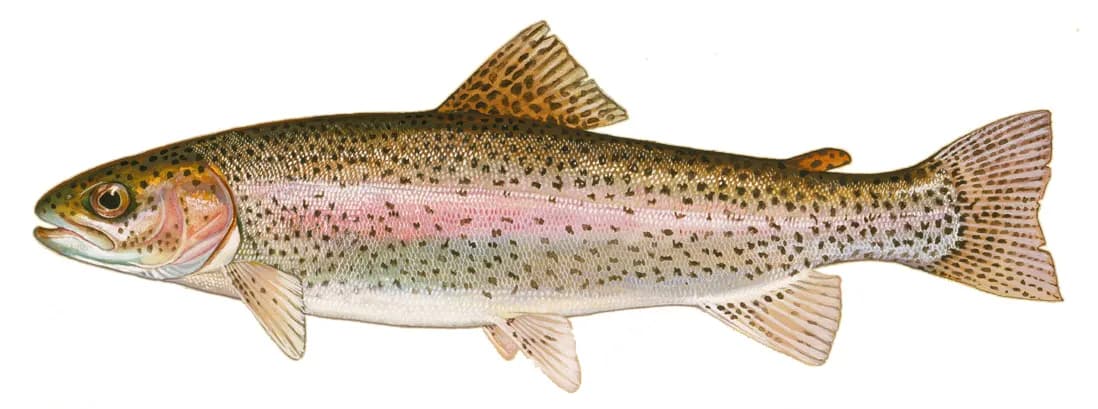
Rainbow trout vary a lot in colour and shape. Adults are silver with many small black spots, a pink or red band along the side, and spots that often run in lines along the tail rays.[2]
- 672waters list it
- 54states and regions
- 5agency sources
Identification
- Rainbow trout vary a lot in colour and shape. Adults are silver with many small black spots, a pink or red band along the side, and spots that often run in lines along the tail rays.[2]
What the source says
“Highly variable in color and body shape, especially between resident fish and steelhead. Adults are silver and heavily spotted with small black spots. Iridescent pink or red along the lateral band. Numerous black spots pepper the body and dorsal fin, often radiating in lines along the rays of the tail.”
- The cheeks are pink and the back ranges from iridescent blue to nearly brown, with silver, white or yellow sides and belly. Young fish carry large, dark oval parr marks along the lateral line.[2]
What the source says
“Opercula (cheeks) are pink, the back iridescent blue to nearly brown, and the sides and belly silver, white or yellow. Juveniles have oval parr marks along the lateral line that are large and dark.”
- Rainbow trout and steelhead are the same species. Rainbows stay inland, while steelhead are the form that migrates to the ocean or, in Michigan, the Great Lakes.[1]
What the source says
“Genetically rainbow trout and steelhead are the same species but lead very different lives. Rainbow trout stays inland, and an anadromous form that migrates to the Great Lakes (or ocean in their native habitat).”
- The McCloud River redband trout, a native California redband form, has a bright brick-red side band, white-tipped fins and rosy red cheeks, and adults often keep their parr marks.[3]
What the source says
“Bright brick-red lateral band, which tends to be darker and more distinct than other redband forms in California. Distinct white tip on the fins; sometimes yellow or orange. Operculum, or cheek, a rosy red. Adult fish often retain parr marks.”
Habitat and range
- Rainbow trout are native to parts of Asia and North America. In the U.S. they range from the Kuskokwim River in Alaska south to Baja California.[2]
What the source says
“Native to parts of Asia and North America. In the U.S., found from the Kuskokwim River in Alaska south to Baja California.”
- Rainbow trout are native to the Pacific watershed. Michigan imported eggs from California in 1876, and rainbows are now found all over the state.[1]
What the source says
“Native to the Pacific watershed, rainbow trout came to Michigan when eggs were imported from California in 1876. First stocked in the Au Sable River, then four years later in the Lake Michigan watershed, rainbows can now be found in all corners of the state.”
Life history
- Young rainbows eat water fleas and then aquatic insects such as caddisflies, mayflies and midges. Larger fish add small fish to their diet but keep eating insects.[1]
What the source says
“Young rainbow trout first eat waterfleas and then add aquatic (water) insects, like caddisflies, mayflies, and midges, to their diet. As they grow larger, they include small fish but continue to consume larval and adult insects.”
Status, protections and rules
Legal status and rules as the agency stated them on the date read. Rules change: check the current regulations for the water.
- In Great Smoky Mountains National Park, rainbow trout are non-native. The National Park Service says rainbow trout introduced in the early 1900s, together with logging, cost native brook trout 75% of their habitat.[4]
What the source says
“In the early 1900s, significant environmental changes occurred in the park due to logging and the introduction of non-native rainbow trout, which destroyed 75% of the native brook trout's habitat. Rainbow trout out-competed brook trout by reproducing at a faster rate as well as growing faster, taking over the streams.”
- Yellowstone National Park rule: in the Lamar River drainage, including parts of Slough and Soda Butte creeks, every rainbow trout caught must be killed. Releasing one alive is illegal there.[5]
What the source says
“All rainbow trout, brook trout, and identifiable cutthroat/rainbow hybrids caught in the Lamar River drainage, including portions of Slough and Soda Butte creeks, must be killed—it is illegal to release them alive.”
Fishing for it: what the agencies say
What agencies and extension services say about catching it, with the source for each line.
- CDFW calls rainbow trout California's most popular cold-water species with anglers. One reason it gives is that rainbows will take every kind of tackle and bait.[2]
What the source says
“Rainbow trout are, by far, the most popular cold-water species amongst anglers in California (and perhaps the world) due to: widespread distribution willingness to take all forms of tackle and bait reputation as hard-fighting fish, regardless of size”
- Ask the nearest fly shop what is hatching on the water this week; it is the most current information there is.
- Match the size and colour of the insects you see on the water before changing anything else.
- Read the water page's gauge before you go: flow and water temperature change by the day.
Water temperature
Warm water stresses trout, char and salmon. These are the published temperature lines we show on every gauge, chosen state first: the state agency's own where it publishes one, otherwise federal guidance (said so). Each water page applies them to the gauge's live reading; the flow and temperature checker does the same for any gauge.
| State | Whose lines | Sources |
|---|---|---|
| Idaho | Idaho Fish and Game (the state's own) | Idaho Department of Fish and Game · Idaho Department of Fish and Game |
| Utah | Federal guidance (the National Park Service); no Utah line found | National Park Service · U.S. Fish and Wildlife Service |
| Alaska | Federal guidance (the National Park Service); no Alaska line found | National Park Service · U.S. Fish and Wildlife Service |
| Arizona | Arizona Game and Fish (the state's own) | Arizona Game and Fish Department |
| Wyoming | Wyoming Game and Fish (the state's own) | Wyoming Game and Fish Department · Wyoming Game and Fish Department · National Park Service |
| Oregon | ODFW (the state's own) | Oregon Department of Fish and Wildlife · Oregon Department of Fish and Wildlife |
| New York | New York DEC (the state's own) | New York State Department of Environmental Conservation |
| Montana | Montana FWP (the state's own) | Montana Fish, Wildlife & Parks · Montana Fish, Wildlife & Parks · Montana Fish, Wildlife & Parks |
| Tennessee | Federal guidance (the National Park Service); no Tennessee line found | National Park Service · U.S. Fish and Wildlife Service |
| Indiana | Federal guidance (the National Park Service); no Indiana line found | National Park Service · U.S. Fish and Wildlife Service |
| Arkansas | Arkansas Game and Fish (the state's own) | Arkansas Game and Fish Commission |
| Delaware | Federal guidance (the National Park Service); no Delaware line found | National Park Service · U.S. Fish and Wildlife Service · Delaware Department of Natural Resources and Environmental Control |
| Colorado | Colorado Parks and Wildlife (the state's own) | Colorado Parks and Wildlife |
| Maryland | Maryland DNR (the state's own) | Maryland Department of Natural Resources |
| Michigan | Federal guidance (the National Park Service); no Michigan line found | National Park Service · U.S. Fish and Wildlife Service |
| Minnesota | Federal guidance (the National Park Service); no Minnesota line found | National Park Service · U.S. Fish and Wildlife Service · Minnesota Department of Natural Resources |
| Oklahoma | Oklahoma Wildlife Conservation (the state's own) | Oklahoma Department of Wildlife Conservation |
| South Carolina | South Carolina DNR (the state's own) | South Carolina Department of Natural Resources |
| Virginia | Virginia DWR (the state's own) | Virginia Department of Wildlife Resources |
| Alabama | Federal guidance (the National Park Service); no Alabama line found | National Park Service · U.S. Fish and Wildlife Service |
| California | CDFW (the state's own) | California Department of Fish and Wildlife |
| Hawaii | Federal guidance (the National Park Service); no Hawaii line found | National Park Service · U.S. Fish and Wildlife Service |
| Kentucky | Federal guidance (the National Park Service); no Kentucky line found | National Park Service · U.S. Fish and Wildlife Service |
| Maine | Maine IF&W (the state's own) | Maine Department of Inland Fisheries and Wildlife |
| Massachusetts | Federal guidance (the National Park Service); no Massachusetts line found | National Park Service · U.S. Fish and Wildlife Service |
| Missouri | Federal guidance (the National Park Service); no Missouri line found | National Park Service · U.S. Fish and Wildlife Service · Missouri Department of Conservation |
| North Dakota | Federal guidance (the National Park Service); no North Dakota line found | National Park Service · U.S. Fish and Wildlife Service |
| South Dakota | Federal guidance (the National Park Service); no South Dakota line found | National Park Service · U.S. Fish and Wildlife Service |
| Texas | Texas Parks and Wildlife (the state's own) | Texas Parks and Wildlife Department · Texas Parks and Wildlife Department |
| Vermont | Vermont Fish and Wildlife (the state's own) | Vermont Fish and Wildlife Department |
| West Virginia | Federal guidance (the National Park Service); no West Virginia line found | National Park Service · U.S. Fish and Wildlife Service |
| Wisconsin | Federal guidance (the National Park Service); no Wisconsin line found | National Park Service · U.S. Fish and Wildlife Service |
Where to fish for rainbow trout
Our 672 water pages whose agency species list names rainbow trout (each list links to the agency page it comes from). A species missing from a list does not mean it is absent: many agencies publish no list for a water.
United States 583 waters
Idaho 230
Rainbow trout in IdahoAll Idaho waters
- Salmon RiverAgency list: Idaho Department of Fish and Game
- South Fork of the Snake RiverAgency list: Idaho Department of Fish and Game
- Teton RiverAgency list: Idaho Department of Fish and Game
- Lochsa RiverAgency list: Idaho Department of Fish and Game
- South Fork Salmon RiverAgency list: Idaho Department of Fish and Game
- Big Wood RiverAgency list: Idaho Department of Fish and Game
- Silver CreekAgency list: Idaho Department of Fish and Game
- Clearwater RiverAgency list: Idaho Department of Fish and Game
- Clark Fork RiverAgency list: Idaho Department of Fish and Game
- Little Wood RiverAgency list: Idaho Department of Fish and Game
- Lake Pend OreilleAgency list: Idaho Department of Fish and Game
- Bear Valley CreekAgency list: Idaho Department of Fish and Game
- Crooked ForkAgency list: Idaho Department of Fish and Game
- Kelly CreekAgency list: Idaho Department of Fish and Game
- Middle Fork Salmon RiverAgency list: Idaho Department of Fish and Game
- Spokane RiverAgency list: Idaho Department of Fish and Game
- Henry's ForkAgency list: Idaho Department of Fish and Game
- Owyhee RiverAgency list: Idaho Department of Fish and Game
- Big Lost RiverAgency list: Idaho Department of Fish and Game
- Selway RiverAgency list: Idaho Department of Fish and Game
- South Fork Boise RiverAgency list: Idaho Department of Fish and Game
- Middle Fork Clearwater RiverAgency list: Idaho Department of Fish and Game
- South Fork Clearwater RiverAgency list: Idaho Department of Fish and Game
- Blackfoot RiverAgency list: Idaho Department of Fish and Game
- Kootenai RiverAgency list: Idaho Department of Fish and Game
- Lemhi RiverAgency list: Idaho Department of Fish and Game
- Little Lost RiverAgency list: Idaho Department of Fish and Game
- Moyie RiverAgency list: Idaho Department of Fish and Game
- Pahsimeroi RiverAgency list: Idaho Department of Fish and Game
- Portneuf RiverAgency list: Idaho Department of Fish and Game
- Yankee Fork Salmon RiverAgency list: Idaho Department of Fish and Game
- Little North Fork Clearwater RiverAgency list: Idaho Department of Fish and Game
- Anderson Ranch ReservoirAgency list: Idaho Department of Fish and Game
- Billingsley CreekAgency list: Idaho Department of Fish and Game
- Blackfoot ReservoirAgency list: Idaho Department of Fish and Game
- Brundage ReservoirAgency list: Idaho Department of Fish and Game
- Chesterfield ReservoirAgency list: Idaho Department of Fish and Game
- Daniels ReservoirAgency list: Idaho Department of Fish and Game
- Deep Creek ReservoirAgency list: Idaho Department of Fish and Game
- Dworshak ReservoirAgency list: Idaho Department of Fish and Game
- East Fork Salmon RiverAgency list: Idaho Department of Fish and Game
- Herd LakeAgency list: Idaho Department of Fish and Game
- Horseshoe LakeAgency list: Idaho Department of Fish and Game
- Jarbidge Riverlisted as “Redband Trout”Agency list: Idaho Department of Fish and Game
- Jimmy Smith LakeAgency list: Idaho Department of Fish and Game
- Lake WalcottAgency list: Idaho Department of Fish and Game
- Little Payette LakeAgency list: Idaho Department of Fish and Game
- Malad RiverAgency list: Idaho Department of Fish and Game
- Middle Fork Boise RiverAgency list: Idaho Department of Fish and Game
- North Fork Payette RiverAgency list: Idaho Department of Fish and Game
- North Fork Salmon RiverAgency list: Idaho Department of Fish and Game
- Pettit LakeAgency list: Idaho Department of Fish and Game
- Spirit LakeAgency list: Idaho Department of Fish and Game
- Stanley LakeAgency list: Idaho Department of Fish and Game
- Sublett ReservoirAgency list: Idaho Department of Fish and Game
- Treasureton ReservoirAgency list: Idaho Department of Fish and Game
- Wallace LakeAgency list: Idaho Department of Fish and Game
- Warm RiverAgency list: Idaho Department of Fish and Game
- Deadwood RiverAgency list: Idaho Department of Fish and Game
- Little Salmon RiverAgency list: Idaho Department of Fish and Game
- American RiverAgency list: Idaho Department of Fish and Game
- Crooked CreekAgency list: Idaho Department of Fish and Game
- East Fork Potlatch RiverAgency list: Idaho Department of Fish and Game
- Hells Canyon ReservoirAgency list: Idaho Department of Fish and Game
- Orofino CreekAgency list: Idaho Department of Fish and Game
- Potlatch RiverAgency list: Idaho Department of Fish and Game
- Bear RiverAgency list: Idaho Department of Fish and Game
- Bruneau RiverAgency list: Idaho Department of Fish and Game
- Camas CreekAgency list: Idaho Department of Fish and Game
- Cassia CreekAgency list: Idaho Department of Fish and Game
- Goose CreekAgency list: Idaho Department of Fish and Game
- Middle Fork Payette RiverAgency list: Idaho Department of Fish and Game
- Mores CreekAgency list: Idaho Department of Fish and Game
- Palouse RiverAgency list: Idaho Department of Fish and Game
- Payette RiverAgency list: Idaho Department of Fish and Game
- Rock CreekAgency list: Idaho Department of Fish and Game
- Salmon Falls CreekAgency list: Idaho Department of Fish and Game
- Valley CreekAgency list: Idaho Department of Fish and Game
- Alexander ReservoirAgency list: Idaho Department of Fish and Game
- Alturas LakeAgency list: Idaho Department of Fish and Game
- American Falls ReservoirAgency list: Idaho Department of Fish and Game
- Antelope LakeAgency list: Idaho Department of Fish and Game
- Arrowrock ReservoirAgency list: Idaho Department of Fish and Game
- Ashton ReservoirAgency list: Idaho Department of Fish and Game
- Avondale LakeAgency list: Idaho Department of Fish and Game
- Baker CreekAgency list: Idaho Department of Fish and Game
- Bayhorse LakeAgency list: Idaho Department of Fish and Game
- Big Smoky CreekAgency list: Idaho Department of Fish and Game
- Birch CreekAgency list: Idaho Department of Fish and Game
- Bloom LakeAgency list: Idaho Department of Fish and Game
- Blue Creek ReservoirAgency list: Idaho Department of Fish and Game
- Bonner LakeAgency list: Idaho Department of Fish and Game
- Boulder Meadows ReservoirAgency list: Idaho Department of Fish and Game
- Breakfast CreekAgency list: Idaho Department of Fish and Game
- Browns PondAgency list: Idaho Department of Fish and Game
- Brush LakeAgency list: Idaho Department of Fish and Game
- Brushy Fork CreekAgency list: Idaho Department of Fish and Game
- Bull Trout LakeAgency list: Idaho Department of Fish and Game
- C J Strike ReservoirAgency list: Idaho Department of Fish and Game
- Cedar Creek ReservoirAgency list: Idaho Department of Fish and Game
- Cocolalla CreekAgency list: Idaho Department of Fish and Game
- Cocolalla LakeAgency list: Idaho Department of Fish and Game
- Corral Creek ReservoirAgency list: Idaho Department of Fish and Game
- Crane Falls LakeAgency list: Idaho Department of Fish and Game
- Crooked RiverAgency list: Idaho Department of Fish and Game
- Crowthers ReservoirAgency list: Idaho Department of Fish and Game
- Cub RiverAgency list: Idaho Department of Fish and Game
- Deadwood ReservoirAgency list: Idaho Department of Fish and Game
- Dierkes LakeAgency list: Idaho Department of Fish and Game
- Dismal LakeAgency list: Idaho Department of Fish and Game
- Dog Creek ReservoirAgency list: Idaho Department of Fish and Game
- Dollar LakeAgency list: Idaho Department of Fish and Game
- Dunes LakeAgency list: Idaho Department of Fish and Game
- East Fork Big Lost RiverAgency list: Idaho Department of Fish and Game
- East Fork South Fork Salmon RiverAgency list: Idaho Department of Fish and Game
- East Fork Weiser RiverAgency list: Idaho Department of Fish and Game
- East Fork Wood RiverAgency list: Idaho Department of Fish and Game
- Eightmile CreekAgency list: Idaho Department of Fish and Game
- Elk CreekAgency list: Idaho Department of Fish and Game
- Elk Creek ReservoirAgency list: Idaho Department of Fish and Game
- Elsie LakeAgency list: Idaho Department of Fish and Game
- Emerald LakeAgency list: Idaho Department of Fish and Game
- Fall RiverAgency list: Idaho Department of Fish and Game
- Fernan LakeAgency list: Idaho Department of Fish and Game
- Fish Creek ReservoirAgency list: Idaho Department of Fish and Game
- Fish LakeAgency list: Idaho Department of Fish and Game
- Foster ReservoirAgency list: Idaho Department of Fish and Game
- Freeman LakeAgency list: Idaho Department of Fish and Game
- Georgetown CreekAgency list: Idaho Department of Fish and Game
- Glendale ReservoirAgency list: Idaho Department of Fish and Game
- Gold Fork RiverAgency list: Idaho Department of Fish and Game
- Goose LakeAgency list: Idaho Department of Fish and Game
- Granite LakeAgency list: Idaho Department of Fish and Game
- Granite LakeAgency list: Idaho Department of Fish and Game
- Grimes CreekAgency list: Idaho Department of Fish and Game
- Grove CreekAgency list: Idaho Department of Fish and Game
- Hayden LakeAgency list: Idaho Department of Fish and Game
- Hazard LakeAgency list: Idaho Department of Fish and Game
- Herrick ReservoirAgency list: Idaho Department of Fish and Game
- Hoodoo CreekAgency list: Idaho Department of Fish and Game
- Hoodoo LakeAgency list: Idaho Department of Fish and Game
- Horsethief ReservoirAgency list: Idaho Department of Fish and Game
- Iron LakeAgency list: Idaho Department of Fish and Game
- Island Park ReservoirAgency list: Idaho Department of Fish and Game
- Jewel LakeAgency list: Idaho Department of Fish and Game
- Johnson ReservoirAgency list: Idaho Department of Fish and Game
- Jordan Creeklisted as “Redband Trout”Agency list: Idaho Department of Fish and Game
- Kelso LakeAgency list: Idaho Department of Fish and Game
- Lake ClevelandAgency list: Idaho Department of Fish and Game
- Lake WahaAgency list: Idaho Department of Fish and Game
- Lamont ReservoirAgency list: Idaho Department of Fish and Game
- Lava LakeAgency list: Idaho Department of Fish and Game
- Lime CreekAgency list: Idaho Department of Fish and Game
- Little Bayhorse LakeAgency list: Idaho Department of Fish and Game
- Little Camas ReservoirAgency list: Idaho Department of Fish and Game
- Little Smoky CreekAgency list: Idaho Department of Fish and Game
- Loon CreekAgency list: Idaho Department of Fish and Game
- Lost Valley ReservoirAgency list: Idaho Department of Fish and Game
- Loving CreekAgency list: Idaho Department of Fish and Game
- Lower Glidden LakeAgency list: Idaho Department of Fish and Game
- Lucky Peak ReservoirAgency list: Idaho Department of Fish and Game
- Mackay ReservoirAgency list: Idaho Department of Fish and Game
- Magic ReservoirAgency list: Idaho Department of Fish and Game
- Mann Creek ReservoirAgency list: Idaho Department of Fish and Game
- Mann LakeAgency list: Idaho Department of Fish and Game
- Martin LakeAgency list: Idaho Department of Fish and Game
- McArthur LakeAgency list: Idaho Department of Fish and Game
- McTucker CreekAgency list: Idaho Department of Fish and Game
- Meadow LakeAgency list: Idaho Department of Fish and Game
- Middle Fork Weiser RiverAgency list: Idaho Department of Fish and Game
- Mink CreekAgency list: Idaho Department of Fish and Game
- Mirror LakeAgency list: Idaho Department of Fish and Game
- Montpelier CreekAgency list: Idaho Department of Fish and Game
- Montpelier ReservoirAgency list: Idaho Department of Fish and Game
- Moose Creek ReservoirAgency list: Idaho Department of Fish and Game
- Moose LakeAgency list: Idaho Department of Fish and Game
- Mormon ReservoirAgency list: Idaho Department of Fish and Game
- Mosquito Flat ReservoirAgency list: Idaho Department of Fish and Game
- Mountain Home ReservoirAgency list: Idaho Department of Fish and Game
- Newsome CreekAgency list: Idaho Department of Fish and Game
- Niagara SpringsAgency list: Idaho Department of Fish and Game
- North Fork Big Lost RiverAgency list: Idaho Department of Fish and Game
- North Fork Big Wood RiverAgency list: Idaho Department of Fish and Game
- North Fork Boise RiverAgency list: Idaho Department of Fish and Game
- Oneida Narrows ReservoirAgency list: Idaho Department of Fish and Game
- Oxbow ReservoirAgency list: Idaho Department of Fish and Game
- Paddock Valley ReservoirAgency list: Idaho Department of Fish and Game
- Payette LakeAgency list: Idaho Department of Fish and Game
- Pebble CreekAgency list: Idaho Department of Fish and Game
- Penny LakeAgency list: Idaho Department of Fish and Game
- Perkins LakeAgency list: Idaho Department of Fish and Game
- Porcupine LakeAgency list: Idaho Department of Fish and Game
- Quartz CreekAgency list: Idaho Department of Fish and Game
- Red RiverAgency list: Idaho Department of Fish and Game
- Ririe ReservoirAgency list: Idaho Department of Fish and Game
- Robinson LakeAgency list: Idaho Department of Fish and Game
- Round LakeAgency list: Idaho Department of Fish and Game
- Sage Hen ReservoirAgency list: Idaho Department of Fish and Game
- Saint Charles CreekAgency list: Idaho Department of Fish and Game
- Salmon Falls Creek ReservoirAgency list: Idaho Department of Fish and Game
- Sand Creek ReservoirAgency list: Idaho Department of Fish and Game
- Scott CreekAgency list: Idaho Department of Fish and Game
- Second Fork Chief Eagle Eye CreekAgency list: Idaho Department of Fish and Game
- Sinclair LakeAgency list: Idaho Department of Fish and Game
- Smith CreekAgency list: Idaho Department of Fish and Game
- Smith LakeAgency list: Idaho Department of Fish and Game
- Soldiers Meadow ReservoirAgency list: Idaho Department of Fish and Game
- Solomon LakeAgency list: Idaho Department of Fish and Game
- Spring Valley ReservoirAgency list: Idaho Department of Fish and Game
- Stalker CreekAgency list: Idaho Department of Fish and Game
- Star Hope CreekAgency list: Idaho Department of Fish and Game
- Succor Creek ReservoirAgency list: Idaho Department of Fish and Game
- Sulphur CreekAgency list: Idaho Department of Fish and Game
- Third Fork Chief Eagle Eye CreekAgency list: Idaho Department of Fish and Game
- Thorn Creek ReservoirAgency list: Idaho Department of Fish and Game
- Tolo LakeAgency list: Idaho Department of Fish and Game
- Toponce CreekAgency list: Idaho Department of Fish and Game
- Trapper CreekAgency list: Idaho Department of Fish and Game
- Trinity CreekAgency list: Idaho Department of Fish and Game
- Trinity LakeAgency list: Idaho Department of Fish and Game
- Tripod ReservoirAgency list: Idaho Department of Fish and Game
- Twin Lakes ReservoirAgency list: Idaho Department of Fish and Game
- Upper Payette LakeAgency list: Idaho Department of Fish and Game
- Warm LakeAgency list: Idaho Department of Fish and Game
- Weston Creek ReservoirAgency list: Idaho Department of Fish and Game
- Wildhorse CreekAgency list: Idaho Department of Fish and Game
- Williams LakeAgency list: Idaho Department of Fish and Game
- Winder ReservoirAgency list: Idaho Department of Fish and Game
- Wiregrass ReservoirAgency list: Idaho Department of Fish and Game
- Yellow Belly LakeAgency list: Idaho Department of Fish and Game
Utah 105
Rainbow trout in UtahAll Utah waters
- Provo RiverAgency list: Utah Division of Wildlife Resources
- Weber RiverAgency list: Utah Division of Wildlife Resources
- Ogden RiverAgency list: Utah Division of Wildlife Resources
- Strawberry ReservoirAgency list: Utah Division of Wildlife Resources
- South Fork Ogden RiverAgency list: Utah Division of Wildlife Resources
- Strawberry RiverAgency list: Utah Division of Wildlife Resources
- Currant Creek ReservoirAgency list: Utah Division of Wildlife Resources
- Deer Creek ReservoirAgency list: Utah Division of Wildlife Resources
- East Canyon ReservoirAgency list: Utah Division of Wildlife Resources
- Fish LakeAgency list: Utah Division of Wildlife Resources
- Flaming Gorge ReservoirAgency list: Utah Division of Wildlife Resources
- Jordanelle ReservoirAgency list: Utah Division of Wildlife Resources
- Kolob ReservoirAgency list: Utah Division of Wildlife Resources
- Lost Creek ReservoirAgency list: Utah Division of Wildlife Resources
- Lower Stillwater PondsAgency list: Utah Division of Wildlife Resources
- Minersville ReservoirAgency list: Utah Division of Wildlife Resources
- Otter Creek ReservoirAgency list: Utah Division of Wildlife Resources
- Panguitch LakeAgency list: Utah Division of Wildlife Resources
- Quail Creek ReservoirAgency list: Utah Division of Wildlife Resources
- Starvation ReservoirAgency list: Utah Division of Wildlife Resources
- Beaver RiverAgency list: Utah Division of Wildlife Resources
- Mammoth CreekAgency list: Utah Division of Wildlife Resources
- American Fork CreekAgency list: Utah Division of Wildlife Resources
- Baker ReservoirAgency list: Utah Division of Wildlife Resources
- Benches PondAgency list: Utah Division of Wildlife Resources
- Big Sand WashAgency list: Utah Division of Wildlife Resources
- Birch Creek ReservoirAgency list: Utah Division of Wildlife Resources
- Blacksmith Fork RiverAgency list: Utah Division of Wildlife Resources
- Blanding Reservoir North 4Agency list: Utah Division of Wildlife Resources
- Boulger ReservoirAgency list: Utah Division of Wildlife Resources
- Brough ReservoirAgency list: Utah Division of Wildlife Resources
- Browne LakeAgency list: Utah Division of Wildlife Resources
- Calder ReservoirAgency list: Utah Division of Wildlife Resources
- Causey ReservoirAgency list: Utah Division of Wildlife Resources
- Cleveland ReservoirAgency list: Utah Division of Wildlife Resources
- Crouse ReservoirAgency list: Utah Division of Wildlife Resources
- Deep LakeAgency list: Utah Division of Wildlife Resources
- Deseret ReservoirAgency list: Utah Division of Wildlife Resources
- Dons LakeAgency list: Utah Division of Wildlife Resources
- East Park ReservoirAgency list: Utah Division of Wildlife Resources
- Echo ReservoirAgency list: Utah Division of Wildlife Resources
- Emerald LakeAgency list: Utah Division of Wildlife Resources
- Enterprise ReservoirsAgency list: Utah Division of Wildlife Resources
- Ferron ReservoirAgency list: Utah Division of Wildlife Resources
- Foy LakeAgency list: Utah Division of Wildlife Resources
- Gooseberry ReservoirAgency list: Utah Division of Wildlife Resources
- Grantsville ReservoirAgency list: Utah Division of Wildlife Resources
- Grassy LakeAgency list: Utah Division of Wildlife Resources
- Hidden LakeAgency list: Utah Division of Wildlife Resources
- Hobbs ReservoirAgency list: Utah Division of Wildlife Resources
- Holmes Creek ReservoirAgency list: Utah Division of Wildlife Resources
- Huntington North ReservoirAgency list: Utah Division of Wildlife Resources
- Hyrum ReservoirAgency list: Utah Division of Wildlife Resources
- Kens LakeAgency list: Utah Division of Wildlife Resources
- Koosharem ReservoirAgency list: Utah Division of Wildlife Resources
- Little Montes ReservoirAgency list: Utah Division of Wildlife Resources
- Lloyds LakeAgency list: Utah Division of Wildlife Resources
- Loggers Fork ReservoirAgency list: Utah Division of Wildlife Resources
- Long Park ReservoirAgency list: Utah Division of Wildlife Resources
- Lower Bowns ReservoirAgency list: Utah Division of Wildlife Resources
- Mantua ReservoirAgency list: Utah Division of Wildlife Resources
- Maple LakeAgency list: Utah Division of Wildlife Resources
- Matt Warner ReservoirAgency list: Utah Division of Wildlife Resources
- Mill Hollow ReservoirAgency list: Utah Division of Wildlife Resources
- Mill Meadow ReservoirAgency list: Utah Division of Wildlife Resources
- Miller Flat ReservoirAgency list: Utah Division of Wildlife Resources
- Millsite ReservoirAgency list: Utah Division of Wildlife Resources
- Monticello LakeAgency list: Utah Division of Wildlife Resources
- Moon LakeAgency list: Utah Division of Wildlife Resources
- Mount Pleasant PondAgency list: Utah Division of Wildlife Resources
- Navajo LakeAgency list: Utah Division of Wildlife Resources
- New Canyon ReservoirAgency list: Utah Division of Wildlife Resources
- Newcastle ReservoirAgency list: Utah Division of Wildlife Resources
- Nine Mile ReservoirAgency list: Utah Division of Wildlife Resources
- Oowah LakeAgency list: Utah Division of Wildlife Resources
- Palisade ReservoirAgency list: Utah Division of Wildlife Resources
- Paragonah ReservoirAgency list: Utah Division of Wildlife Resources
- Petes Hole ReservoirAgency list: Utah Division of Wildlife Resources
- Pine LakeAgency list: Utah Division of Wildlife Resources
- Pine Valley ReservoirAgency list: Utah Division of Wildlife Resources
- Piute ReservoirAgency list: Utah Division of Wildlife Resources
- Porcupine ReservoirAgency list: Utah Division of Wildlife Resources
- Red Creek ReservoirAgency list: Utah Division of Wildlife Resources
- Red Fleet ReservoirAgency list: Utah Division of Wildlife Resources
- Rockport ReservoirAgency list: Utah Division of Wildlife Resources
- Settlement Canyon ReservoirAgency list: Utah Division of Wildlife Resources
- Sevier River In Marysvale CanyonAgency list: Utah Division of Wildlife Resources
- Shingle Mill ReservoirAgency list: Utah Division of Wildlife Resources
- Silver LakeAgency list: Utah Division of Wildlife Resources
- Silver Lake Flat ReservoirAgency list: Utah Division of Wildlife Resources
- Smith and Morehouse ReservoirAgency list: Utah Division of Wildlife Resources
- Soup Bowl ReservoirAgency list: Utah Division of Wildlife Resources
- Stateline ReservoirAgency list: Utah Division of Wildlife Resources
- Steinaker ReservoirAgency list: Utah Division of Wildlife Resources
- Tibble Fork ReservoirAgency list: Utah Division of Wildlife Resources
- Town ReservoirAgency list: Utah Division of Wildlife Resources
- Tropic ReservoirAgency list: Utah Division of Wildlife Resources
- Upper Wpa PondAgency list: Utah Division of Wildlife Resources
- Vernon ReservoirAgency list: Utah Division of Wildlife Resources
- Wide Hollow ReservoirAgency list: Utah Division of Wildlife Resources
- Willow LakeAgency list: Utah Division of Wildlife Resources
- Wrigley Springs ReservoirAgency list: Utah Division of Wildlife Resources
- Yankee Meadow ReservoirAgency list: Utah Division of Wildlife Resources
- Yearns ReservoirAgency list: Utah Division of Wildlife Resources
- Yuba ReservoirAgency list: Utah Division of Wildlife Resources
Alaska 53
Rainbow trout in AlaskaAll Alaska waters
- Kenai RiverAgency list: Alaska Department of Fish and Game
- Mulchatna RiverAgency list: Alaska Department of Fish and Game, Division of Sport Fish
- Aniak RiverAgency list: Alaska Department of Fish and Game, Division of Sport Fish
- Kisaralik RiverAgency list: Alaska Department of Fish and Game, Division of Sport Fish
- Ninilchik Riverlisted as “Rainbow/steelhead trout”Agency list: Alaska Department of Fish and Game, Division of Sport Fish
- Nushagak RiverAgency list: Alaska Department of Fish and Game, Division of Sport Fish
- Sandy Riverlisted as “Rainbow/steelhead trout”Agency list: Alaska Department of Fish and Game, Division of Sport Fish
- Jim Creeklisted as “Rainbow/steelhead trout”Agency list: Alaska Department of Fish and Game, Division of Sport Fish
- Kasilof Riverlisted as “Rainbow/steelhead trout”Agency list: Alaska Department of Fish and Game, Division of Sport Fish
- Tebay Riverlisted as “Rainbow/steelhead trout”Agency list: Alaska Department of Fish and Game, Division of Sport Fish
- Chilkat RiverAgency list: Alaska Department of Fish and Game, Division of Sport Fish
- Gulkana Riverlisted as “Rainbow/steelhead trout”Agency list: Alaska Department of Fish and Game, Division of Sport Fish
- Hatchery CreekAgency list: Alaska Department of Fish and Game, Division of Sport Fish
- Sweetwater LakeAgency list: Alaska Department of Fish and Game, Division of Sport Fish
- Anchor Riverlisted as “Rainbow/steelhead trout”Agency list: Alaska Department of Fish and Game, Division of Sport Fish
- Control LakeAgency list: Alaska Department of Fish and Game, Division of Sport Fish
- Deep Creeklisted as “Rainbow/steelhead trout”Agency list: Alaska Department of Fish and Game, Division of Sport Fish
- Deshka Riverlisted as “Rainbow/steelhead trout”Agency list: Alaska Department of Fish and Game, Division of Sport Fish
- Karta RiverAgency list: Alaska Department of Fish and Game, Division of Sport Fish
- Kashwitna Riverlisted as “Rainbow/steelhead trout”Agency list: Alaska Department of Fish and Game, Division of Sport Fish
- Lake Creeklisted as “Rainbow/steelhead trout”Agency list: Alaska Department of Fish and Game, Division of Sport Fish
- McDonald LakeAgency list: Alaska Department of Fish and Game, Division of Sport Fish
- Naha RiverAgency list: Alaska Department of Fish and Game, Division of Sport Fish
- South Fork Eagle Riverlisted as “Rainbow/steelhead trout”Agency list: Alaska Department of Fish and Game, Division of Sport Fish
- Stariski Creeklisted as “Rainbow/steelhead trout”Agency list: Alaska Department of Fish and Game, Division of Sport Fish
- Talachulitna Riverlisted as “Rainbow/steelhead trout”Agency list: Alaska Department of Fish and Game, Division of Sport Fish
- Thorne RiverAgency list: Alaska Department of Fish and Game, Division of Sport Fish
- X LakeAgency list: Alaska Department of Fish and Game, Division of Sport Fish
- Campbell Creeklisted as “Rainbow/steelhead trout”Agency list: Alaska Department of Fish and Game, Division of Sport Fish
- Long LakeAgency list: Alaska Department of Fish and Game, Division of Sport Fish
- Wishbone LakeAgency list: Alaska Department of Fish and Game, Division of Sport Fish
- Arolik RiverAgency list: Alaska Department of Fish and Game, Division of Sport Fish
- Chokosna RiverAgency list: Alaska Department of Fish and Game, Division of Sport Fish
- Bodenburg Creeklisted as “Rainbow/steelhead trout”Agency list: Alaska Department of Fish and Game, Division of Sport Fish
- Hanagita Riverlisted as “Rainbow/steelhead trout”Agency list: Alaska Department of Fish and Game, Division of Sport Fish
- Anan LakeAgency list: Alaska Department of Fish and Game, Division of Sport Fish
- Bakewell LakeAgency list: Alaska Department of Fish and Game, Division of Sport Fish
- Baranof LakeAgency list: Alaska Department of Fish and Game, Division of Sport Fish
- Buck LakeAgency list: Alaska Department of Fish and Game, Division of Sport Fish
- Kah Sheets LakeAgency list: Alaska Department of Fish and Game, Division of Sport Fish
- Kasigluk RiverAgency list: Alaska Department of Fish and Game, Division of Sport Fish
- Kegan LakeAgency list: Alaska Department of Fish and Game, Division of Sport Fish
- Kook LakeAgency list: Alaska Department of Fish and Game, Division of Sport Fish
- Kwethluk RiverAgency list: Alaska Department of Fish and Game, Division of Sport Fish
- Long LakeAgency list: Alaska Department of Fish and Game, Division of Sport Fish
- Neck LakeAgency list: Alaska Department of Fish and Game, Division of Sport Fish
- Noname LakeAgency list: Alaska Department of Fish and Game, Division of Sport Fish
- Salmon LakeAgency list: Alaska Department of Fish and Game, Division of Sport Fish
- Shelter LakeAgency list: Alaska Department of Fish and Game, Division of Sport Fish
- Sitkoh LakeAgency list: Alaska Department of Fish and Game, Division of Sport Fish
- Thoms LakeAgency list: Alaska Department of Fish and Game, Division of Sport Fish
- Virginia LakeAgency list: Alaska Department of Fish and Game, Division of Sport Fish
- Young LakeAgency list: Alaska Department of Fish and Game, Division of Sport Fish
Arizona 45
Rainbow trout in ArizonaAll Arizona waters
- Canyon CreekAgency list: Arizona Game and Fish Department / Arizona Game and Fish Commission (2025-2026 Arizona Fishing Regulations, official eRegulations edition)
- Silver CreekAgency list: Arizona Game and Fish Department / Arizona Game and Fish Commission (2025-2026 Arizona Fishing Regulations, official eRegulations edition)
- Salt RiverAgency list: Arizona Game and Fish Department (AZGFD)
- Colorado River at Lees FerryAgency list: National Park Service
- Chevelon CreekAgency list: Arizona Game and Fish Department / Arizona Game and Fish Commission (2025-2026 Arizona Fishing Regulations, official eRegulations edition)
- Oak CreekAgency list: Arizona Game and Fish Department / Arizona Game and Fish Commission (2025-2026 Arizona Fishing Regulations, official eRegulations edition)
- East Verde RiverAgency list: Arizona Game and Fish Department / Arizona Game and Fish Commission (2025-2026 Arizona Fishing Regulations, official eRegulations edition)
- Becker LakeAgency list: Arizona Game and Fish Department / Arizona Game and Fish Commission (2025-2026 Arizona Fishing Regulations, official eRegulations edition)
- Colorado River Below Davis DamAgency list: Arizona Game and Fish Department (AZGFD)
- Elk TankAgency list: Arizona Game and Fish Department / Arizona Game and Fish Commission (2025-2026 Arizona Fishing Regulations, official eRegulations edition)
- J D Dam LakeAgency list: Arizona Game and Fish Department / Arizona Game and Fish Commission (2025-2026 Arizona Fishing Regulations, official eRegulations edition)
- Lower Goldwater LakeAgency list: Arizona Game and Fish Department / Arizona Game and Fish Commission (2025-2026 Arizona Fishing Regulations, official eRegulations edition)
- Middle TankAgency list: Arizona Game and Fish Department / Arizona Game and Fish Commission (2025-2026 Arizona Fishing Regulations, official eRegulations edition)
- Perkins TankAgency list: Arizona Game and Fish Department / Arizona Game and Fish Commission (2025-2026 Arizona Fishing Regulations, official eRegulations edition)
- River ReservoirAgency list: Arizona Game and Fish Department / Arizona Game and Fish Commission (2025-2026 Arizona Fishing Regulations, official eRegulations edition)
- Tonto CreekAgency list: Arizona Game and Fish Department (AZGFD)
- Ashurst LakeAgency list: Arizona Game and Fish Department (AZGFD)
- Big LakeAgency list: Arizona Game and Fish Department (AZGFD)
- Bunch ReservoirAgency list: Arizona Game and Fish Department (AZGFD)
- C C Cragin ReservoirAgency list: Arizona Game and Fish Department (AZGFD)
- Christopher CreekAgency list: Arizona Game and Fish Department (AZGFD)
- Crescent LakeAgency list: Arizona Game and Fish Department (AZGFD)
- East Clear CreekAgency list: Arizona Game and Fish Department (AZGFD)
- Fool Hollow LakeAgency list: Arizona Game and Fish Department (AZGFD)
- Haigler CreekAgency list: Arizona Game and Fish Department (AZGFD)
- Kinnikinick LakeAgency list: Arizona Game and Fish Department (AZGFD)
- Knoll LakeAgency list: Arizona Game and Fish Department (AZGFD)
- Luna LakeAgency list: Arizona Game and Fish Department (AZGFD)
- Lynx LakeAgency list: Arizona Game and Fish Department (AZGFD)
- Mingus LakeAgency list: Arizona Game and Fish Department (AZGFD)
- Nelson ReservoirAgency list: Arizona Game and Fish Department (AZGFD)
- Patagonia LakeAgency list: Arizona Game and Fish Department (AZGFD)
- Pine CreekAgency list: Arizona Game and Fish Department (AZGFD)
- Rainbow LakeAgency list: Arizona Game and Fish Department (AZGFD)
- Riggs Flat LakeAgency list: Arizona Game and Fish Department (AZGFD)
- Rose Canyon LakeAgency list: Arizona Game and Fish Department (AZGFD)
- Show Low LakeAgency list: Arizona Game and Fish Department (AZGFD)
- Sycamore CreekAgency list: Arizona Game and Fish Department (AZGFD)
- Tunnel ReservoirAgency list: Arizona Game and Fish Department (AZGFD)
- Watson LakeAgency list: Arizona Game and Fish Department (AZGFD)
- Webber CreekAgency list: Arizona Game and Fish Department (AZGFD)
- Woodland ReservoirAgency list: Arizona Game and Fish Department (AZGFD)
- Workman CreekAgency list: Arizona Game and Fish Department (AZGFD)
- Carnero LakeAgency list: Arizona Game and Fish Department / Arizona Game and Fish Commission (2025-2026 Arizona Fishing Regulations, official eRegulations edition)
- Chevelon Canyon LakeAgency list: Arizona Game and Fish Department / Arizona Game and Fish Commission (2025-2026 Arizona Fishing Regulations, official eRegulations edition)
Wyoming 44
Rainbow trout in WyomingAll Wyoming waters
- North Platte RiverAgency list: Wyoming Game and Fish Department
- New Fork RiverAgency list: Wyoming Game and Fish Department
- Green RiverAgency list: Wyoming Game and Fish Department
- Salt RiverAgency list: Wyoming Game and Fish Department
- Wind RiverAgency list: Wyoming Game and Fish Department
- Bighorn RiverAgency list: Wyoming Game and Fish Department
- Shoshone RiverAgency list: Wyoming Game and Fish Department
- North Fork Powder RiverAgency list: Wyoming Game and Fish Department
- Middle Fork Powder RiverAgency list: Wyoming Game and Fish Department
- Clarks Fork Yellowstone RiverAgency list: Wyoming Game and Fish Department
- North Fork Shoshone RiverAgency list: Wyoming Game and Fish Department
- South Tongue RiverAgency list: Wyoming Game and Fish Department
- Deer CreekAgency list: Wyoming Game and Fish Department
- Clear CreekAgency list: Wyoming Game and Fish Department
- Paint Rock CreekAgency list: Wyoming Game and Fish Department
- Bates CreekAgency list: Wyoming Game and Fish Department
- Big CreekAgency list: Wyoming Game and Fish Department
- Canyon CreekAgency list: Wyoming Game and Fish Department
- la Prele CreekAgency list: Wyoming Game and Fish Department
- Tensleep CreekAgency list: Wyoming Game and Fish Department
- Boulder CreekAgency list: Wyoming Game and Fish Department
- Pine CreekAgency list: Wyoming Game and Fish Department
- Medicine Lodge CreekAgency list: Wyoming Game and Fish Department
- Tongue RiverAgency list: Wyoming Game and Fish Department
- Cedar CreekAgency list: Wyoming Game and Fish Department
- Crazy CreekAgency list: Wyoming Game and Fish Department
- Duck CreekAgency list: Wyoming Game and Fish Department
- Grizzly CreekAgency list: Wyoming Game and Fish Department
- Jakeys ForkAgency list: Wyoming Game and Fish Department
- Jones CreekAgency list: Wyoming Game and Fish Department
- la Bonte CreekAgency list: Wyoming Game and Fish Department
- Little Canyon CreekAgency list: Wyoming Game and Fish Department
- Little Popo Agie RiverAgency list: Wyoming Game and Fish Department
- North Tongue RiverAgency list: Wyoming Game and Fish Department
- Popo Agie RiverAgency list: Wyoming Game and Fish Department
- Shell CreekAgency list: Wyoming Game and Fish Department
- Silver Tip CreekAgency list: Wyoming Game and Fish Department
- South Fork Little Canyon CreekAgency list: Wyoming Game and Fish Department
- Medicine Bow RiverAgency list: Wyoming Game and Fish Department
- Big Sandy RiverAgency list: Wyoming Game and Fish Department
- Rock CreekAgency list: Wyoming Game and Fish Department
- Sweetwater RiverAgency list: Wyoming Game and Fish Department
- East Fork Smiths ForkAgency list: Wyoming Game and Fish Department
- West Tensleep CreekAgency list: Wyoming Game and Fish Department
Oregon 25
Rainbow trout in OregonAll Oregon waters
- Deschutes RiverAgency list: Oregon Department of Fish and Wildlife
- Metolius RiverAgency list: Oregon Department of Fish and Wildlife
- Fall RiverAgency list: Oregon Department of Fish and Wildlife
- Bradley LakeAgency list: Oregon Department of Fish and Wildlife
- Butterfield LakeAgency list: Oregon Department of Fish and Wildlife
- Davis LakeAgency list: Oregon Department of Fish and Wildlife
- Devil's LakeAgency list: Oregon Department of Fish and Wildlife
- East LakeAgency list: Oregon Department of Fish and Wildlife
- Fourmile Lakelisted as “Rainbow”Agency list: Oregon Department of Fish and Wildlife
- Haystack ReservoirAgency list: Oregon Department of Fish and Wildlife
- Hosmer LakeAgency list: Oregon Department of Fish and Wildlife
- Laird LakeAgency list: Oregon Department of Fish and Wildlife
- Lake In the WoodsAgency list: Oregon Department of Fish and Wildlife
- Lake MarieAgency list: Oregon Department of Fish and Wildlife
- Lake SimtustusAgency list: Oregon Department of Fish and Wildlife
- Little Lava LakeAgency list: Oregon Department of Fish and Wildlife
- North Twin LakeAgency list: Oregon Department of Fish and Wildlife
- Ochoco Creeklisted as “Redband trout”Agency list: Oregon Department of Fish and Wildlife
- Ochoco ReservoirAgency list: Oregon Department of Fish and Wildlife
- Paulina LakeAgency list: Oregon Department of Fish and Wildlife
- Powers PondAgency list: Oregon Department of Fish and Wildlife
- Prineville ReservoirAgency list: Oregon Department of Fish and Wildlife
- Saunders LakeAgency list: Oregon Department of Fish and Wildlife
- South Twin LakeAgency list: Oregon Department of Fish and Wildlife
- Tumalo Creeklisted as “Redband trout”Agency list: Oregon Department of Fish and Wildlife
New York 18
Rainbow trout in New YorkAll New York waters
- West Branch Delaware RiverAgency list: New York State Department of Environmental Conservation
- Upper Delaware RiverAgency list: National Park Service
- Genesee RiverAgency list: New York State Department of Environmental Conservation (NYSDEC), Bureau of Fisheries
- Black RiverAgency list: New York State Department of Environmental Conservation (NYSDEC), Bureau of Fisheries
- East Branch Delaware RiverAgency list: New York State Department of Environmental Conservation
- Oak Orchard CreekAgency list: New York State Department of Environmental Conservation (NYSDEC), Bureau of Fisheries
- Irondequoit CreekAgency list: New York State Department of Environmental Conservation (NYSDEC), Bureau of Fisheries
- Sandy CreekAgency list: New York State Department of Environmental Conservation (NYSDEC), Bureau of Fisheries
- Sandy CreekAgency list: New York State Department of Environmental Conservation (NYSDEC), Bureau of Fisheries
- Johnson CreekAgency list: New York State Department of Environmental Conservation (NYSDEC), Bureau of Fisheries
- South Sandy CreekAgency list: New York State Department of Environmental Conservation (NYSDEC), Bureau of Fisheries
- Keg CreekAgency list: New York State Department of Environmental Conservation (NYSDEC), Bureau of Fisheries
- Stony CreekAgency list: New York State Department of Environmental Conservation (NYSDEC), Bureau of Fisheries
- Twelve Mile CreekAgency list: New York State Department of Environmental Conservation (NYSDEC), Bureau of Fisheries
- Esopus CreekAgency list: New York State Department of Environmental Conservation
- Grindstone CreekAgency list: New York State Department of Environmental Conservation (NYSDEC), Bureau of Fisheries
- Little Sandy CreekAgency list: New York State Department of Environmental Conservation (NYSDEC), Bureau of Fisheries
- Marsh CreekAgency list: New York State Department of Environmental Conservation (NYSDEC), Bureau of Fisheries
Montana 16
Rainbow trout in MontanaAll Montana waters
- Madison RiverAgency list: Montana Fish, Wildlife & Parks
- Yellowstone RiverAgency list: Montana Fish, Wildlife & Parks
- Blackfoot RiverAgency list: Montana Fish, Wildlife & Parks
- Clark Fork RiverAgency list: Montana Fish, Wildlife & Parks
- Bitterroot RiverAgency list: Montana Fish, Wildlife & Parks
- Rock CreekAgency list: Montana Fish, Wildlife & Parks
- Beaverhead RiverAgency list: Montana Fish, Wildlife & Parks
- Jefferson RiverAgency list: Montana Fish, Wildlife & Parks
- Big Hole RiverAgency list: Montana Fish, Wildlife & Parks
- Smith RiverAgency list: Montana Fish, Wildlife & Parks
- Ruby RiverAgency list: Montana Fish, Wildlife & Parks
- Gallatin RiverAgency list: Montana Fish, Wildlife & Parks
- Boulder RiverAgency list: Montana Fish, Wildlife & Parks
- Bighorn LakeAgency list: National Park Service (Bighorn Canyon National Recreation Area)
- Ennis LakeAgency list: Montana Fish, Wildlife & Parks
- DePuy Spring CreekAgency list: Montana Fish, Wildlife & Parks
Tennessee 8
Rainbow trout in TennesseeAll Tennessee waters
- Caney Fork RiverAgency list: Tennessee Wildlife Resources Agency
- Elk RiverAgency list: Tennessee Wildlife Resources Agency (official Tennessee Fishing Guide, eRegulations edition)
- Duck RiverAgency list: Tennessee Wildlife Resources Agency (official Tennessee Fishing Guide, eRegulations edition)
- Ocoee RiverAgency list: Tennessee Wildlife Resources Agency (official Tennessee Fishing Guide, eRegulations edition)
- Stones RiverAgency list: Tennessee Wildlife Resources Agency (official Tennessee Fishing Guide, eRegulations edition)
- Holston RiverAgency list: Tennessee Wildlife Resources Agency (official Tennessee Fishing Guide, eRegulations edition)
- Obey RiverAgency list: Tennessee Wildlife Resources Agency (official Tennessee Fishing Guide, eRegulations edition)
- Wilbur ReservoirAgency list: Tennessee Wildlife Resources Agency (official Tennessee Fishing Guide, eRegulations edition)
Indiana 6
Rainbow trout in IndianaAll Indiana waters
- Whitewater RiverAgency list: Indiana Department of Natural Resources, Division of Fish & Wildlife
- Pigeon RiverAgency list: Indiana Department of Natural Resources, Division of Fish & Wildlife
- Big Blue RiverAgency list: Indiana Department of Natural Resources, Division of Fish & Wildlife
- Mississinewa RiverAgency list: Indiana Department of Natural Resources, Division of Fish & Wildlife
- Spy Run CreekAgency list: Indiana Department of Natural Resources, Division of Fish & Wildlife
- Wildcat CreekAgency list: Indiana Department of Natural Resources, Division of Fish & Wildlife
Arkansas 3
Delaware 3
- Red Clay CreekAgency list: Delaware Department of Natural Resources and Environmental Control (DNREC), Division of Fish and Wildlife
- White Clay CreekAgency list: Delaware Department of Natural Resources and Environmental Control (DNREC), Division of Fish and Wildlife
- Pike CreekAgency list: Delaware Department of Natural Resources and Environmental Control (DNREC), Division of Fish and Wildlife
Colorado 2
Maryland 2
Michigan 2
Oklahoma 2
South Carolina 2
Virginia 2
California 1
Kentucky 1
Maine 1
Massachusetts 1
Missouri 1
North Dakota 1
South Dakota 1
Texas 1
Vermont 1
West Virginia 1
Wisconsin 1
New Zealand 42 waters
Waikato 8
Rainbow trout in WaikatoAll Waikato waters
- Lake TaupōAgency list: Department of Conservation
- Tongariro RiverAgency list: Department of Conservation
- Lake OtamangakauAgency list: Department of Conservation
- Waihou RiverAgency list: Fish & Game New Zealand
- Waikato RiverAgency list: Fish & Game New Zealand
- Waipa RiverAgency list: Fish & Game New Zealand
- Hinemaiaia RiverAgency list: Department of Conservation
- Waitahanui RiverAgency list: Department of Conservation
Canterbury 6
Rainbow trout in CanterburyAll Canterbury waters
- Hydro CanalsAgency list: Fish & Game New Zealand
- Rakaia RiverAgency list: Fish & Game New Zealand
- Waimakariri RiverAgency list: Fish & Game New Zealand
- Waitaki RiverAgency list: Fish & Game New Zealand
- Lake TekapoAgency list: Fish & Game New Zealand
- Rangitata RiverAgency list: Fish & Game New Zealand
Hawke's Bay 6
Rainbow trout in Hawke's BayAll Hawke's Bay waters
- Mohaka RiverAgency list: Fish & Game New Zealand
- Ngaruroro RiverAgency list: Fish & Game New Zealand
- Lake TutiraAgency list: Fish & Game New Zealand
- Tukituki RiverAgency list: Fish & Game New Zealand
- Tutaekuri RiverAgency list: Fish & Game New Zealand
- Lake WaikaremoanaAgency list: Fish & Game New Zealand
Otago 5
Rainbow trout in OtagoAll Otago waters
- Upper Clutha River / Mata-AuAgency list: Fish & Game New Zealand
- Lower Clutha River / Mata-AuAgency list: Fish & Game New Zealand
- Lake WakatipuAgency list: Fish & Game New Zealand
- Lake WānakaAgency list: Fish & Game New Zealand
- Lake HāweaAgency list: Fish & Game New Zealand
Manawatū-Whanganui 4
- Manganuioteao RiverAgency list: Fish & Game New Zealand
- Manawatu RiverAgency list: Fish & Game New Zealand
- Rangitikei RiverAgency list: Fish & Game New Zealand
- Whanganui RiverAgency list: Fish & Game New Zealand
Southland 3
- Waiau RiverAgency list: Fish & Game New Zealand
- Lake ManapouriAgency list: Fish & Game NZ
- Lake Te AnauAgency list: Fish & Game NZ
Taranaki 3
- Lake MangamahoeAgency list: Fish & Game New Zealand
- Stony (Hangatahua) RiverAgency list: Fish & Game New Zealand
- Waingongoro RiverAgency list: Fish & Game New Zealand
Marlborough 2
- Pelorus RiverAgency list: Fish & Game New Zealand
- Wairau RiverAgency list: Fish & Game New Zealand
Northland 2
- Kerikeri RiverAgency list: Fish & Game New Zealand
- Lake ManuwaiAgency list: Fish & Game New Zealand
Bay of Plenty 1
Wellington 1
West Coast 1
Australia 29 waters
Tasmania 28
Rainbow trout in TasmaniaAll Tasmania waters
- Penstock LagoonAgency list: Inland Fisheries Service (Tasmanian Government)
- Yingina / Great LakeAgency list: Inland Fisheries Service (Tasmanian Government)
- Lake BurburyAgency list: Inland Fisheries Service (Tasmanian Government)
- Meander RiverAgency list: Inland Fisheries Service (Tasmanian Government)
- Bronte LagoonAgency list: Inland Fisheries Service (Tasmanian Government)
- River DerwentAgency list: Inland Fisheries Service (Tasmanian Government)
- South Esk RiverAgency list: Inland Fisheries Service (Tasmanian Government)
- Craigbourne LakeAgency list: Inland Fisheries Service (Tasmanian Government)
- Four Springs LakeAgency list: Inland Fisheries Service (Tasmanian Government)
- Huon RiverAgency list: Inland Fisheries Service (Tasmanian Government)
- Lake MackintoshAgency list: Inland Fisheries Service (Tasmanian Government)
- Lake RowallanAgency list: Inland Fisheries Service (Tasmanian Government)
- Lake St ClairAgency list: Inland Fisheries Service (Tasmanian Government)
- St Clair LagoonAgency list: Inland Fisheries Service (Tasmanian Government)
- Tyenna RiverAgency list: Inland Fisheries Service (Tasmanian Government)
- Mersey RiverAgency list: Inland Fisheries Service (Tasmanian Government)
- Brumbys CreekAgency list: Inland Fisheries Service (Tasmanian Government)
- Dee LagoonAgency list: Inland Fisheries Service (Tasmanian Government)
- Lake AugustaAgency list: Inland Fisheries Service (Tasmanian Government)
- Lake BarringtonAgency list: Inland Fisheries Service (Tasmanian Government)
- Lake CrescentAgency list: Inland Fisheries Service (Tasmanian Government)
- Lake EchoAgency list: Inland Fisheries Service (Tasmanian Government)
- Lake LeakeAgency list: Inland Fisheries Service (Tasmanian Government)
- Little Blue LagoonAgency list: Inland Fisheries Service (Tasmanian Government)
- North Esk RiverAgency list: Inland Fisheries Service (Tasmanian Government)
- River LevenAgency list: Inland Fisheries Service (Tasmanian Government)
- Tinamirakuna / Macquarie RiverAgency list: Inland Fisheries Service (Tasmanian Government)
- Tooms LakeAgency list: Inland Fisheries Service (Tasmanian Government)
Slovenia 9 waters
Gorenjska 4
- RadovnaAgency list: Zavod za ribištvo Slovenije (via ribiskekarte.si, the clubs' official permit shop)
- Sava BohinjkaAgency list: Ribiška družina Bohinj (via ribiskekarte.si, the clubs' official permit shop)
- Bohinjsko jezeroAgency list: Ribiška družina Bohinj (via ribiskekarte.si, the clubs' official permit shop)
- Sava DolinkaAgency list: Ribiška družina Jesenice (via ribiskekarte.si, the clubs' official permit shop)
Goriška 3
Jugovzhodna Slovenija 1
Canada 5 waters
Ontario 5
Rainbow trout in OntarioAll Ontario waters
- Grand RiverAgency list: Government of Ontario (Ministry of Natural Resources)
- Credit RiverAgency list: Government of Ontario (Ministry of Natural Resources)
- Ganaraska RiverAgency list: Government of Ontario (Ministry of Natural Resources)
- Humber RiverAgency list: Government of Ontario (Ministry of Natural Resources)
- Nottawasaga RiverAgency list: Government of Ontario (Ministry of Natural Resources)
Argentina 2 waters
Chile 2 waters
Aysén 1
- Lago PolluxAgency list: SERNAPESCA
Los Ríos 1
- Río CalcurrupeAgency list: SERNAPESCA
Destination hubs
Hubs that list one of these waters, or that a water page is near: each has guides, shops, licences and trip planning for the area.
- Bend & the Deschutes, Oregon15 rainbow trout waters
- Island Park & the Henry's Fork, Idaho11 rainbow trout waters
- Bozeman & Livingston, Montana6 rainbow trout waters
- Ennis & the Madison Valley, Montana6 rainbow trout waters
- Mat-Su: Willow & the Susitna, Alaska6 rainbow trout waters
- Pulaski & the Salmon River, New York6 rainbow trout waters
- Taupō & the Tongariro, Waikato6 rainbow trout waters
- Jackson Hole, Wyoming5 rainbow trout waters
- Missoula, Montana5 rainbow trout waters
- Tasmania's Central Highlands lakes, Tasmania5 rainbow trout waters
- Bohinj & Bled, Gorenjska4 rainbow trout waters
- Kenai Peninsula: Soldotna & the Kenai, Alaska4 rainbow trout waters
Sources
Every fact on this page is our paraphrase of the page cited beside it, read on the date shown. Rules and seasons change: check the agency's current regulations before you fish.
- Rainbow trout Michigan Department of Natural Resources, read Oct 24, 2026.
- Fishing for Coastal Rainbow Trout / Steelhead California Department of Fish and Wildlife, read Oct 24, 2026.
- Fishing for McCloud River Redband Trout California Department of Fish and Wildlife, read Oct 24, 2026.
- Fish - Great Smoky Mountains National Park (U.S. National Park Service) National Park Service, read Oct 24, 2026.
- Fishing - Yellowstone National Park (U.S. National Park Service) National Park Service, read Oct 24, 2026.
16 states and regions have a page of rainbow trout waters of its own (five or more waters).