
Legendary Species · Char
Brook trout
Salvelinus fontinalis[1]
Brook trout have worm-like markings (vermiculations) on the back and red spots, sometimes with blue halos, on the sides. The lower fins have a white front edge, then black, then reddish orange.[1]
- 291waters list it
- 24states and regions
- 6agency sources
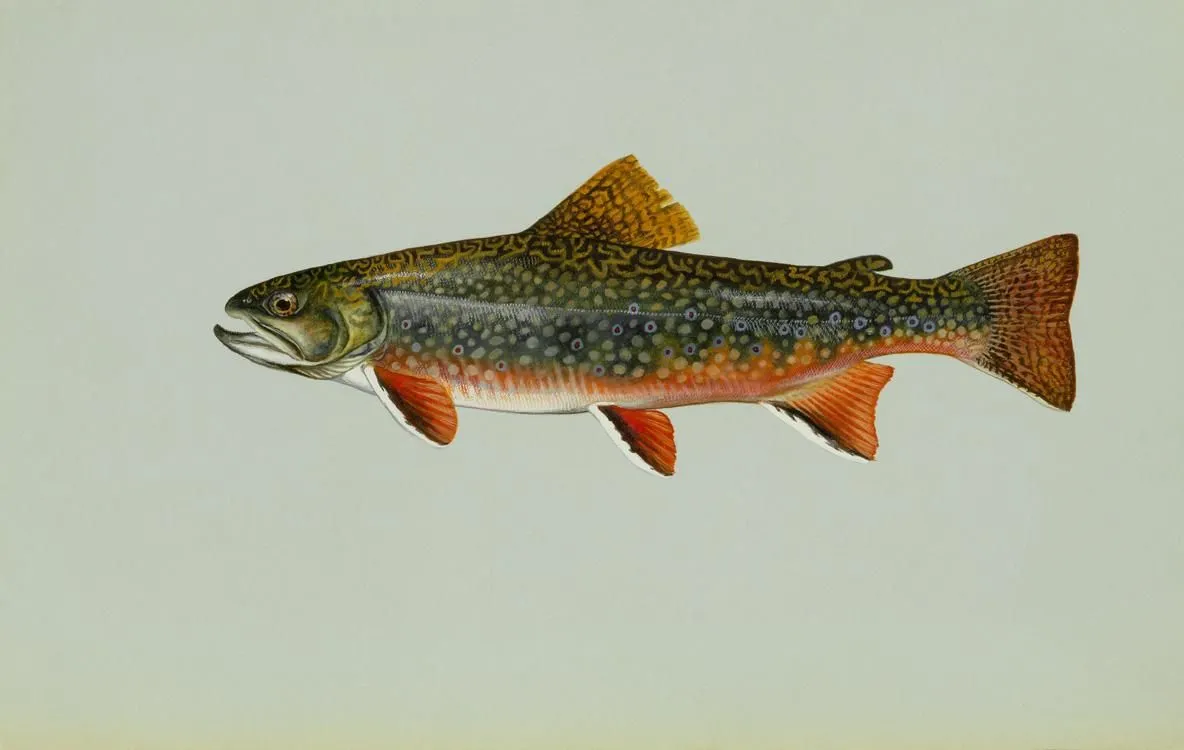
Identification
- Brook trout have worm-like markings (vermiculations) on the back and red spots, sometimes with blue halos, on the sides. The lower fins have a white front edge, then black, then reddish orange.[1]
What the source says
“Color variations include olive, blue-gray or black above with a silvery white belly and wormlike markings (vermiculation pattern) along the back. They have red spots sometimes surrounded by bluish halos on their sides. The lower fins have a white front edge followed by black and the remainder being reddish orange.”
- In California, the brook trout is the only trout with wavy, maze-like lines (vermiculations) on its back and upper sides.[2]
What the source says
“Only trout in California with vermiculation pattern (wavy, maze-like lines) on back and upper sides.”
- Brook trout belong to the char family and are often confused with bull trout. Brook trout have vermiculations and black spots on the dorsal fin, which bull trout lack.[3]
What the source says
“Closely related to and commonly misidentified as brook trout (both are members of the char family). A distinguishing characteristic is the lack of black spots on the dorsal fin. Do not have vermiculations that occur on brook trout.”
Habitat and range
- The native range covers much of eastern Canada, and south through the Atlantic, Great Lakes and Mississippi River basins to Minnesota and, along the Appalachians, northern Georgia.[4]
What the source says
“Native Range: Most of eastern Canada from Newfoundland to western side of Hudson Bay; south in Atlantic, Great Lakes, and Mississippi River basins to Minnesota and (in Appalachian Mountains) northern Georgia (Page and Burr 1991).”
- Brook trout are native to Michigan and are its state fish. They live in cold, spring-fed streams, rivers, lakes and the Great Lakes, often near rocks, logs and undercut banks.[1]
What the source says
“The brook trout is native to Michigan's waters and has been designated the state fish of Michigan. They can be found alongside rocks, under cover of logs and undercut banks, in cold water, spring-fed streams, rivers, lakes and in the Great Lakes.”
Life history
- Brook trout generally spawn in October and November, choosing gravel riffles in spring-fed streams, seepage areas of ponds, lake shores with swift currents, or groundwater seeps.[1]
What the source says
“Spawning generally occurs in the months of October and November. Mature brook trout seek a gravel riffle area in spring-fed streams, seepage areas of ponds, lake shores with swift currents or groundwater seepages.”
- Brook trout eat large numbers of mayflies, stoneflies and other aquatic insects, as well as land insects, but will feed on whatever is most available.[1]
What the source says
“Brook trout have been described as voracious feeders with the potential to consume large numbers seasonally available mayflies, stoneflies and other aquatic insects as well as terrestrial insects. However, they will often feed on whatever is most readily available like zooplankton, crustaceans, worms and fish.”
Status, protections and rules
Legal status and rules as the agency stated them on the date read. Rules change: check the current regulations for the water.
- In Great Smoky Mountains National Park, the brook trout is the only native trout species.[5]
What the source says
“The brook trout is the only native species of trout in the Smokies.”
- Great Smoky Mountains National Park reopened brook trout fishing in 2006 after a 30-year ban.[6]
What the source says
“As a result of research and successful restoration efforts, park management reopened brook trout fishing in 2006 after a 30-year ban.”
Fishing for it: what the agencies say
What agencies and extension services say about catching it, with the source for each line.
- Brook trout bite readily on worms, crickets, grasshoppers, wet and dry flies, spoons and spinners. Look for them in deep holes and under logs or overhanging banks.[1]
What the source says
“Brook trout are ready biters and they can be caught by using various baits and lures including worms, crickets, grasshoppers, wet and dry flies, spoons and spinners. They can be found in deep holes and under the cover of logs or overhanging banks in many streams”
- Ask the nearest fly shop what the fish are feeding on this week before you choose flies.
- Read the water page's gauge before you go: flow and water temperature change by the day.
- Check the agency's rules for the water before you keep a fish.
Water temperature
Warm water stresses trout, char and salmon. These are the published temperature lines we show on every gauge, chosen state first: the state agency's own where it publishes one, otherwise federal guidance (said so). Each water page applies them to the gauge's live reading; the flow and temperature checker does the same for any gauge.
| State | Whose lines | Sources |
|---|---|---|
| Idaho | Idaho Fish and Game (the state's own) | Idaho Department of Fish and Game · Idaho Department of Fish and Game |
| Pennsylvania | Pennsylvania Fish and Boat Commission (the state's own) | Pennsylvania Fish and Boat Commission |
| Utah | Federal guidance (the National Park Service); no Utah line found | National Park Service · U.S. Fish and Wildlife Service |
| Wyoming | Wyoming Game and Fish (the state's own) | Wyoming Game and Fish Department · Wyoming Game and Fish Department · National Park Service |
| Maine | Maine IF&W (the state's own) | Maine Department of Inland Fisheries and Wildlife |
| Montana | Montana FWP (the state's own) | Montana Fish, Wildlife & Parks · Montana Fish, Wildlife & Parks · Montana Fish, Wildlife & Parks |
| Iowa | Federal guidance (the National Park Service); no Iowa line found | National Park Service · U.S. Fish and Wildlife Service · Iowa Department of Natural Resources |
| Oregon | ODFW (the state's own) | Oregon Department of Fish and Wildlife · Oregon Department of Fish and Wildlife |
| Arizona | Arizona Game and Fish (the state's own) | Arizona Game and Fish Department |
| New York | New York DEC (the state's own) | New York State Department of Environmental Conservation |
| Delaware | Federal guidance (the National Park Service); no Delaware line found | National Park Service · U.S. Fish and Wildlife Service · Delaware Department of Natural Resources and Environmental Control |
| Maryland | Maryland DNR (the state's own) | Maryland Department of Natural Resources |
| Tennessee | Federal guidance (the National Park Service); no Tennessee line found | National Park Service · U.S. Fish and Wildlife Service |
| Kentucky | Federal guidance (the National Park Service); no Kentucky line found | National Park Service · U.S. Fish and Wildlife Service |
| Massachusetts | Federal guidance (the National Park Service); no Massachusetts line found | National Park Service · U.S. Fish and Wildlife Service |
| Michigan | Federal guidance (the National Park Service); no Michigan line found | National Park Service · U.S. Fish and Wildlife Service |
| Minnesota | Federal guidance (the National Park Service); no Minnesota line found | National Park Service · U.S. Fish and Wildlife Service · Minnesota Department of Natural Resources |
| Rhode Island | Federal guidance (the National Park Service); no Rhode Island line found | National Park Service · U.S. Fish and Wildlife Service |
| Vermont | Vermont Fish and Wildlife (the state's own) | Vermont Fish and Wildlife Department |
| Wisconsin | Federal guidance (the National Park Service); no Wisconsin line found | National Park Service · U.S. Fish and Wildlife Service |
Where to fish for brook trout
Our 291 water pages whose agency species list names brook trout (each list links to the agency page it comes from). A species missing from a list does not mean it is absent: many agencies publish no list for a water.
United States 283 waters
Idaho 97
Brook trout in IdahoAll Idaho waters
- Salmon RiverAgency list: Idaho Department of Fish and Game
- Teton RiverAgency list: Idaho Department of Fish and Game
- South Fork Salmon RiverAgency list: Idaho Department of Fish and Game
- Big Wood RiverAgency list: Idaho Department of Fish and Game
- Silver CreekAgency list: Idaho Department of Fish and Game
- Little Wood RiverAgency list: Idaho Department of Fish and Game
- Bear Valley CreekAgency list: Idaho Department of Fish and Game
- Middle Fork Salmon RiverAgency list: Idaho Department of Fish and Game
- Henry's ForkAgency list: Idaho Department of Fish and Game
- Big Lost RiverAgency list: Idaho Department of Fish and Game
- South Fork Boise RiverAgency list: Idaho Department of Fish and Game
- Henry's LakeAgency list: Idaho Department of Fish and Game
- South Fork Clearwater RiverAgency list: Idaho Department of Fish and Game
- Lemhi RiverAgency list: Idaho Department of Fish and Game
- Little Lost RiverAgency list: Idaho Department of Fish and Game
- Moyie RiverAgency list: Idaho Department of Fish and Game
- Pahsimeroi RiverAgency list: Idaho Department of Fish and Game
- Priest RiverAgency list: Idaho Department of Fish and Game
- Saint Maries RiverAgency list: Idaho Department of Fish and Game
- Yankee Fork Salmon RiverAgency list: Idaho Department of Fish and Game
- East Fork Salmon RiverAgency list: Idaho Department of Fish and Game
- Middle Fork Boise RiverAgency list: Idaho Department of Fish and Game
- North Fork Payette RiverAgency list: Idaho Department of Fish and Game
- North Fork Salmon RiverAgency list: Idaho Department of Fish and Game
- Pettit LakeAgency list: Idaho Department of Fish and Game
- South Fork Coeur d'Alene RiverAgency list: Idaho Department of Fish and Game
- Spirit LakeAgency list: Idaho Department of Fish and Game
- Warm RiverAgency list: Idaho Department of Fish and Game
- Little Salmon RiverAgency list: Idaho Department of Fish and Game
- American RiverAgency list: Idaho Department of Fish and Game
- East Fork Potlatch RiverAgency list: Idaho Department of Fish and Game
- Potlatch RiverAgency list: Idaho Department of Fish and Game
- Cassia CreekAgency list: Idaho Department of Fish and Game
- Goose CreekAgency list: Idaho Department of Fish and Game
- Middle Fork Payette RiverAgency list: Idaho Department of Fish and Game
- Mores CreekAgency list: Idaho Department of Fish and Game
- Palouse RiverAgency list: Idaho Department of Fish and Game
- Salmon Falls CreekAgency list: Idaho Department of Fish and Game
- Valley CreekAgency list: Idaho Department of Fish and Game
- Baker CreekAgency list: Idaho Department of Fish and Game
- Birch CreekAgency list: Idaho Department of Fish and Game
- Blue Creek ReservoirAgency list: Idaho Department of Fish and Game
- Brushy Fork CreekAgency list: Idaho Department of Fish and Game
- Bull Trout LakeAgency list: Idaho Department of Fish and Game
- Buster LakeAgency list: Idaho Department of Fish and Game
- Carlson LakeAgency list: Idaho Department of Fish and Game
- Cocolalla CreekAgency list: Idaho Department of Fish and Game
- Cocolalla LakeAgency list: Idaho Department of Fish and Game
- Crooked RiverAgency list: Idaho Department of Fish and Game
- East Fork Big Lost RiverAgency list: Idaho Department of Fish and Game
- East Fork South Fork Salmon RiverAgency list: Idaho Department of Fish and Game
- East Fork Weiser RiverAgency list: Idaho Department of Fish and Game
- East Fork Wood RiverAgency list: Idaho Department of Fish and Game
- Elk CreekAgency list: Idaho Department of Fish and Game
- Elk Creek ReservoirAgency list: Idaho Department of Fish and Game
- Elsie LakeAgency list: Idaho Department of Fish and Game
- Fall RiverAgency list: Idaho Department of Fish and Game
- Fernan LakeAgency list: Idaho Department of Fish and Game
- Fish Creek ReservoirAgency list: Idaho Department of Fish and Game
- Gold Fork RiverAgency list: Idaho Department of Fish and Game
- Goose LakeAgency list: Idaho Department of Fish and Game
- Granite LakeAgency list: Idaho Department of Fish and Game
- Grimes CreekAgency list: Idaho Department of Fish and Game
- Grove CreekAgency list: Idaho Department of Fish and Game
- Hazard LakeAgency list: Idaho Department of Fish and Game
- Hoodoo CreekAgency list: Idaho Department of Fish and Game
- Little Redfish LakeAgency list: Idaho Department of Fish and Game
- Lost Valley ReservoirAgency list: Idaho Department of Fish and Game
- Loving CreekAgency list: Idaho Department of Fish and Game
- Lower Glidden LakeAgency list: Idaho Department of Fish and Game
- Martin LakeAgency list: Idaho Department of Fish and Game
- McArthur LakeAgency list: Idaho Department of Fish and Game
- Middle Fork Weiser RiverAgency list: Idaho Department of Fish and Game
- Mirror LakeAgency list: Idaho Department of Fish and Game
- Montpelier CreekAgency list: Idaho Department of Fish and Game
- Mosquito Flat ReservoirAgency list: Idaho Department of Fish and Game
- North Fork Big Lost RiverAgency list: Idaho Department of Fish and Game
- North Fork Big Wood RiverAgency list: Idaho Department of Fish and Game
- North Fork Boise RiverAgency list: Idaho Department of Fish and Game
- North Fork Saint Joe RiverAgency list: Idaho Department of Fish and Game
- Perkins LakeAgency list: Idaho Department of Fish and Game
- Porcupine LakeAgency list: Idaho Department of Fish and Game
- Quartz CreekAgency list: Idaho Department of Fish and Game
- Red RiverAgency list: Idaho Department of Fish and Game
- Robinson LakeAgency list: Idaho Department of Fish and Game
- Round LakeAgency list: Idaho Department of Fish and Game
- Round Prairie CreekAgency list: Idaho Department of Fish and Game
- Second Fork Chief Eagle Eye CreekAgency list: Idaho Department of Fish and Game
- Smith CreekAgency list: Idaho Department of Fish and Game
- Stalker CreekAgency list: Idaho Department of Fish and Game
- Star Hope CreekAgency list: Idaho Department of Fish and Game
- Third Fork Chief Eagle Eye CreekAgency list: Idaho Department of Fish and Game
- Trapper CreekAgency list: Idaho Department of Fish and Game
- Upper Payette LakeAgency list: Idaho Department of Fish and Game
- Warm LakeAgency list: Idaho Department of Fish and Game
- Wildhorse CreekAgency list: Idaho Department of Fish and Game
- Yellow Belly LakeAgency list: Idaho Department of Fish and Game
Pennsylvania 41
Brook trout in PennsylvaniaAll Pennsylvania waters
- Falling Spring BranchAgency list: Pennsylvania Fish and Boat Commission
- Kettle CreekAgency list: Pennsylvania Fish and Boat Commission
- Bush KillAgency list: Pennsylvania Fish and Boat Commission
- Big Spring CreekAgency list: Pennsylvania Fish and Boat Commission
- Francis BranchAgency list: Pennsylvania Fish and Boat Commission
- East Branch Antietam CreekAgency list: Pennsylvania Fish and Boat Commission
- Marvin CreekAgency list: Pennsylvania Fish and Boat Commission
- Slate RunAgency list: Pennsylvania Fish and Boat Commission
- White Deer CreekAgency list: Pennsylvania Fish and Boat Commission
- Pine CreekAgency list: Pennsylvania Fish and Boat Commission
- Chest CreekAgency list: Pennsylvania Fish and Boat Commission
- Cedar RunAgency list: Pennsylvania Fish and Boat Commission
- Cross ForkAgency list: Pennsylvania Fish and Boat Commission
- Germania BranchAgency list: Pennsylvania Fish and Boat Commission
- Grays RunAgency list: Pennsylvania Fish and Boat Commission
- Indian RunAgency list: Pennsylvania Fish and Boat Commission
- Roaring BrookAgency list: Pennsylvania Fish and Boat Commission
- Billings BranchAgency list: Pennsylvania Fish and Boat Commission
- Cherry RunAgency list: Pennsylvania Fish and Boat Commission
- Hunts RunAgency list: Pennsylvania Fish and Boat Commission
- Long RunAgency list: Pennsylvania Fish and Boat Commission
- Sliders BranchAgency list: Pennsylvania Fish and Boat Commission
- Bear CreekAgency list: Pennsylvania Fish and Boat Commission
- Laurel RunAgency list: Pennsylvania Fish and Boat Commission
- East Fork Sinnemahoning CreekAgency list: Pennsylvania Fish and Boat Commission
- Elk CreekAgency list: Pennsylvania Fish and Boat Commission
- Freeman RunAgency list: Pennsylvania Fish and Boat Commission
- Aquashicola CreekAgency list: Pennsylvania Fish and Boat Commission
- Big Moores RunAgency list: Pennsylvania Fish and Boat Commission
- Devils Hole CreekAgency list: Pennsylvania Fish and Boat Commission
- English RunAgency list: Pennsylvania Fish and Boat Commission
- Huntington CreekAgency list: Pennsylvania Fish and Boat Commission
- Laurel RunAgency list: Pennsylvania Fish and Boat Commission
- Marsh CreekAgency list: Pennsylvania Fish and Boat Commission
- Mill RunAgency list: Pennsylvania Fish and Boat Commission
- Paddy RunAgency list: Pennsylvania Fish and Boat Commission
- Panther RunAgency list: Pennsylvania Fish and Boat Commission
- Schuylkill RiverAgency list: Pennsylvania Fish and Boat Commission
- Waldy RunAgency list: Pennsylvania Fish and Boat Commission
- Wallace RunAgency list: Pennsylvania Fish and Boat Commission
- West Branch Genesee RiverAgency list: Pennsylvania Fish and Boat Commission
Utah 34
Brook trout in UtahAll Utah waters
- Provo RiverAgency list: Utah Division of Wildlife Resources
- Weber RiverAgency list: Utah Division of Wildlife Resources
- East Fork Sevier RiverAgency list: Utah Division of Wildlife Resources
- Logan RiverAgency list: Utah Division of Wildlife Resources
- Duchesne RiverAgency list: Utah Division of Wildlife Resources
- Bear RiverAgency list: Utah Division of Wildlife Resources
- Blacks ForkAgency list: Utah Division of Wildlife Resources
- Rock CreekAgency list: Utah Division of Wildlife Resources
- Uinta RiverAgency list: Utah Division of Wildlife Resources
- Whiterocks RiverAgency list: Utah Division of Wildlife Resources
- Lower Stillwater PondsAgency list: Utah Division of Wildlife Resources
- Yellowstone CreekAgency list: Utah Division of Wildlife Resources
- Mammoth CreekAgency list: Utah Division of Wildlife Resources
- Bee TreeAgency list: Utah Division of Wildlife Resources
- Brad's SecretAgency list: Utah Division of Wildlife Resources
- Browne LakeAgency list: Utah Division of Wildlife Resources
- Deep LakeAgency list: Utah Division of Wildlife Resources
- East Park ReservoirAgency list: Utah Division of Wildlife Resources
- East Parley'sAgency list: Utah Division of Wildlife Resources
- Ferron ReservoirAgency list: Utah Division of Wildlife Resources
- Foy LakeAgency list: Utah Division of Wildlife Resources
- Lake CatherineAgency list: Utah Division of Wildlife Resources
- Lake FlorenceAgency list: Utah Division of Wildlife Resources
- Lake MaryAgency list: Utah Division of Wildlife Resources
- Long Park ReservoirAgency list: Utah Division of Wildlife Resources
- Lower Wpa PondAgency list: Utah Division of Wildlife Resources
- Moon LakeAgency list: Utah Division of Wildlife Resources
- Pittsburgh LakeAgency list: Utah Division of Wildlife Resources
- Shingle Mill ReservoirAgency list: Utah Division of Wildlife Resources
- Silver LakeAgency list: Utah Division of Wildlife Resources
- Silver LakeAgency list: Utah Division of Wildlife Resources
- Silver Lake Flat ReservoirAgency list: Utah Division of Wildlife Resources
- Upper Wpa PondAgency list: Utah Division of Wildlife Resources
- Yankee Meadow ReservoirAgency list: Utah Division of Wildlife Resources
Wyoming 32
Brook trout in WyomingAll Wyoming waters
- New Fork RiverAgency list: Wyoming Game and Fish Department
- Wind RiverAgency list: Wyoming Game and Fish Department
- Clarks Fork Yellowstone RiverAgency list: Wyoming Game and Fish Department
- Deer CreekAgency list: Wyoming Game and Fish Department
- Bates CreekAgency list: Wyoming Game and Fish Department
- la Prele CreekAgency list: Wyoming Game and Fish Department
- Middle Crow CreekAgency list: Wyoming Game and Fish Department
- Sunlight CreekAgency list: Wyoming Game and Fish Department
- Texas CreekAgency list: Wyoming Game and Fish Department
- Boulder CreekAgency list: Wyoming Game and Fish Department
- Dry Laramie RiverAgency list: Wyoming Game and Fish Department
- Medicine Lodge CreekAgency list: Wyoming Game and Fish Department
- Bear CreekAgency list: Wyoming Game and Fish Department
- Brandel CreekAgency list: Wyoming Game and Fish Department
- Cedar CreekAgency list: Wyoming Game and Fish Department
- Duck CreekAgency list: Wyoming Game and Fish Department
- Goose CreekAgency list: Wyoming Game and Fish Department
- Grizzly CreekAgency list: Wyoming Game and Fish Department
- Jakeys ForkAgency list: Wyoming Game and Fish Department
- la Bonte CreekAgency list: Wyoming Game and Fish Department
- Little Popo Agie RiverAgency list: Wyoming Game and Fish Department
- Mule CreekAgency list: Wyoming Game and Fish Department
- North Fork Canyon CreekAgency list: Wyoming Game and Fish Department
- North Tongue RiverAgency list: Wyoming Game and Fish Department
- Rock CreekAgency list: Wyoming Game and Fish Department
- Silver Tip CreekAgency list: Wyoming Game and Fish Department
- South Fork Little Canyon CreekAgency list: Wyoming Game and Fish Department
- Medicine Bow RiverAgency list: Wyoming Game and Fish Department
- Big Sandy RiverAgency list: Wyoming Game and Fish Department
- Rock CreekAgency list: Wyoming Game and Fish Department
- North Brush CreekAgency list: Wyoming Game and Fish Department
- West Tensleep CreekAgency list: Wyoming Game and Fish Department
Maine 24
Brook trout in MaineAll Maine waters
- Kennebec RiverAgency list: Maine Department of Inland Fisheries and Wildlife
- Pickerel PondAgency list: Maine Department of Inland Fisheries and Wildlife (MDIFW)
- Magalloway RiverAgency list: Maine Department of Inland Fisheries and Wildlife
- Horseshoe PondAgency list: Maine Department of Inland Fisheries and Wildlife (MDIFW)
- Big Notch PondAgency list: Maine Department of Inland Fisheries and Wildlife (MDIFW)
- Brown PondAgency list: Maine Department of Inland Fisheries and Wildlife (MDIFW)
- Fish PondAgency list: Maine Department of Inland Fisheries and Wildlife (MDIFW)
- Grassy PondAgency list: Maine Department of Inland Fisheries and Wildlife (MDIFW)
- Rapid RiverAgency list: Maine Department of Inland Fisheries and Wildlife
- Trout PondAgency list: Maine Department of Inland Fisheries and Wildlife (MDIFW)
- Baker PondAgency list: Maine Department of Inland Fisheries and Wildlife (MDIFW)
- Beaver PondAgency list: Maine Department of Inland Fisheries and Wildlife (MDIFW)
- Butler PondAgency list: Maine Department of Inland Fisheries and Wildlife (MDIFW)
- Kidney PondAgency list: Maine Department of Inland Fisheries and Wildlife (MDIFW)
- Little Pleasant PondAgency list: Maine Department of Inland Fisheries and Wildlife (MDIFW)
- Lost PondAgency list: Maine Department of Inland Fisheries and Wildlife (MDIFW)
- Round PondAgency list: Maine Department of Inland Fisheries and Wildlife (MDIFW)
- Round PondAgency list: Maine Department of Inland Fisheries and Wildlife (MDIFW)
- Little Beaver PondAgency list: Maine Department of Inland Fisheries and Wildlife (MDIFW)
- Long PondAgency list: Maine Department of Inland Fisheries and Wildlife (MDIFW)
- West Branch Penobscot RiverAgency list: Maine Department of Inland Fisheries and Wildlife
- Kennebago RiverAgency list: Maine Department of Inland Fisheries and Wildlife
- Rangeley LakeAgency list: Maine Department of Inland Fisheries and Wildlife
- Mooselookmeguntic LakeAgency list: Maine Department of Inland Fisheries and Wildlife
Montana 14
Brook trout in MontanaAll Montana waters
- Madison RiverAgency list: Montana Fish, Wildlife & Parks
- Yellowstone RiverAgency list: Montana Fish, Wildlife & Parks
- Blackfoot RiverAgency list: Montana Fish, Wildlife & Parks
- Clark Fork RiverAgency list: Montana Fish, Wildlife & Parks
- Bitterroot RiverAgency list: Montana Fish, Wildlife & Parks
- Rock CreekAgency list: Montana Fish, Wildlife & Parks
- Beaverhead RiverAgency list: Montana Fish, Wildlife & Parks
- Jefferson RiverAgency list: Montana Fish, Wildlife & Parks
- Big Hole RiverAgency list: Montana Fish, Wildlife & Parks
- Smith RiverAgency list: Montana Fish, Wildlife & Parks
- Ruby RiverAgency list: Montana Fish, Wildlife & Parks
- Gallatin RiverAgency list: Montana Fish, Wildlife & Parks
- Boulder RiverAgency list: Montana Fish, Wildlife & Parks
- Ennis LakeAgency list: Montana Fish, Wildlife & Parks
Iowa 10
Brook trout in IowaAll Iowa waters
- Casey SpringsAgency list: Iowa Department of Natural Resources
- Falcon Spring BranchAgency list: Iowa Department of Natural Resources
- French CreekAgency list: Iowa Department of Natural Resources
- Pine Spring CreekAgency list: Iowa Department of Natural Resources
- South Pine CreekAgency list: Iowa Department of Natural Resources
- West Branch French CreekAgency list: Iowa Department of Natural Resources
- Dutton Cave SpringAgency list: Iowa Department of Natural Resources
- Little Paint CreekAgency list: Iowa Department of Natural Resources
- Middle Bear CreekAgency list: Iowa Department of Natural Resources
- North Cedar CreekAgency list: Iowa Department of Natural Resources
Oregon 7
Brook trout in OregonAll Oregon waters
- Rogue RiverAgency list: Oregon Department of Fish and Wildlife
- Crane Prairie ReservoirAgency list: Oregon Department of Fish and Wildlife
- Devil's LakeAgency list: Oregon Department of Fish and Wildlife
- Elk LakeAgency list: Oregon Department of Fish and Wildlife
- Hosmer LakeAgency list: Oregon Department of Fish and Wildlife
- Little Lava LakeAgency list: Oregon Department of Fish and Wildlife
- Sparks LakeAgency list: Oregon Department of Fish and Wildlife
Arizona 5
Brook trout in ArizonaAll Arizona waters
- Perkins TankAgency list: Arizona Game and Fish Department / Arizona Game and Fish Commission (2025-2026 Arizona Fishing Regulations, official eRegulations edition)
- Big LakeAgency list: Arizona Game and Fish Department (AZGFD)
- Crescent LakeAgency list: Arizona Game and Fish Department (AZGFD)
- Kinnikinick LakeAgency list: Arizona Game and Fish Department (AZGFD)
- Lynx LakeAgency list: Arizona Game and Fish Department (AZGFD)
New York 5
Brook trout in New YorkAll New York waters
- Upper Delaware RiverAgency list: National Park Service
- BeaverkillAgency list: New York State Department of Environmental Conservation
- Neversink RiverAgency list: New York State Department of Environmental Conservation
- Esopus CreekAgency list: New York State Department of Environmental Conservation
- Grindstone CreekAgency list: New York State Department of Environmental Conservation (NYSDEC), Bureau of Fisheries
Delaware 3
- Red Clay CreekAgency list: Delaware Department of Natural Resources and Environmental Control (DNREC), Division of Fish and Wildlife
- White Clay CreekAgency list: Delaware Department of Natural Resources and Environmental Control (DNREC), Division of Fish and Wildlife
- Pike CreekAgency list: Delaware Department of Natural Resources and Environmental Control (DNREC), Division of Fish and Wildlife
Maryland 2
Massachusetts 1
Michigan 1
Vermont 1
Wisconsin 1
Canada 4 waters
Ontario 4
- Nipigon RiverAgency list: Government of Ontario (Ministry of Natural Resources)
- Grand RiverAgency list: Government of Ontario (Ministry of Natural Resources)
- Credit RiverAgency list: Government of Ontario (Ministry of Natural Resources)
- Humber RiverAgency list: Government of Ontario (Ministry of Natural Resources)
Australia 2 waters
Tasmania 2
Chile 1 water
Magallanes 1
- Laguna ParrillarAgency list: SERNAPESCA
Slovenia 1 water
Destination hubs
Hubs that list one of these waters, or that a water page is near: each has guides, shops, licences and trip planning for the area.
- The Forks & the upper Kennebec, Maine12 brook trout waters
- State College, Penns Creek & Spring Creek, Pennsylvania9 brook trout waters
- Island Park & the Henry's Fork, Idaho7 brook trout waters
- Bend & the Deschutes, Oregon6 brook trout waters
- Ennis & the Madison Valley, Montana6 brook trout waters
- Rangeley Lakes, Maine6 brook trout waters
- Bozeman & Livingston, Montana5 brook trout waters
- Missoula, Montana4 brook trout waters
- Roscoe & the Catskills, New York4 brook trout waters
- Carlisle & the Cumberland Valley, Pennsylvania3 brook trout waters
- Jackson Hole, Wyoming2 brook trout waters
- The Driftless: Viroqua & Westby, Wisconsin2 brook trout waters
Sources
Every fact on this page is our paraphrase of the page cited beside it, read on the date shown. Rules and seasons change: check the agency's current regulations before you fish.
- Brook trout Michigan Department of Natural Resources, read Oct 24, 2026.
- Fishing for Brook Trout (non-native) California Department of Fish and Wildlife, read Oct 24, 2026.
- Fishing for Bull Trout (native) California Department of Fish and Wildlife, read Oct 24, 2026.
- Brook Trout (Salvelinus fontinalis) - Species Profile U.S. Geological Survey, Nonindigenous Aquatic Species program, read Oct 24, 2026.
- Fishing - Great Smoky Mountains National Park (U.S. National Park Service) National Park Service, read Oct 24, 2026.
- Fish - Great Smoky Mountains National Park (U.S. National Park Service) National Park Service, read Oct 24, 2026.
10 states and regions have a page of brook trout waters of its own (five or more waters).