
Legendary Species · New York
Brown trout in New York
Salmo trutta[1]
18 New York waters whose agency species list names brown trout. Each links to its water page (gauge, regulations, access map, guides and shops) and to the agency list it comes from.
- 18waters list it
- 2destination hubs
New York waters
Most fished first. A species missing from an agency list does not mean it is absent; this page lists only waters whose list names it (at least 5 are needed for a page).
- Salmon RiverAgency list: New York State Department of Environmental Conservation
- West Branch Delaware RiverAgency list: New York State Department of Environmental Conservation
- Upper Delaware RiverAgency list: National Park Service
- BeaverkillAgency list: New York State Department of Environmental Conservation
- Genesee RiverAgency list: New York State Department of Environmental Conservation (NYSDEC), Bureau of Fisheries
- Black RiverAgency list: New York State Department of Environmental Conservation (NYSDEC), Bureau of Fisheries
- East Branch Delaware RiverAgency list: New York State Department of Environmental Conservation
- Neversink RiverAgency list: New York State Department of Environmental Conservation
- Oak Orchard CreekAgency list: New York State Department of Environmental Conservation (NYSDEC), Bureau of Fisheries
- Irondequoit CreekAgency list: New York State Department of Environmental Conservation (NYSDEC), Bureau of Fisheries
- Lindsey CreekAgency list: New York State Department of Environmental Conservation (NYSDEC), Bureau of Fisheries
- Sandy CreekAgency list: New York State Department of Environmental Conservation (NYSDEC), Bureau of Fisheries
- Johnson CreekAgency list: New York State Department of Environmental Conservation (NYSDEC), Bureau of Fisheries
- Keg CreekAgency list: New York State Department of Environmental Conservation (NYSDEC), Bureau of Fisheries
- Twelve Mile CreekAgency list: New York State Department of Environmental Conservation (NYSDEC), Bureau of Fisheries
- Esopus CreekAgency list: New York State Department of Environmental Conservation
- Grindstone CreekAgency list: New York State Department of Environmental Conservation (NYSDEC), Bureau of Fisheries
- Marsh CreekAgency list: New York State Department of Environmental Conservation (NYSDEC), Bureau of Fisheries
Identification
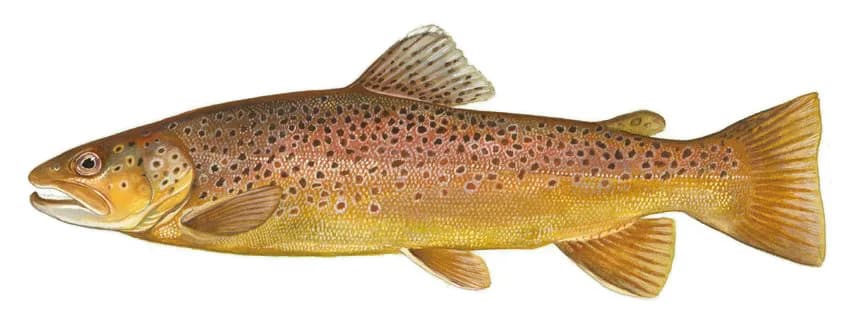
- In California, the brown trout is the only trout with both red and black spots on its body. The dark spots on its sides usually have a pale halo.[2]
What the source says
“Only trout in California with both red and black spots on body. Dark spots on the sides typically surrounded by a pale halo. Coloration is usually dark to olive brown on the back, shading to yellow on the sides, and yellow or white on the belly.”
- Michigan DNR points to a broad, square tongue with 11 to 12 large teeth, light pectoral fins and a square tail. Lake-run browns are mostly silver, and their spots can be hard to see.[1]
What the source says
“Dorsal and adipose fin, broad square tongue with 11 to 12 large teeth, light pectoral fins, square tail, and nine to 10 rays in the anal fin. Lake-run browns are predominately silver in color and the body spots are often obscured in lake-dwellers compared to the resident stream dwellers.”
Status, protections and rules
As each agency stated them on the date read; a rule applies only where its agency says so. Check the current regulations for the water before you fish.
- The U.S. Geological Survey reports that brown trout have been linked to declines in native fish, including other trout and salmon, through predation, displacement and competition for food.[3]
What the source says
“Brown Trout have been implicated in reducing native fish populations (including other salmonids) through predation, displacement, and food competition (Taylor et al. 1984).”
- Yellowstone National Park rule: in the Firehole River, Madison River and lower Gibbon River (below Gibbon Falls), all rainbow and brown trout must be released.[4]
What the source says
“Firehole River, Madison River, lower Gibbon River (downstream of Gibbon Falls)—possession of up to five brook trout is allowed. Catch and release all rainbow and brown trout.”
Water temperature in New York
- Under New York DEC's 70°F lineThat is not over the 70°F above which New York DEC says “trout and salmon can experience physical stress”. “Fish early in the day. Stream temperatures are at their coolest in the early morning hours.”
- Over 70°F: heat stressNew York DEC: trout and salmon “can experience physical stress whenever water temperatures climb above 70 degrees Fahrenheit.” “Avoid catch-and-release fishing for heat-stressed trout on hot days.” “Do not disturb trout where they have gathered in unusually high numbers.”
Sources: DEC Asks Anglers to Help Heat-Stressed Trout and Salmon (28 June 2019) (New York State Department of Environmental Conservation).
Destination hubs
Hubs that list one of these waters, or that a water page is near: each has guides, shops, licences and trip planning for the area.
- Roscoe & the Catskills, New York6 brown trout waters
- Pulaski & the Salmon River, New York4 brown trout waters
Hatch & season charts
- Catskills and the Northeast17 sourced rows
- Great Lakes10 sourced rows
Sources
Every fact on this page is our paraphrase of the page cited beside it, read on the date shown. Rules and seasons change: check the agency's current regulations before you fish.
- Brown trout Michigan Department of Natural Resources, read Oct 24, 2026.
- Fishing for Brown Trout (non-native) California Department of Fish and Wildlife, read Oct 24, 2026.
- Brown Trout (Salmo trutta) - Species Profile U.S. Geological Survey, Nonindigenous Aquatic Species program, read Oct 24, 2026.
- Fishing - Yellowstone National Park (U.S. National Park Service) National Park Service, read Oct 24, 2026.