
Legendary Species · Tennessee
Rainbow trout in Tennessee
Oncorhynchus mykiss[1]
8 Tennessee waters whose agency species list names rainbow trout. Each links to its water page (gauge, regulations, access map, guides and shops) and to the agency list it comes from.
- 8waters list it
- 2destination hubs
Tennessee waters
Most fished first. A species missing from an agency list does not mean it is absent; this page lists only waters whose list names it (at least 5 are needed for a page).
- Caney Fork RiverAgency list: Tennessee Wildlife Resources Agency
- Elk RiverAgency list: Tennessee Wildlife Resources Agency (official Tennessee Fishing Guide, eRegulations edition)
- Duck RiverAgency list: Tennessee Wildlife Resources Agency (official Tennessee Fishing Guide, eRegulations edition)
- Ocoee RiverAgency list: Tennessee Wildlife Resources Agency (official Tennessee Fishing Guide, eRegulations edition)
- Stones RiverAgency list: Tennessee Wildlife Resources Agency (official Tennessee Fishing Guide, eRegulations edition)
- Holston RiverAgency list: Tennessee Wildlife Resources Agency (official Tennessee Fishing Guide, eRegulations edition)
- Obey RiverAgency list: Tennessee Wildlife Resources Agency (official Tennessee Fishing Guide, eRegulations edition)
- Wilbur ReservoirAgency list: Tennessee Wildlife Resources Agency (official Tennessee Fishing Guide, eRegulations edition)
Identification
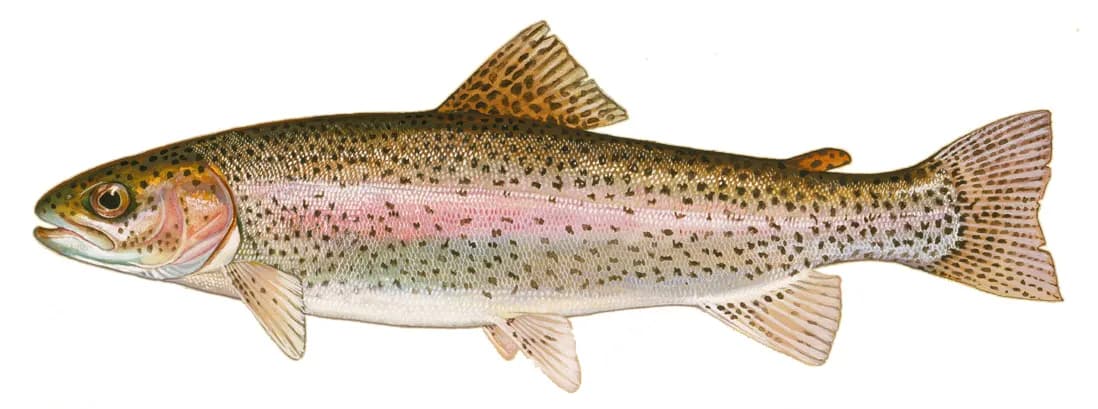
- Rainbow trout vary a lot in colour and shape. Adults are silver with many small black spots, a pink or red band along the side, and spots that often run in lines along the tail rays.[2]
What the source says
“Highly variable in color and body shape, especially between resident fish and steelhead. Adults are silver and heavily spotted with small black spots. Iridescent pink or red along the lateral band. Numerous black spots pepper the body and dorsal fin, often radiating in lines along the rays of the tail.”
- The cheeks are pink and the back ranges from iridescent blue to nearly brown, with silver, white or yellow sides and belly. Young fish carry large, dark oval parr marks along the lateral line.[2]
What the source says
“Opercula (cheeks) are pink, the back iridescent blue to nearly brown, and the sides and belly silver, white or yellow. Juveniles have oval parr marks along the lateral line that are large and dark.”
- Rainbow trout and steelhead are the same species. Rainbows stay inland, while steelhead are the form that migrates to the ocean or, in Michigan, the Great Lakes.[1]
What the source says
“Genetically rainbow trout and steelhead are the same species but lead very different lives. Rainbow trout stays inland, and an anadromous form that migrates to the Great Lakes (or ocean in their native habitat).”
Status, protections and rules
As each agency stated them on the date read; a rule applies only where its agency says so. Check the current regulations for the water before you fish.
- In Great Smoky Mountains National Park, rainbow trout are non-native. The National Park Service says rainbow trout introduced in the early 1900s, together with logging, cost native brook trout 75% of their habitat.[3]
What the source says
“In the early 1900s, significant environmental changes occurred in the park due to logging and the introduction of non-native rainbow trout, which destroyed 75% of the native brook trout's habitat. Rainbow trout out-competed brook trout by reproducing at a faster rate as well as growing faster, taking over the streams.”
- Yellowstone National Park rule: in the Lamar River drainage, including parts of Slough and Soda Butte creeks, every rainbow trout caught must be killed. Releasing one alive is illegal there.[4]
What the source says
“All rainbow trout, brook trout, and identifiable cutthroat/rainbow hybrids caught in the Lamar River drainage, including portions of Slough and Soda Butte creeks, must be killed—it is illegal to release them alive.”
Water temperature in Tennessee
Tennessee Wildlife Resources Agency publishes no water-temperature line for trout anglers that we found. The lines below are the National Park Service's, federal guidance, not a Tennessee rule:
- Under the federal 68°F lineThat is under the 68°F at which the National Park Service, at Grand Teton National Park, recommends anglers stop fishing in the afternoon (“cease fishing at 2 p.m. when water temperatures are likely to exceed 68°F”). Water warms through the afternoon, so check again later in the day: “Carry a pocket thermometer to monitor water temperature.”
- Stressful for troutAt 68°F the U.S. Fish and Wildlife Service says rainbow trout “start stressing”, and the National Park Service at Grand Teton recommends that anglers “cease fishing at 2 p.m. when water temperatures are likely to exceed 68°F.” Its advice: “Fish early in the morning while the water temperature is cooler”, “Play and land fish quickly to reduce exhaustion stress” and “Keep the fish in the water as much as possible.”
Sources: High water temperatures prompt fishing advisory in Grand Teton National Park (29 July 2022) (National Park Service); Up a climate-stressed creek (9 June 2023) (U.S. Fish and Wildlife Service).
Destination hubs
Hubs that list one of these waters, or that a water page is near: each has guides, shops, licences and trip planning for the area.
- Blue Ridge & the Toccoa, Georgia1 rainbow trout water
- Northeast Tennessee: the South Holston & the Watauga, Tennessee1 rainbow trout water
Hatch & season charts
- Southern Appalachians27 sourced rows
Sources
Every fact on this page is our paraphrase of the page cited beside it, read on the date shown. Rules and seasons change: check the agency's current regulations before you fish.
- Rainbow trout Michigan Department of Natural Resources, read Oct 24, 2026.
- Fishing for Coastal Rainbow Trout / Steelhead California Department of Fish and Wildlife, read Oct 24, 2026.
- Fish - Great Smoky Mountains National Park (U.S. National Park Service) National Park Service, read Oct 24, 2026.
- Fishing - Yellowstone National Park (U.S. National Park Service) National Park Service, read Oct 24, 2026.