
Legendary Species · Char
Lake trout
Salvelinus namaycush[1]
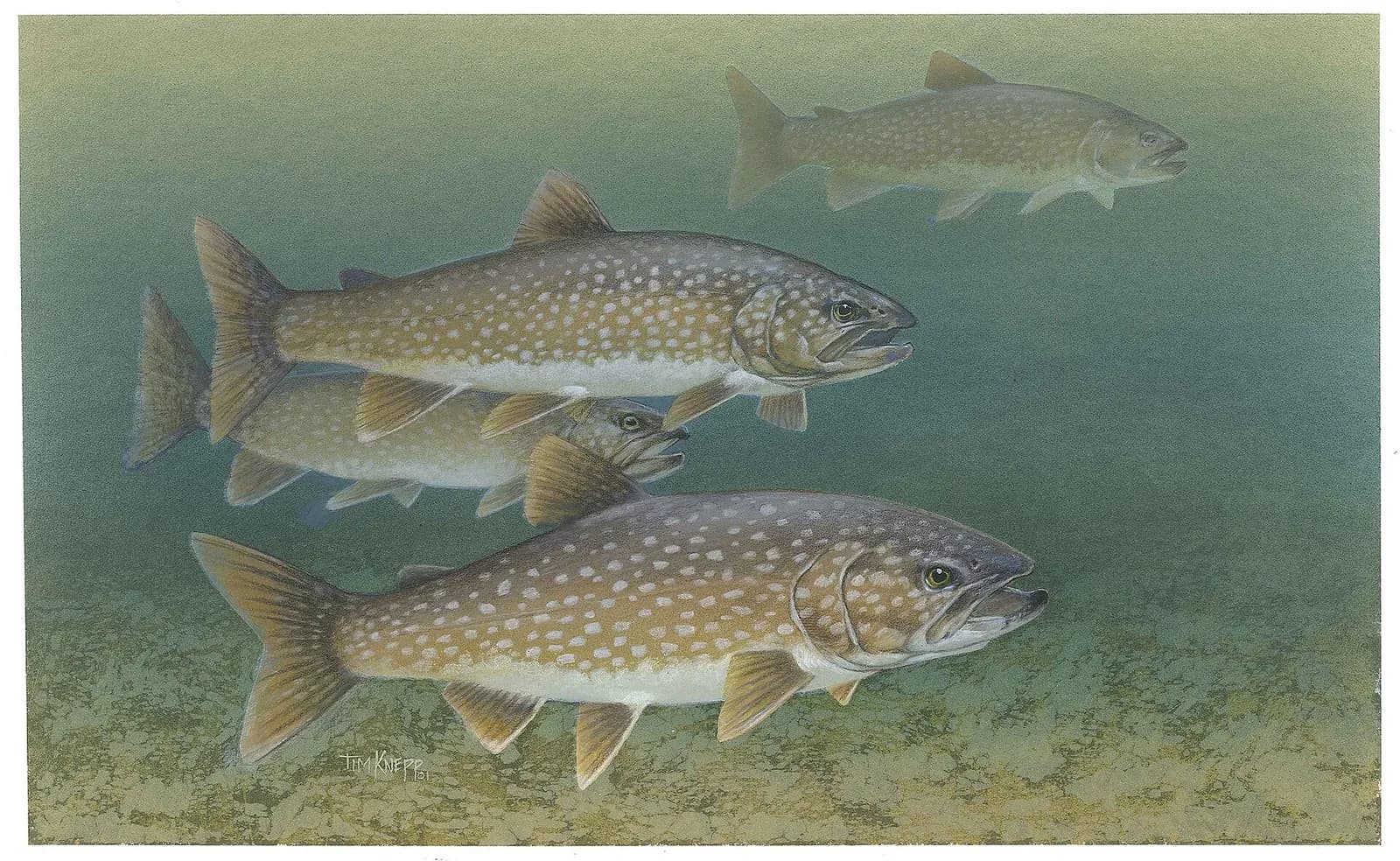
Lake trout have light spots on a black to gray background that get lighter down the sides, a white belly, and orange to orange-red lower fins with white leading edges.[1]
- 20waters list it
- 6states and regions
- 5agency sources
Identification
- Lake trout have light spots on a black to gray background that get lighter down the sides, a white belly, and orange to orange-red lower fins with white leading edges.[1]
What the source says
“The lake trout has light spots on a black to gray background, which progressively get lighter moving down the side of the fish. The belly is white. The lower fins are often orange to orange-red with a leading white edge.”
- Glacier National Park says lake trout have a deeply forked tail and many light markings, with no pink or orange spots on the sides. That helps separate them from bull trout.[2]
What the source says
“Lake trout have a deeply forked tail and numerous white (light) markings on their body. They do not have pink or orange spots on their sides.”
Habitat and range
- Lake trout are native from northern Canada and Alaska south to New England and the Great Lakes basin.[3]
What the source says
“Native Range: Widely distributed from northern Canada and Alaska (missing in southern prairie provinces) south to New England and Great Lakes basin (Page and Burr 1991).”
- Lake trout prefer water of 40-55°F. In summer they follow cold water down to 100 to 200 feet or more, and they move into 10 to 30 feet of water in fall, winter and spring.[1]
What the source says
“The lake trout prefers water temperatures between 40-55 degrees Fahrenheit. In the fall, winter and spring seasons this fish may be found in shallow water areas of the lake, 10 to 30 feet deep. As near shore waters warm in the summer, it follows the cold water temperatures to depths of 100 to 200 feet or more.”
Life history
- Lake trout spawn in the fall over shoals or shallow reefs and return to the same spawning area each year.[1]
What the source says
“Lake trout are fall season broadcast spawning fish on shoals or shallow reefs. They do show homing behavior and will return each year to the same spawning area.”
- Adult lake trout eat mostly other fish, such as ciscoes and sculpin.[1]
What the source says
“The lake trout, as adults, feed primarily on other fish. The native prey includes ciscoes and sculpin”
Status, protections and rules
Legal status and rules as the agency stated them on the date read. Rules change: check the current regulations for the water.
- Overfishing and the parasitic sea lamprey severely reduced Great Lakes lake trout populations from 1935 to 1965.[1]
What the source says
“Over commercial fishing and the introduction of the parasitic sea lamprey severely reduced the lake trout populations in the Great Lakes from 1935 to 1965.”
- Yellowstone National Park rule: every lake trout caught from Yellowstone Lake must be killed. Releasing one alive is illegal.[4]
What the source says
“All lake trout caught from Yellowstone Lake must be killed— it is illegal to release them alive.”
- In Glacier National Park, the National Park Service says non-native lake trout are a grave threat to native bull trout, westslope cutthroat trout and other native species in several lakes.[5]
What the source says
“Non-native Lake trout pose a grave threat to native bull trout, westslope cutthroat trout and other native species in several park lakes.”
Fishing for it: what the agencies say
What agencies and extension services say about catching it, with the source for each line.
- Most lake trout are caught by trolling spoons, flashers and flies, or cowbells and minnows, often near the bottom. In spring and fall they can be caught in fairly shallow water.[1]
What the source says
“Lake trout prefer cold water and are often found at significant depths, though they can be taken in relatively shallow water in spring and fall. For the most part, lakers are caught by trolling anglers using spoons, flashers and flies or cowbells and minnows, often near bottom.”
- Ask the nearest fly shop what the fish are feeding on this week before you choose flies.
- Read the water page's gauge before you go: flow and water temperature change by the day.
- Check the agency's rules for the water before you keep a fish.
Water temperature
Warm water stresses trout, char and salmon. These are the published temperature lines we show on every gauge, chosen state first: the state agency's own where it publishes one, otherwise federal guidance (said so). Each water page applies them to the gauge's live reading; the flow and temperature checker does the same for any gauge.
| State | Whose lines | Sources |
|---|---|---|
| Idaho | Idaho Fish and Game (the state's own) | Idaho Department of Fish and Game · Idaho Department of Fish and Game |
| Alaska | Federal guidance (the National Park Service); no Alaska line found | National Park Service · U.S. Fish and Wildlife Service |
| Utah | Federal guidance (the National Park Service); no Utah line found | National Park Service · U.S. Fish and Wildlife Service |
| Montana | Montana FWP (the state's own) | Montana Fish, Wildlife & Parks · Montana Fish, Wildlife & Parks · Montana Fish, Wildlife & Parks |
| Oregon | ODFW (the state's own) | Oregon Department of Fish and Wildlife · Oregon Department of Fish and Wildlife |
Where to fish for lake trout
Our 20 water pages whose agency species list names lake trout (each list links to the agency page it comes from). A species missing from a list does not mean it is absent: many agencies publish no list for a water.
United States 18 waters
Idaho 8
Lake trout in IdahoAll Idaho waters
- Clark Fork RiverAgency list: Idaho Department of Fish and Game
- Lake Pend OreilleAgency list: Idaho Department of Fish and Game
- Priest LakeAgency list: Idaho Department of Fish and Game
- Stanley LakeAgency list: Idaho Department of Fish and Game
- Upper Priest LakeAgency list: Idaho Department of Fish and Game
- Palisades ReservoirAgency list: Idaho Department of Fish and Game
- Payette LakeAgency list: Idaho Department of Fish and Game
- Warm LakeAgency list: Idaho Department of Fish and Game
Alaska 4
- Middle Fork Gulkana RiverAgency list: Alaska Department of Fish and Game, Division of Sport Fish
- Nowitna RiverAgency list: Alaska Department of Fish and Game, Division of Sport Fish
- Fielding LakeAgency list: Alaska Department of Fish and Game, Division of Sport Fish
- Tyone RiverAgency list: Alaska Department of Fish and Game, Division of Sport Fish
Utah 4
- Bear LakeAgency list: Utah Division of Wildlife Resources
- Fish LakeAgency list: Utah Division of Wildlife Resources
- Flaming Gorge ReservoirAgency list: Utah Division of Wildlife Resources
- Lake MaryAgency list: Utah Division of Wildlife Resources
Montana 1
Oregon 1
Argentina 2 waters
Destination hubs
Hubs that list one of these waters, or that a water page is near: each has guides, shops, licences and trip planning for the area.
- Jackson Hole, Wyoming1 lake trout water
- Missoula, Montana1 lake trout water
Sources
Every fact on this page is our paraphrase of the page cited beside it, read on the date shown. Rules and seasons change: check the agency's current regulations before you fish.
- Lake trout Michigan Department of Natural Resources, read Oct 24, 2026.
- Fishing - Glacier National Park (U.S. National Park Service) National Park Service, read Oct 24, 2026.
- Lake Trout (Salvelinus namaycush) - Species Profile U.S. Geological Survey, Nonindigenous Aquatic Species program, read Oct 24, 2026.
- Fishing - Yellowstone National Park (U.S. National Park Service) National Park Service, read Oct 24, 2026.
- Fish - Glacier National Park (U.S. National Park Service) National Park Service, read Oct 24, 2026.
1 state or region has a page of lake trout waters of its own (five or more waters).