
Legendary Species · Montana
Brook trout in Montana
Salvelinus fontinalis[1]
14 Montana waters whose agency species list names brook trout. Each links to its water page (gauge, regulations, access map, guides and shops) and to the agency list it comes from.
- 14waters list it
- 4destination hubs
Montana waters
Most fished first. A species missing from an agency list does not mean it is absent; this page lists only waters whose list names it (at least 5 are needed for a page).
- Madison RiverAgency list: Montana Fish, Wildlife & Parks
- Yellowstone RiverAgency list: Montana Fish, Wildlife & Parks
- Blackfoot RiverAgency list: Montana Fish, Wildlife & Parks
- Clark Fork RiverAgency list: Montana Fish, Wildlife & Parks
- Bitterroot RiverAgency list: Montana Fish, Wildlife & Parks
- Rock CreekAgency list: Montana Fish, Wildlife & Parks
- Beaverhead RiverAgency list: Montana Fish, Wildlife & Parks
- Jefferson RiverAgency list: Montana Fish, Wildlife & Parks
- Big Hole RiverAgency list: Montana Fish, Wildlife & Parks
- Smith RiverAgency list: Montana Fish, Wildlife & Parks
- Ruby RiverAgency list: Montana Fish, Wildlife & Parks
- Gallatin RiverAgency list: Montana Fish, Wildlife & Parks
- Boulder RiverAgency list: Montana Fish, Wildlife & Parks
- Ennis LakeAgency list: Montana Fish, Wildlife & Parks
Identification
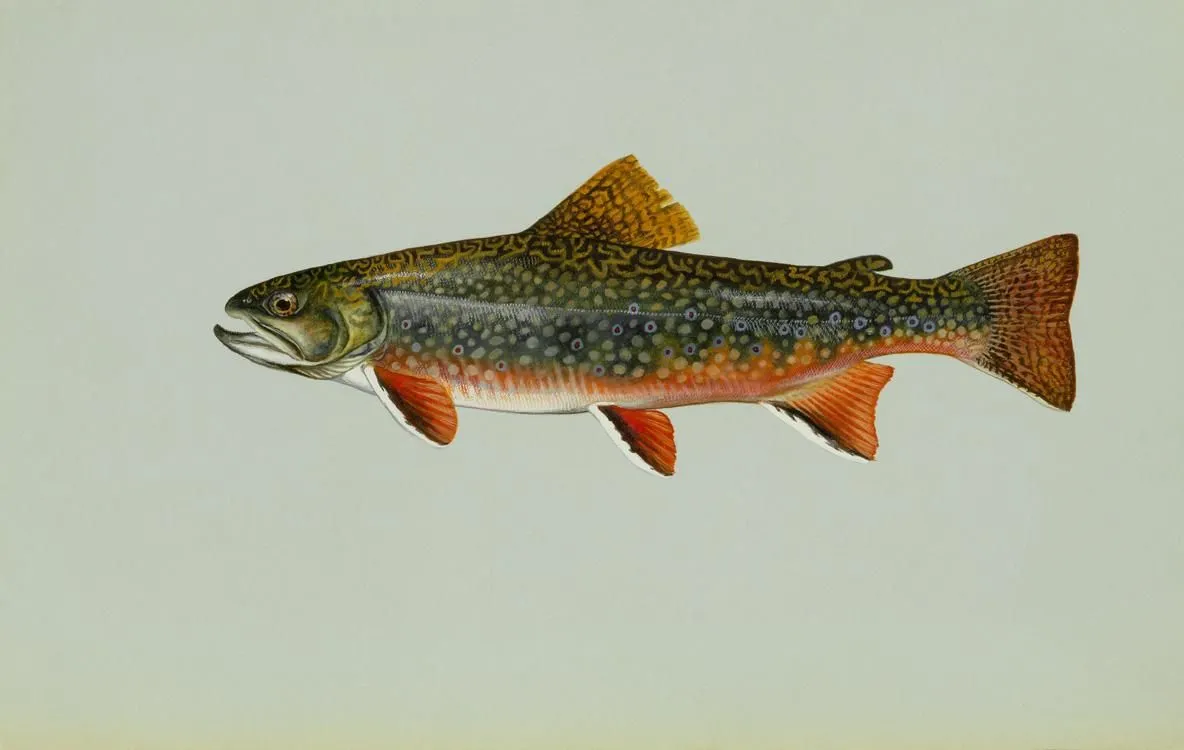
- Brook trout have worm-like markings (vermiculations) on the back and red spots, sometimes with blue halos, on the sides. The lower fins have a white front edge, then black, then reddish orange.[1]
What the source says
“Color variations include olive, blue-gray or black above with a silvery white belly and wormlike markings (vermiculation pattern) along the back. They have red spots sometimes surrounded by bluish halos on their sides. The lower fins have a white front edge followed by black and the remainder being reddish orange.”
- In California, the brook trout is the only trout with wavy, maze-like lines (vermiculations) on its back and upper sides.[2]
What the source says
“Only trout in California with vermiculation pattern (wavy, maze-like lines) on back and upper sides.”
- Brook trout belong to the char family and are often confused with bull trout. Brook trout have vermiculations and black spots on the dorsal fin, which bull trout lack.[3]
What the source says
“Closely related to and commonly misidentified as brook trout (both are members of the char family). A distinguishing characteristic is the lack of black spots on the dorsal fin. Do not have vermiculations that occur on brook trout.”
Status, protections and rules
As each agency stated them on the date read; a rule applies only where its agency says so. Check the current regulations for the water before you fish.
- In Great Smoky Mountains National Park, the brook trout is the only native trout species.[4]
What the source says
“The brook trout is the only native species of trout in the Smokies.”
- Great Smoky Mountains National Park reopened brook trout fishing in 2006 after a 30-year ban.[5]
What the source says
“As a result of research and successful restoration efforts, park management reopened brook trout fishing in 2006 after a 30-year ban.”
Water temperature in Montana
- Under Montana FWP's 68°F lineMontana FWP cites a study in which trout “caught and released from water with a temperature above 68 degrees F were far more likely to perish than those taken from cooler water.” Water warms through the day: “Fish in the cool morning hours.”
- Warm for released troutAbove 68°F, released trout were “far more likely to perish than those taken from cooler water” (the study Montana FWP cites). FWP: “Fish in the cool morning hours — low water flow and rising temperatures combine to stress fish.”
- 66°F: Montana's cutthroat triggerMontana rule, cutthroat trout waters only: “In cutthroat trout waters, angling restrictions occur when the temperatures reach at least 66 degrees for three consecutive days.”
- 73°F: Montana's hoot-owl triggerMontana rule: FWP's drought policy provides for angling restrictions “when maximum daily water temperatures reach at least 73 degrees for three consecutive days”; hoot-owl restrictions “prohibit fishing from 2 p.m. to midnight each day.” FWP sets them reach by reach: check the current list.
- 77°FMontana FWP: “Water temperatures of 77 degrees or more can be lethal to trout.”
Sources: “Giving a hoot”, Montana Outdoors (July–August 2024) (Montana Fish, Wildlife & Parks); Drought and fishing (Montana Fish, Wildlife & Parks); Additional fishing restrictions begin July 22 on several Montana rivers (21 July 2026) (Montana Fish, Wildlife & Parks); Current waterbody restrictions (Montana Fish, Wildlife & Parks).
Destination hubs
Hubs that list one of these waters, or that a water page is near: each has guides, shops, licences and trip planning for the area.
- Ennis & the Madison Valley, Montana6 brook trout waters
- Bozeman & Livingston, Montana5 brook trout waters
- Missoula, Montana4 brook trout waters
- Island Park & the Henry's Fork, Idaho1 brook trout water
Hatch & season charts
- Northern Rockies8 sourced rows
Sources
Every fact on this page is our paraphrase of the page cited beside it, read on the date shown. Rules and seasons change: check the agency's current regulations before you fish.
- Brook trout Michigan Department of Natural Resources, read Oct 24, 2026.
- Fishing for Brook Trout (non-native) California Department of Fish and Wildlife, read Oct 24, 2026.
- Fishing for Bull Trout (native) California Department of Fish and Wildlife, read Oct 24, 2026.
- Fishing - Great Smoky Mountains National Park (U.S. National Park Service) National Park Service, read Oct 24, 2026.
- Fish - Great Smoky Mountains National Park (U.S. National Park Service) National Park Service, read Oct 24, 2026.