
Legendary Species · Char
Bull trout
Salvelinus confluentus[1]
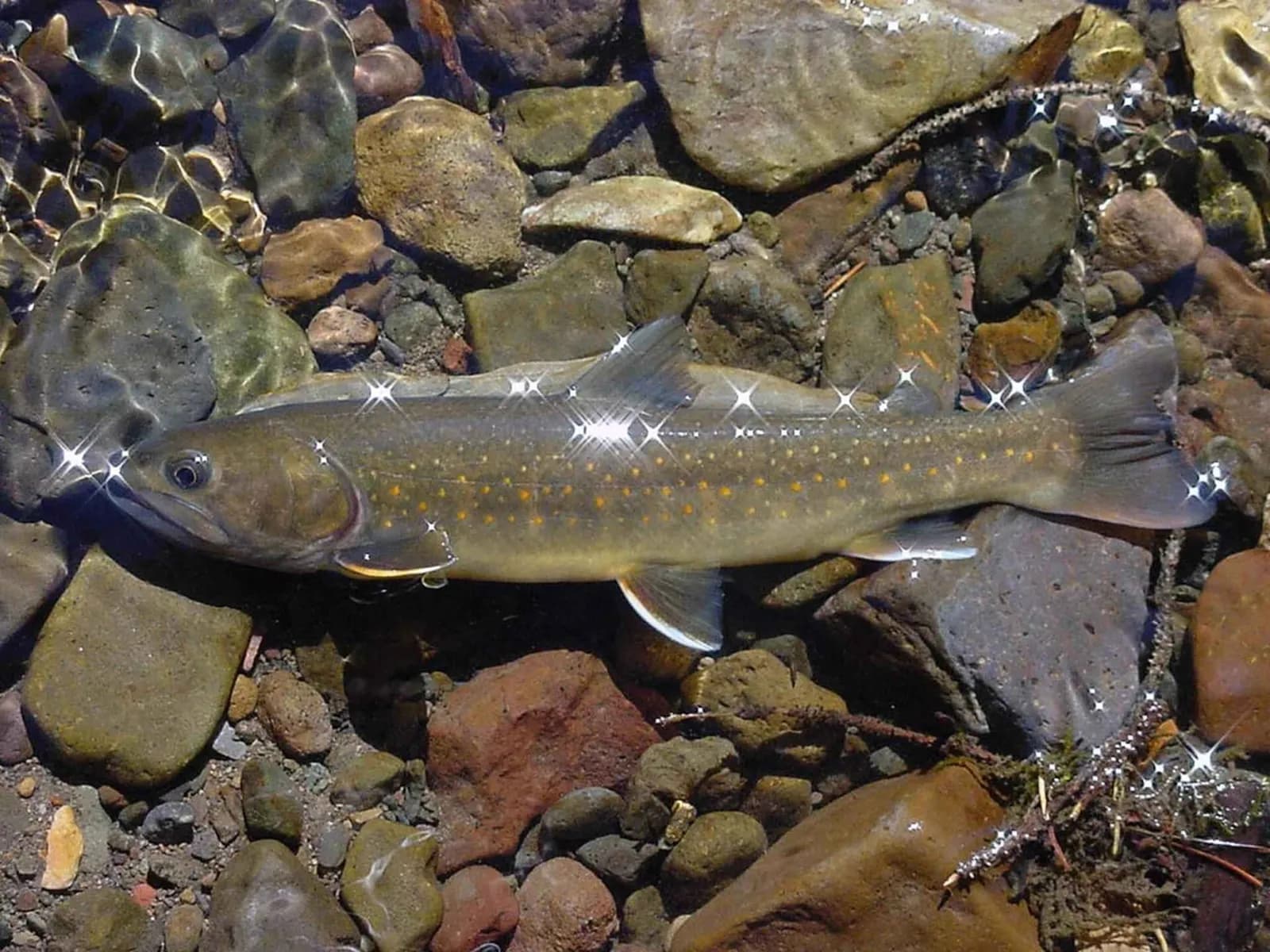
Like lake trout and brook trout, bull trout have light spots on a dark background, the reverse of rainbow and cutthroat trout, which have dark spots on a lighter background.[2]
- 48waters list it
- 3states and regions
- 6agency sources
Identification
- Like lake trout and brook trout, bull trout have light spots on a dark background, the reverse of rainbow and cutthroat trout, which have dark spots on a lighter background.[2]
What the source says
“Also, like lake trout and brook trout their most obvious distinctive feature is light spots on a dark background, unlike rainbow and cutthroat that have dark spots on a lighter background.”
- Bull trout are often mistaken for brook trout. Key differences: bull trout have no black spots on the dorsal fin and no worm-like vermiculations.[3]
What the source says
“Closely related to and commonly misidentified as brook trout (both are members of the char family). A distinguishing characteristic is the lack of black spots on the dorsal fin. Do not have vermiculations that occur on brook trout.”
- Glacier National Park says bull trout have pink or orange spots on their sides and pale yellow spots on their backs.[4]
What the source says
“Bull trout have pink or orange spots on their sides with pale yellow spots on their backs.”
Habitat and range
- Bull trout need cold, clean, complex and connected habitat. They are most common in high mountains with snowfields and glaciers, mainly in deep pools of large, cold rivers and lakes.[1]
What the source says
“Bull trout have specific habitat requirements that are called the Four Cs; cold, clean, complex, and connected habitats. They are most common in high mountainous areas where snowfields and glaciers are present. They mainly occur in deep pools of large, cold, rivers and lakes.”
- The bull trout's range is limited to northwestern North America, from Alaska to northern California.[1]
What the source says
“The geographic range of the bull trout is confined to northwestern North America from Alaska to northern California.”
Life history
- Bull trout usually mature at four to seven years old. They typically spawn between August and November, sometimes as late as December, and females lay an average of 5,000 eggs.[1]
What the source says
“Bull trout usually mature between four to seven years of age. An individual may spawn annually or every other year. Typically spawning for bull trout occurs between August and November, but sometimes as late as December. Redds (egg nests) are dug into clean gravel and laid during spawning: females lay an average of 5,000 eggs.”
Status, protections and rules
Legal status and rules as the agency stated them on the date read. Rules change: check the current regulations for the water.
- Under a USFWS final rule, bull trout are listed as threatened under the Endangered Species Act throughout their range in the coterminous (lower 48) United States.[5]
What the source says
“With this final rule, the bull trout will now be listed as threatened throughout its entire range in the coterminous United States.”
- Montana FWP 2026 rule: possessing a live bull trout is unlawful for any reason. A bull trout being harvested must be killed immediately, and every other bull trout must be released unharmed with no delay.[6]
What the source says
“NOTE: It is unlawful to possess a live Bull Trout for any reason. Any Bull Trout being harvested must be killed immediately; all other Bull Trout must be released unharmed with no delay.”
- WDFW rule: a bull trout caught in water closed to bull trout fishing must not be taken out of the water. It must be unhooked and released immediately.[2]
What the source says
“If an angler catches a bull trout in a water closed for bull trout fishing, they must not be taken out of the water. They must be de-hooked and immediately released.”
- Glacier National Park rule: no bull trout may be kept. Any caught by accident must be handled carefully and released immediately.[4]
What the source says
“No bull trout may be retained. Any caught incidentally must be handled carefully and immediately released.”
Fishing for it: what the agencies say
No agency page we read says how to fish for it; the general advice below is ours.
- Ask the nearest fly shop what the fish are feeding on this week before you choose flies.
- Read the water page's gauge before you go: flow and water temperature change by the day.
- Check the agency's rules for the water before you keep a fish.
Water temperature
Warm water stresses trout, char and salmon. These are the published temperature lines we show on every gauge, chosen state first: the state agency's own where it publishes one, otherwise federal guidance (said so). Each water page applies them to the gauge's live reading; the flow and temperature checker does the same for any gauge.
| State | Whose lines | Sources |
|---|---|---|
| Idaho | Idaho Fish and Game (the state's own) | Idaho Department of Fish and Game · Idaho Department of Fish and Game |
| Montana | Montana FWP (the state's own) | Montana Fish, Wildlife & Parks · Montana Fish, Wildlife & Parks · Montana Fish, Wildlife & Parks |
| Oregon | ODFW (the state's own) | Oregon Department of Fish and Wildlife · Oregon Department of Fish and Wildlife |
Where to fish for bull trout
Our 48 water pages whose agency species list names bull trout (each list links to the agency page it comes from). A species missing from a list does not mean it is absent: many agencies publish no list for a water.
United States 48 waters
Idaho 41
Bull trout in IdahoAll Idaho waters
- Salmon RiverAgency list: Idaho Department of Fish and Game
- Lochsa RiverAgency list: Idaho Department of Fish and Game
- South Fork Salmon RiverAgency list: Idaho Department of Fish and Game
- Clearwater RiverAgency list: Idaho Department of Fish and Game
- Clark Fork RiverAgency list: Idaho Department of Fish and Game
- Lake Pend OreilleAgency list: Idaho Department of Fish and Game
- Kelly CreekAgency list: Idaho Department of Fish and Game
- Middle Fork Salmon RiverAgency list: Idaho Department of Fish and Game
- Selway RiverAgency list: Idaho Department of Fish and Game
- South Fork Boise RiverAgency list: Idaho Department of Fish and Game
- Middle Fork Clearwater RiverAgency list: Idaho Department of Fish and Game
- South Fork Clearwater RiverAgency list: Idaho Department of Fish and Game
- Lemhi RiverAgency list: Idaho Department of Fish and Game
- Little Lost RiverAgency list: Idaho Department of Fish and Game
- Pahsimeroi RiverAgency list: Idaho Department of Fish and Game
- Yankee Fork Salmon RiverAgency list: Idaho Department of Fish and Game
- Little North Fork Clearwater RiverAgency list: Idaho Department of Fish and Game
- Dworshak ReservoirAgency list: Idaho Department of Fish and Game
- East Fork Salmon RiverAgency list: Idaho Department of Fish and Game
- Middle Fork Boise RiverAgency list: Idaho Department of Fish and Game
- North Fork Salmon RiverAgency list: Idaho Department of Fish and Game
- Pettit LakeAgency list: Idaho Department of Fish and Game
- Redfish LakeAgency list: Idaho Department of Fish and Game
- Upper Priest LakeAgency list: Idaho Department of Fish and Game
- Little Salmon RiverAgency list: Idaho Department of Fish and Game
- Crooked CreekAgency list: Idaho Department of Fish and Game
- Middle Fork Payette RiverAgency list: Idaho Department of Fish and Game
- Alturas LakeAgency list: Idaho Department of Fish and Game
- Arrowrock ReservoirAgency list: Idaho Department of Fish and Game
- Cocolalla CreekAgency list: Idaho Department of Fish and Game
- Crooked RiverAgency list: Idaho Department of Fish and Game
- Deadwood ReservoirAgency list: Idaho Department of Fish and Game
- East Fork South Fork Salmon RiverAgency list: Idaho Department of Fish and Game
- Gold Fork RiverAgency list: Idaho Department of Fish and Game
- Little Redfish LakeAgency list: Idaho Department of Fish and Game
- North Fork Boise RiverAgency list: Idaho Department of Fish and Game
- Perkins LakeAgency list: Idaho Department of Fish and Game
- Red RiverAgency list: Idaho Department of Fish and Game
- Warm LakeAgency list: Idaho Department of Fish and Game
- Williams LakeAgency list: Idaho Department of Fish and Game
- Yellow Belly LakeAgency list: Idaho Department of Fish and Game
Montana 4
- Blackfoot RiverAgency list: Montana Fish, Wildlife & Parks
- Clark Fork RiverAgency list: Montana Fish, Wildlife & Parks
- Bitterroot RiverAgency list: Montana Fish, Wildlife & Parks
- Rock CreekAgency list: Montana Fish, Wildlife & Parks
Oregon 3
Destination hubs
Hubs that list one of these waters, or that a water page is near: each has guides, shops, licences and trip planning for the area.
- Missoula, Montana4 bull trout waters
- Bend & the Deschutes, Oregon3 bull trout waters
Sources
Every fact on this page is our paraphrase of the page cited beside it, read on the date shown. Rules and seasons change: check the agency's current regulations before you fish.
- Bull Trout (Salvelinus confluentus) | U.S. Fish & Wildlife Service U.S. Fish and Wildlife Service, read Oct 24, 2026.
- Bull trout | Washington Department of Fish & Wildlife Washington Department of Fish and Wildlife, read Oct 24, 2026.
- Fishing for Bull Trout (native) California Department of Fish and Wildlife, read Oct 24, 2026.
- Fishing - Glacier National Park (U.S. National Park Service) National Park Service, read Oct 24, 2026.
- ETWP; Determination of Threatened Status for Bull Trout in the Coterminous United States U.S. Fish and Wildlife Service, read Oct 24, 2026.
- 2026 Bull Trout Regulations (PDF) Montana Fish, Wildlife & Parks, read Oct 24, 2026.
1 state or region has a page of bull trout waters of its own (five or more waters).