
Legendary Species · Bass, carp, pike and panfish
Largemouth bass
Micropterus nigricans (syn. M. salmoides)[1]
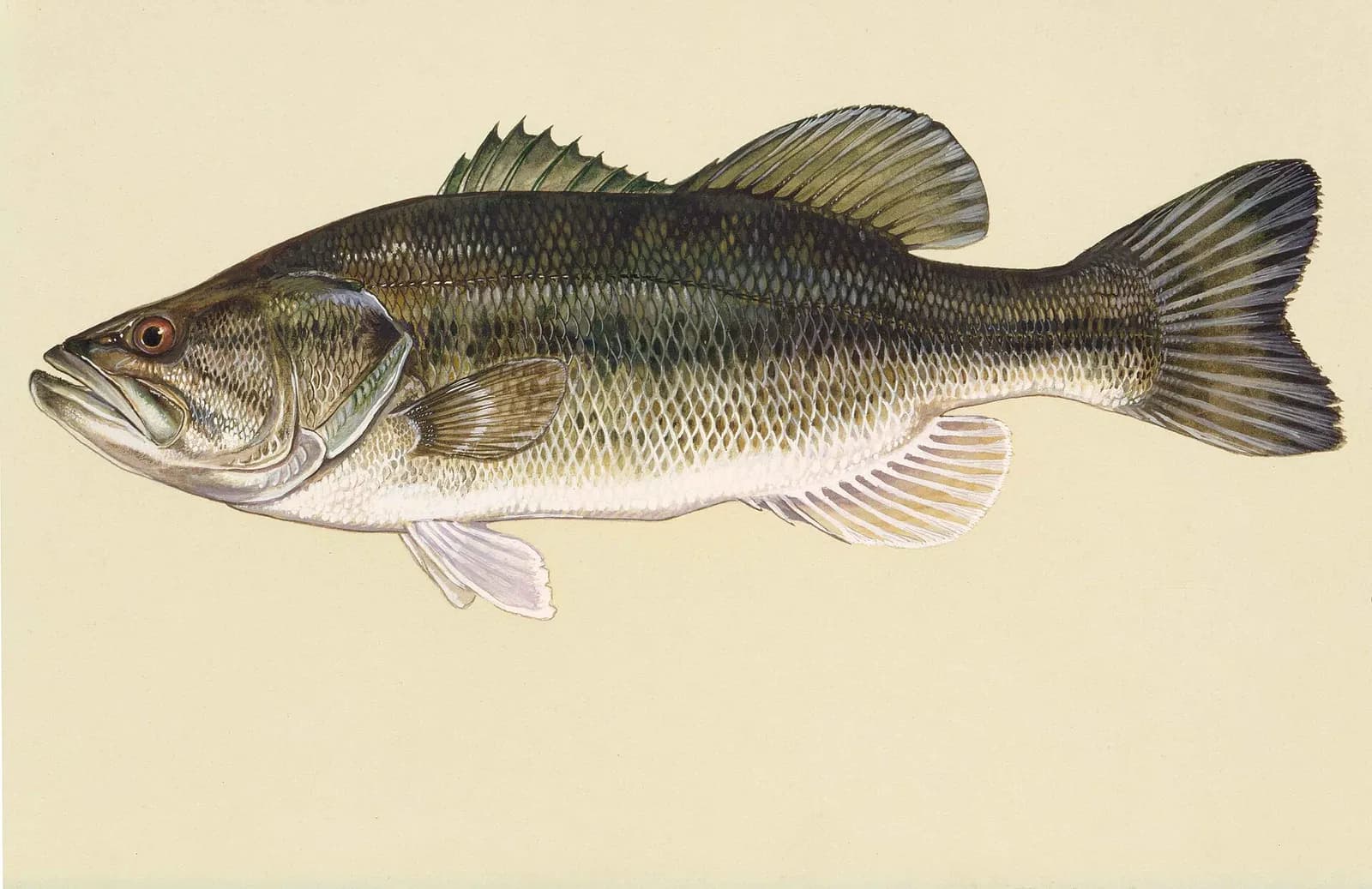
In largemouth bass the upper jaw reaches far past the back edge of the eye (except in small young), the tongue is smooth, and the dorsal fins are not well connected.[1]
- 125waters list it
- 11states and regions
- 3agency sources
Identification
- In largemouth bass the upper jaw reaches far past the back edge of the eye (except in small young), the tongue is smooth, and the dorsal fins are not well connected.[1]
What the source says
“The upper jaw reaches far beyond the rear margin of the eye, except in small young. The tongue is smooth. The dorsal fins are not well connected.”
- A broad, dark, continuous stripe runs along the middle of the side; the upper body is greenish and the belly white.[1]
What the source says
“The upper parts are greenish; the lower sides and belly are white, without dark spots or with spots that are irregularly arranged. The midside has a broad, dark, continuous stripe.”
- Michigan DNR separates it by a deep notch between the two parts of the dorsal fin and an upper jaw that reaches beyond the back of the eye.[2]
What the source says
“Two dorsal fins with a deep notch between spinous and soft-rayed portions, body longer than deep, upper jaw extends beyond rear of eye, body usually light green with a dark green lateral streak.”
Habitat and range
- Largemouth thrive in warm, moderately clear water with little or no current: lowland lakes, impoundments, stream pools and quiet river backwaters.[1]
What the source says
“Found in lowland lakes, artificial impoundments of all sizes, permanent pools of streams, and quiet backwaters of large rivers. The largemouth bass thrives in warm, moderately clear waters with little or no current.”
- Michigan DNR says largemouth are most active in water of 70-85 F and are seldom found deeper than 20 feet in Michigan.[2]
What the source says
“In Michigan, largemouth bass are seldom found deeper than 20 feet. Largemouth bass are most active in warm waters of 70-85 degrees Fahrenheit.”
- The native range includes the St. Lawrence, Great Lakes, Hudson Bay (Red River) and Mississippi basins from southern Quebec to Minnesota and south to the Gulf.[3]
What the source says
“Largemouth Bass are native to the St. Lawrence and Great Lakes, Hudson Bay (Red River), and Mississippi River basins from southern Quebec to Minnesota and south to the Gulf.”
Life history
- In Missouri, largemouth spawn from mid-April through late May or June, building nests on firm, silt-free bottoms away from current or waves.[1]
What the source says
“In Missouri, spawning occurs from mid-April through late May or June. They prefer to build their nests on rock or gravelly substrates, but any firm, silt-free bottom will do.”
- They eat fish, crayfish and large insects, and sometimes frogs, mice, snakes or other small animals that fall into the water.[1]
What the source says
“Carnivorous, feeding on fish, crayfish, large insects, and occasionally frogs, mice, snakes, or other small animals that fall into the water.”
Fishing for it: what the agencies say
What agencies and extension services say about catching it, with the source for each line.
- Michigan DNR says that after spawning some bass, especially largemouth, almost always stay shallow near cover such as weed beds, fallen timber or docks.[2]
What the source says
“After spawning, bass typically move out to deeper water, though there are almost always some bass, especially largemouth, in shallow water, usually associated with cover such as weed beds, fallen timber or boat docks.”
- Bass take all types of flies; fly anglers often use streamers that imitate minnows or crayfish.[2]
What the source says
“Similarly, bass can be taken on all types of flies, with fly fishermen often using streamers that imitate minnows or crayfish to take them subsurface.”
- Ask a local shop which flies are working on that lake or river this month.
- Check the state's size, possession and transport rules before you keep or move a fish.
Where to fish for largemouth bass
Our 125 water pages whose agency species list names largemouth bass (each list links to the agency page it comes from). A species missing from a list does not mean it is absent: many agencies publish no list for a water.
United States 125 waters
Idaho 47
Largemouth bass in IdahoAll Idaho waters
- Lake Pend OreilleAgency list: Idaho Department of Fish and Game
- Kootenai RiverAgency list: Idaho Department of Fish and Game
- Pend Oreille RiverAgency list: Idaho Department of Fish and Game
- Saint Joe RiverAgency list: Idaho Department of Fish and Game
- Saint Maries RiverAgency list: Idaho Department of Fish and Game
- Coeur d'Alene LakeAgency list: Idaho Department of Fish and Game
- Deep Creek ReservoirAgency list: Idaho Department of Fish and Game
- Lake WalcottAgency list: Idaho Department of Fish and Game
- Spirit LakeAgency list: Idaho Department of Fish and Game
- Payette RiverAgency list: Idaho Department of Fish and Game
- American Falls ReservoirAgency list: Idaho Department of Fish and Game
- Avondale LakeAgency list: Idaho Department of Fish and Game
- Black Canyon ReservoirAgency list: Idaho Department of Fish and Game
- Bonner LakeAgency list: Idaho Department of Fish and Game
- Brush LakeAgency list: Idaho Department of Fish and Game
- C J Strike ReservoirAgency list: Idaho Department of Fish and Game
- Cocolalla LakeAgency list: Idaho Department of Fish and Game
- Crane Falls LakeAgency list: Idaho Department of Fish and Game
- Crowthers ReservoirAgency list: Idaho Department of Fish and Game
- Dierkes LakeAgency list: Idaho Department of Fish and Game
- Dog Creek ReservoirAgency list: Idaho Department of Fish and Game
- Dunes LakeAgency list: Idaho Department of Fish and Game
- Elk Creek ReservoirAgency list: Idaho Department of Fish and Game
- Emerald LakeAgency list: Idaho Department of Fish and Game
- Fernan LakeAgency list: Idaho Department of Fish and Game
- Foster ReservoirAgency list: Idaho Department of Fish and Game
- Freeman LakeAgency list: Idaho Department of Fish and Game
- Glendale ReservoirAgency list: Idaho Department of Fish and Game
- Granite LakeAgency list: Idaho Department of Fish and Game
- Hayden LakeAgency list: Idaho Department of Fish and Game
- Johnson ReservoirAgency list: Idaho Department of Fish and Game
- Kelso LakeAgency list: Idaho Department of Fish and Game
- Lamont ReservoirAgency list: Idaho Department of Fish and Game
- Mann Creek ReservoirAgency list: Idaho Department of Fish and Game
- Mann LakeAgency list: Idaho Department of Fish and Game
- McArthur LakeAgency list: Idaho Department of Fish and Game
- Moose Creek ReservoirAgency list: Idaho Department of Fish and Game
- Paddock Valley ReservoirAgency list: Idaho Department of Fish and Game
- Robinson LakeAgency list: Idaho Department of Fish and Game
- Round LakeAgency list: Idaho Department of Fish and Game
- Smith LakeAgency list: Idaho Department of Fish and Game
- Soldiers Meadow ReservoirAgency list: Idaho Department of Fish and Game
- Spring Valley ReservoirAgency list: Idaho Department of Fish and Game
- Tolo LakeAgency list: Idaho Department of Fish and Game
- Twin Lakes ReservoirAgency list: Idaho Department of Fish and Game
- Weston Creek ReservoirAgency list: Idaho Department of Fish and Game
- Winder ReservoirAgency list: Idaho Department of Fish and Game
Alabama 23
Largemouth bass in AlabamaAll Alabama waters
- Sipsey ForkAgency list: Alabama Department of Conservation and Natural Resources, Wildlife and Freshwater Fisheries Division
- Alabama RiverAgency list: Alabama Department of Conservation and Natural Resources, Wildlife and Freshwater Fisheries Division
- Cahaba RiverAgency list: Alabama Department of Conservation and Natural Resources, Wildlife and Freshwater Fisheries Division
- Conecuh RiverAgency list: Alabama Department of Conservation and Natural Resources, Wildlife and Freshwater Fisheries Division
- Coosa RiverAgency list: Alabama Department of Conservation and Natural Resources, Wildlife and Freshwater Fisheries Division
- Cypress CreekAgency list: Alabama Department of Conservation and Natural Resources, Wildlife and Freshwater Fisheries Division
- Fish RiverAgency list: Alabama Department of Conservation and Natural Resources, Wildlife and Freshwater Fisheries Division
- Flint CreekAgency list: Alabama Department of Conservation and Natural Resources, Wildlife and Freshwater Fisheries Division
- Flint RiverAgency list: Alabama Department of Conservation and Natural Resources, Wildlife and Freshwater Fisheries Division
- Hatchet CreekAgency list: Alabama Department of Conservation and Natural Resources, Wildlife and Freshwater Fisheries Division
- Little Cahaba RiverAgency list: Alabama Department of Conservation and Natural Resources, Wildlife and Freshwater Fisheries Division
- Little RiverAgency list: Alabama Department of Conservation and Natural Resources, Wildlife and Freshwater Fisheries Division
- Mulberry ForkAgency list: Alabama Department of Conservation and Natural Resources, Wildlife and Freshwater Fisheries Division
- North RiverAgency list: Alabama Department of Conservation and Natural Resources, Wildlife and Freshwater Fisheries Division
- Pea RiverAgency list: Alabama Department of Conservation and Natural Resources, Wildlife and Freshwater Fisheries Division
- Sepulga RiverAgency list: Alabama Department of Conservation and Natural Resources, Wildlife and Freshwater Fisheries Division
- Shades CreekAgency list: Alabama Department of Conservation and Natural Resources, Wildlife and Freshwater Fisheries Division
- Sipsey RiverAgency list: Alabama Department of Conservation and Natural Resources, Wildlife and Freshwater Fisheries Division
- Tallapoosa RiverAgency list: Alabama Department of Conservation and Natural Resources, Wildlife and Freshwater Fisheries Division
- Terrapin CreekAgency list: Alabama Department of Conservation and Natural Resources, Wildlife and Freshwater Fisheries Division
- Tombigbee RiverAgency list: Alabama Department of Conservation and Natural Resources, Wildlife and Freshwater Fisheries Division
- Perdido RiverAgency list: Alabama Department of Conservation and Natural Resources, Wildlife and Freshwater Fisheries Division
- Tennessee RiverAgency list: Alabama Department of Conservation and Natural Resources, Wildlife and Freshwater Fisheries Division
Utah 14
Largemouth bass in UtahAll Utah waters
- Lake PowellAgency list: Utah Division of Wildlife Resources
- Deer Creek ReservoirAgency list: Utah Division of Wildlife Resources
- Gunlock ReservoirAgency list: Utah Division of Wildlife Resources
- Quail Creek ReservoirAgency list: Utah Division of Wildlife Resources
- Sand Hollow ReservoirAgency list: Utah Division of Wildlife Resources
- Brough ReservoirAgency list: Utah Division of Wildlife Resources
- Holmes Creek ReservoirAgency list: Utah Division of Wildlife Resources
- Huntington North ReservoirAgency list: Utah Division of Wildlife Resources
- Kens LakeAgency list: Utah Division of Wildlife Resources
- Little Montes ReservoirAgency list: Utah Division of Wildlife Resources
- Mantua ReservoirAgency list: Utah Division of Wildlife Resources
- Red Fleet ReservoirAgency list: Utah Division of Wildlife Resources
- Steinaker ReservoirAgency list: Utah Division of Wildlife Resources
- Wide Hollow ReservoirAgency list: Utah Division of Wildlife Resources
Arizona 12
Largemouth bass in ArizonaAll Arizona waters
- Salt RiverAgency list: Arizona Game and Fish Department (AZGFD)
- Oak CreekAgency list: Arizona Game and Fish Department / Arizona Game and Fish Commission (2025-2026 Arizona Fishing Regulations, official eRegulations edition)
- Becker LakeAgency list: Arizona Game and Fish Department / Arizona Game and Fish Commission (2025-2026 Arizona Fishing Regulations, official eRegulations edition)
- Colorado River Below Davis DamAgency list: Arizona Game and Fish Department (AZGFD)
- Lower Goldwater LakeAgency list: Arizona Game and Fish Department / Arizona Game and Fish Commission (2025-2026 Arizona Fishing Regulations, official eRegulations edition)
- Fool Hollow LakeAgency list: Arizona Game and Fish Department (AZGFD)
- Lynx LakeAgency list: Arizona Game and Fish Department (AZGFD)
- Patagonia LakeAgency list: Arizona Game and Fish Department (AZGFD)
- Rainbow LakeAgency list: Arizona Game and Fish Department (AZGFD)
- Show Low LakeAgency list: Arizona Game and Fish Department (AZGFD)
- Watson LakeAgency list: Arizona Game and Fish Department (AZGFD)
- Woodland ReservoirAgency list: Arizona Game and Fish Department (AZGFD)
Oregon 10
Largemouth bass in OregonAll Oregon waters
- Benson LakeAgency list: Oregon Department of Fish and Wildlife
- Bradley LakeAgency list: Oregon Department of Fish and Wildlife
- Crane Prairie ReservoirAgency list: Oregon Department of Fish and Wildlife
- Davis LakeAgency list: Oregon Department of Fish and Wildlife
- Haystack ReservoirAgency list: Oregon Department of Fish and Wildlife
- Lake SelmacAgency list: Oregon Department of Fish and Wildlife
- Powers PondAgency list: Oregon Department of Fish and Wildlife
- Prineville ReservoirAgency list: Oregon Department of Fish and Wildlife
- Saunders LakeAgency list: Oregon Department of Fish and Wildlife
- Willow LakeAgency list: Oregon Department of Fish and Wildlife
South Carolina 10
Largemouth bass in South CarolinaAll South Carolina waters
- Lake JocasseeAgency list: South Carolina Department of Natural Resources (official eRegulations edition of the SC fishing regulations)
- Santee RiverAgency list: South Carolina Department of Natural Resources (official eRegulations edition of the SC fishing regulations)
- Lake GreenwoodAgency list: South Carolina Department of Natural Resources (official eRegulations edition of the SC fishing regulations)
- Lake MarionAgency list: South Carolina Department of Natural Resources (official eRegulations edition of the SC fishing regulations)
- Lake MoultrieAgency list: South Carolina Department of Natural Resources (official eRegulations edition of the SC fishing regulations)
- Lake MurrayAgency list: South Carolina Department of Natural Resources (official eRegulations edition of the SC fishing regulations)
- Lake RobinsonAgency list: South Carolina Department of Natural Resources (official eRegulations edition of the SC fishing regulations)
- Lake SecessionAgency list: South Carolina Department of Natural Resources (official eRegulations edition of the SC fishing regulations)
- Lake WatereeAgency list: South Carolina Department of Natural Resources (official eRegulations edition of the SC fishing regulations)
- Monticello ReservoirAgency list: South Carolina Department of Natural Resources (official eRegulations edition of the SC fishing regulations)
Arkansas 3
Montana 3
Massachusetts 1
Missouri 1
Destination hubs
Hubs that list one of these waters, or that a water page is near: each has guides, shops, licences and trip planning for the area.
- Bend & the Deschutes, Oregon4 largemouth bass waters
- White River & the Ozarks, Arkansas3 largemouth bass waters
- Charleston & the Lowcountry, South Carolina2 largemouth bass waters
- Missoula, Montana2 largemouth bass waters
- Bozeman & Livingston, Montana1 largemouth bass water
- Grants Pass & the Rogue, Oregon1 largemouth bass water
- Western Massachusetts: the Deerfield & the Swift, Massachusetts1 largemouth bass water
Sources
Every fact on this page is our paraphrase of the page cited beside it, read on the date shown. Rules and seasons change: check the agency's current regulations before you fish.
- Largemouth Bass | Missouri Department of Conservation Missouri Department of Conservation, read Oct 24, 2026.
- Largemouth bass Michigan Department of Natural Resources, read Oct 24, 2026.
- Largemouth Bass (Micropterus nigricans) - Species Profile U.S. Geological Survey, Nonindigenous Aquatic Species Program, read Oct 24, 2026.
6 states and regions have a page of largemouth bass waters of its own (five or more waters).