
Legendary Species · Bass, carp, pike and panfish
Smallmouth bass
Micropterus dolomieu[1]
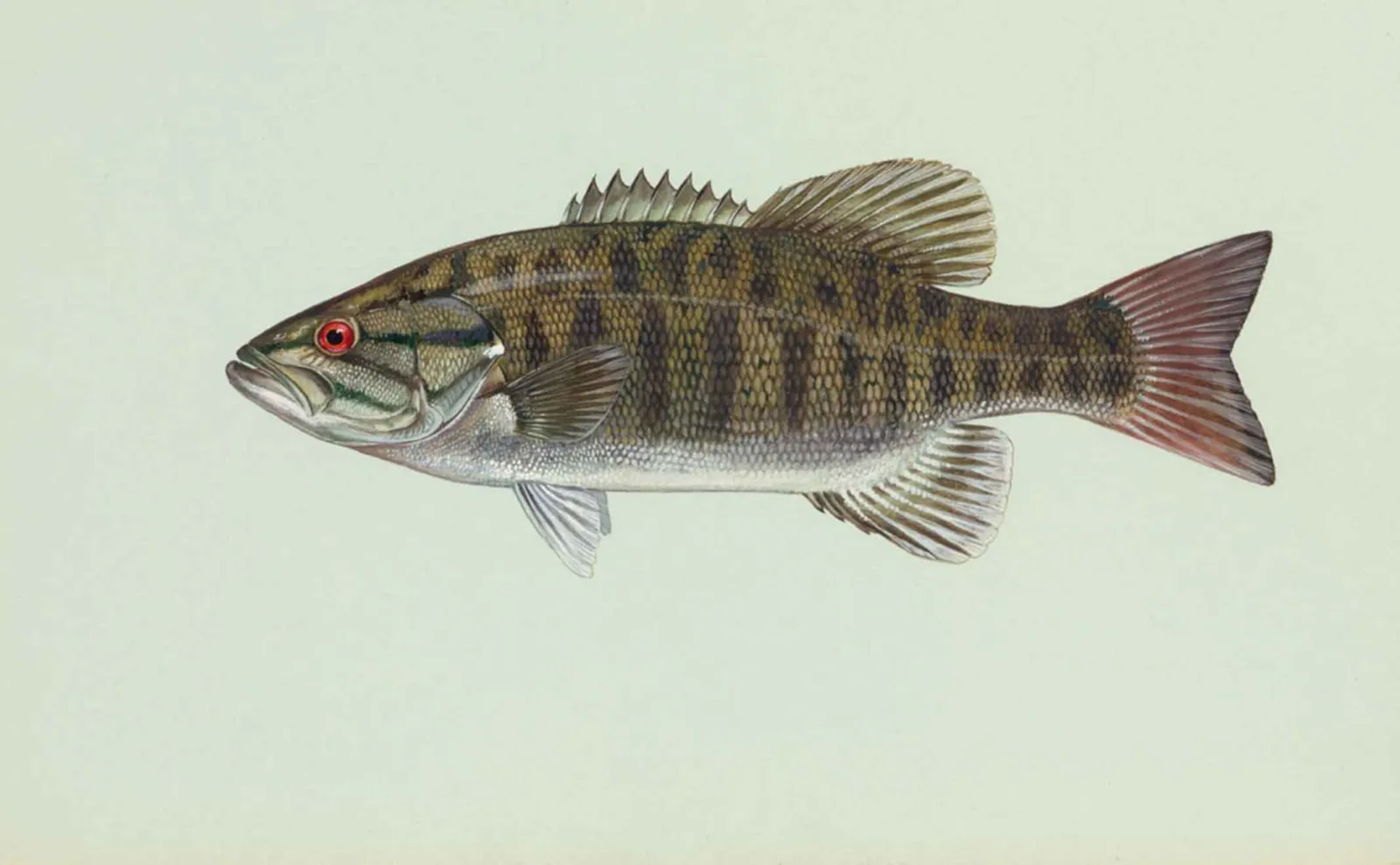
In adult smallmouth the upper jaw reaches only to about the back edge of the eye, not beyond it; in largemouth bass it reaches far behind the eye.[1]
- 101waters list it
- 19states and regions
- 3agency sources
Identification
- In adult smallmouth the upper jaw reaches only to about the back edge of the eye, not beyond it; in largemouth bass it reaches far behind the eye.[1]
What the source says
“In adults, the upper jaw extends to about the rear margin of the eye; it does not extend beyond the back of the eye (in largemouth bass, the upper jaw extends far behind the back of the eye)”
- The back and sides are greenish brown with faint dark mottling and bars, and there is no dark horizontal stripe along the side.[1]
What the source says
“The back and sides are greenish brown, with faint dark mottling and bars; the belly is whitish, overlain with dusky pigment. There is no dark horizontal stripe, and it lacks rows of dark spots.”
- Michigan DNR notes the two dorsal fins are joined, the jaw reaches to the middle of the eye, and there are bronze streaks on the cheek.[2]
What the source says
“Two dorsal fins with spinous and soft-rayed portions united, body longer than deep, jaw extends to the middle of the eye, bronze streaks in cheek.”
Habitat and range
- Smallmouth do best in clear streams with silt-free rock or gravel bottoms, holding near riffles but out of the main current.[1]
What the source says
“Thrives in clear streams, with silt-free rock or gravel bottoms, near riffles but not in the main current.”
- Native range covers the St. Lawrence, Great Lakes, Hudson Bay (Red River) and Mississippi basins, from southern Quebec to North Dakota and south to northern Alabama and eastern Oklahoma.[3]
What the source says
“Native Range: St. Lawrence and Great Lakes, Hudson Bay (Red River), and Mississippi River basins from southern Quebec to North Dakota and south to northern Alabama and eastern Oklahoma”
Life history
- In Missouri, spawning starts in early or mid-April once water passes 60 F, can run into June or July, and peaks in May.[1]
What the source says
“Smallmouth bass spawn from early or mid-April (when the water temperature exceeds 60 F) and continues well into June or even July. Peak spawning activity is in May.”
- Smallmouth eat fish, crayfish and large aquatic insects, and often hunt minnows along the shoreline in quite shallow water.[1]
What the source says
“Carnivorous, feeding on fish, crayfish, and large aquatic insects. When actively foraging for minnows and other prey, smallmouth bass commonly prowl the shoreline in quite shallow water.”
Status, protections and rules
Legal status and rules as the agency stated them on the date read. Rules change: check the current regulations for the water.
- In Missouri, smallmouth numbers have fallen in the Moreau River drainage, partly from hybridizing with introduced spotted bass.[1]
What the source says
“Populations have declined in the Moreau River drainage partly because of hybridization with an introduced population of the closely related spotted bass.”
Fishing for it: what the agencies say
What agencies and extension services say about catching it, with the source for each line.
- Missouri's agency names minnows, crayfish and hellgrammites as the best live baits and notes some anglers see fly fishing as the ultimate way to catch smallmouth.[1]
What the source says
“The most effective live baits include minnows, crayfish, and hellgrammites. Spinning and casting with the same types of lures used for taking largemouth bass also work. Some people consider fly fishing to be the ultimate sporting method for catching "brownies."”
- Michigan DNR says bass take all types of flies, and fly anglers often fish streamers that imitate minnows or crayfish below the surface.[2]
What the source says
“Similarly, bass can be taken on all types of flies, with fly fishermen often using streamers that imitate minnows or crayfish to take them subsurface.”
- Ask a local shop which flies are working on that lake or river this month.
- Check the state's size, possession and transport rules before you keep or move a fish.
Where to fish for smallmouth bass
Our 101 water pages whose agency species list names smallmouth bass (each list links to the agency page it comes from). A species missing from a list does not mean it is absent: many agencies publish no list for a water.
United States 100 waters
Idaho 41
Smallmouth bass in IdahoAll Idaho waters
- Salmon RiverAgency list: Idaho Department of Fish and Game
- Clearwater RiverAgency list: Idaho Department of Fish and Game
- Clark Fork RiverAgency list: Idaho Department of Fish and Game
- Lake Pend OreilleAgency list: Idaho Department of Fish and Game
- Spokane RiverAgency list: Idaho Department of Fish and Game
- Owyhee RiverAgency list: Idaho Department of Fish and Game
- Middle Fork Clearwater RiverAgency list: Idaho Department of Fish and Game
- Pend Oreille RiverAgency list: Idaho Department of Fish and Game
- Priest RiverAgency list: Idaho Department of Fish and Game
- Saint Joe RiverAgency list: Idaho Department of Fish and Game
- Saint Maries RiverAgency list: Idaho Department of Fish and Game
- Anderson Ranch ReservoirAgency list: Idaho Department of Fish and Game
- Blackfoot ReservoirAgency list: Idaho Department of Fish and Game
- Coeur d'Alene LakeAgency list: Idaho Department of Fish and Game
- Dworshak ReservoirAgency list: Idaho Department of Fish and Game
- Lake WalcottAgency list: Idaho Department of Fish and Game
- Little Payette LakeAgency list: Idaho Department of Fish and Game
- North Fork Payette RiverAgency list: Idaho Department of Fish and Game
- Priest LakeAgency list: Idaho Department of Fish and Game
- Spirit LakeAgency list: Idaho Department of Fish and Game
- Hells Canyon ReservoirAgency list: Idaho Department of Fish and Game
- Potlatch RiverAgency list: Idaho Department of Fish and Game
- Bear RiverAgency list: Idaho Department of Fish and Game
- Payette RiverAgency list: Idaho Department of Fish and Game
- Salmon Falls CreekAgency list: Idaho Department of Fish and Game
- Alexander ReservoirAgency list: Idaho Department of Fish and Game
- American Falls ReservoirAgency list: Idaho Department of Fish and Game
- Arrowrock ReservoirAgency list: Idaho Department of Fish and Game
- Black Canyon ReservoirAgency list: Idaho Department of Fish and Game
- C J Strike ReservoirAgency list: Idaho Department of Fish and Game
- Elk Creek ReservoirAgency list: Idaho Department of Fish and Game
- Fernan LakeAgency list: Idaho Department of Fish and Game
- Hayden LakeAgency list: Idaho Department of Fish and Game
- Lake WahaAgency list: Idaho Department of Fish and Game
- Little Camas ReservoirAgency list: Idaho Department of Fish and Game
- Lucky Peak ReservoirAgency list: Idaho Department of Fish and Game
- Magic ReservoirAgency list: Idaho Department of Fish and Game
- Oneida Narrows ReservoirAgency list: Idaho Department of Fish and Game
- Oxbow ReservoirAgency list: Idaho Department of Fish and Game
- Ririe ReservoirAgency list: Idaho Department of Fish and Game
- Salmon Falls Creek ReservoirAgency list: Idaho Department of Fish and Game
Utah 12
Smallmouth bass in UtahAll Utah waters
- Lake PowellAgency list: Utah Division of Wildlife Resources
- Deer Creek ReservoirAgency list: Utah Division of Wildlife Resources
- East Canyon ReservoirAgency list: Utah Division of Wildlife Resources
- Flaming Gorge ReservoirAgency list: Utah Division of Wildlife Resources
- Jordanelle ReservoirAgency list: Utah Division of Wildlife Resources
- Minersville ReservoirAgency list: Utah Division of Wildlife Resources
- Willard Bay ReservoirAgency list: Utah Division of Wildlife Resources
- Big Sand WashAgency list: Utah Division of Wildlife Resources
- Echo ReservoirAgency list: Utah Division of Wildlife Resources
- Enterprise ReservoirsAgency list: Utah Division of Wildlife Resources
- Newcastle ReservoirAgency list: Utah Division of Wildlife Resources
- Rockport ReservoirAgency list: Utah Division of Wildlife Resources
Illinois 10
Smallmouth bass in IllinoisAll Illinois waters
- Apple RiverAgency list: Illinois Department of Natural Resources
- Pine CreekAgency list: Illinois Department of Natural Resources
- Piscasaw CreekAgency list: Illinois Department of Natural Resources
- Fox RiverAgency list: Illinois Department of Natural Resources
- Kankakee RiverAgency list: Illinois Department of Natural Resources
- Kishwaukee RiverAgency list: Illinois Department of Natural Resources
- Pecatonica RiverAgency list: Illinois Department of Natural Resources
- Rock RiverAgency list: Illinois Department of Natural Resources
- South Branch Kishwaukee RiverAgency list: Illinois Department of Natural Resources
- West Branch DuPage RiverAgency list: Illinois Department of Natural Resources
Arkansas 9
Smallmouth bass in ArkansasAll Arkansas waters
- Spring RiverAgency list: Arkansas Game and Fish Commission
- Crooked CreekAgency list: Arkansas Game and Fish Commission
- Buffalo National RiverAgency list: National Park Service
- Kings RiverAgency list: Arkansas Game and Fish Commission
- Caddo RiverAgency list: Arkansas Game and Fish Commission
- Eleven Point RiverAgency list: Arkansas Game and Fish Commission
- War Eagle CreekAgency list: Arkansas Game and Fish Commission
- Current RiverAgency list: Arkansas Game and Fish Commission
- Illinois RiverAgency list: Arkansas Game and Fish Commission
Oregon 6
Smallmouth bass in OregonAll Oregon waters
- Lake Billy ChinookAgency list: Oregon Department of Fish and Wildlife
- Eel LakeAgency list: Oregon Department of Fish and Wildlife
- Haystack ReservoirAgency list: Oregon Department of Fish and Wildlife
- Lake SimtustusAgency list: Oregon Department of Fish and Wildlife
- Ochoco ReservoirAgency list: Oregon Department of Fish and Wildlife
- Prineville ReservoirAgency list: Oregon Department of Fish and Wildlife
Alabama 3
- Cypress CreekAgency list: Alabama Department of Conservation and Natural Resources, Wildlife and Freshwater Fisheries Division
- Flint RiverAgency list: Alabama Department of Conservation and Natural Resources, Wildlife and Freshwater Fisheries Division
- Tennessee RiverAgency list: Alabama Department of Conservation and Natural Resources, Wildlife and Freshwater Fisheries Division
New York 3
Michigan 2
Montana 2
Virginia 2
California 1
Missouri 1
North Carolina 1
Texas 1
Vermont 1
- West Riverlisted as “small mouth bass”Agency list: Vermont Department of Forests, Parks and Recreation (Vermont State Parks)
Canada 1 water
Ontario 1
Destination hubs
Hubs that list one of these waters, or that a water page is near: each has guides, shops, licences and trip planning for the area.
- Bend & the Deschutes, Oregon4 smallmouth bass waters
- Pulaski & the Salmon River, New York2 smallmouth bass waters
- White River & the Ozarks, Arkansas2 smallmouth bass waters
- Asheville & Western North Carolina, North Carolina1 smallmouth bass water
- Baldwin & the Pere Marquette, Michigan1 smallmouth bass water
- Bozeman & Livingston, Montana1 smallmouth bass water
- Grayling & the Au Sable, Michigan1 smallmouth bass water
- Manchester & the Battenkill, Vermont1 smallmouth bass water
- Missoula, Montana1 smallmouth bass water
- Northwest Connecticut: the Farmington & the Housatonic, Connecticut1 smallmouth bass water
- Redding & the Lower Sacramento, California1 smallmouth bass water
- Roscoe & the Catskills, New York1 smallmouth bass water
Sources
Every fact on this page is our paraphrase of the page cited beside it, read on the date shown. Rules and seasons change: check the agency's current regulations before you fish.
- Smallmouth Bass | Missouri Department of Conservation Missouri Department of Conservation, read Oct 24, 2026.
- Smallmouth bass Michigan Department of Natural Resources, read Oct 24, 2026.
- Smallmouth Bass (Micropterus dolomieu) - Species Profile U.S. Geological Survey, Nonindigenous Aquatic Species Program, read Oct 24, 2026.
5 states and regions have a page of smallmouth bass waters of its own (five or more waters).