
Legendary Species · Utah
Largemouth bass in Utah
Micropterus nigricans (syn. M. salmoides)[1]
14 Utah waters whose agency species list names largemouth bass. Each links to its water page (gauge, regulations, access map, guides and shops) and to the agency list it comes from.
- 14waters list it
- 0destination hubs
Utah waters
Most fished first. A species missing from an agency list does not mean it is absent; this page lists only waters whose list names it (at least 5 are needed for a page).
- Lake PowellAgency list: Utah Division of Wildlife Resources
- Deer Creek ReservoirAgency list: Utah Division of Wildlife Resources
- Gunlock ReservoirAgency list: Utah Division of Wildlife Resources
- Quail Creek ReservoirAgency list: Utah Division of Wildlife Resources
- Sand Hollow ReservoirAgency list: Utah Division of Wildlife Resources
- Brough ReservoirAgency list: Utah Division of Wildlife Resources
- Holmes Creek ReservoirAgency list: Utah Division of Wildlife Resources
- Huntington North ReservoirAgency list: Utah Division of Wildlife Resources
- Kens LakeAgency list: Utah Division of Wildlife Resources
- Little Montes ReservoirAgency list: Utah Division of Wildlife Resources
- Mantua ReservoirAgency list: Utah Division of Wildlife Resources
- Red Fleet ReservoirAgency list: Utah Division of Wildlife Resources
- Steinaker ReservoirAgency list: Utah Division of Wildlife Resources
- Wide Hollow ReservoirAgency list: Utah Division of Wildlife Resources
Identification
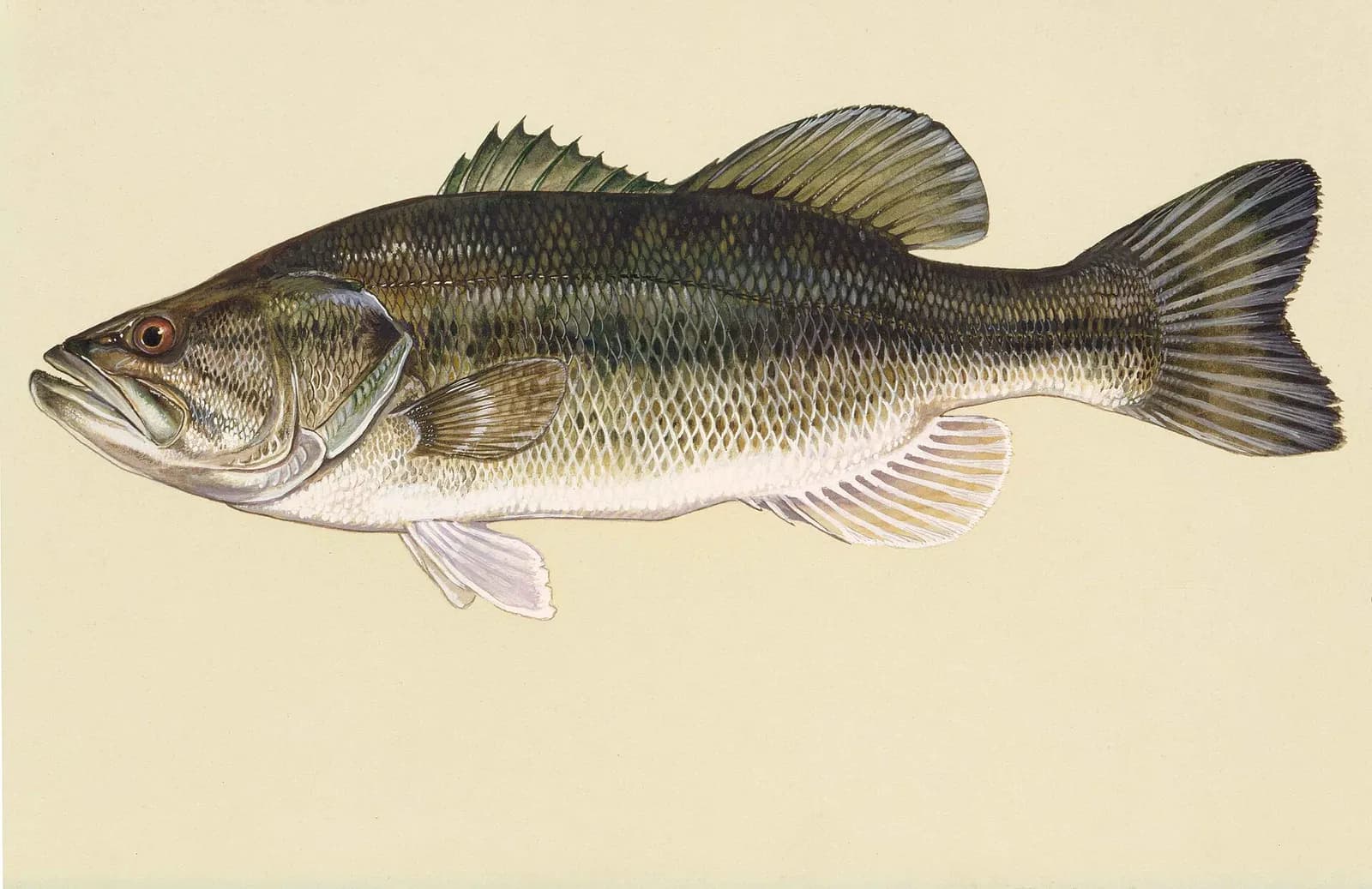
- In largemouth bass the upper jaw reaches far past the back edge of the eye (except in small young), the tongue is smooth, and the dorsal fins are not well connected.[1]
What the source says
“The upper jaw reaches far beyond the rear margin of the eye, except in small young. The tongue is smooth. The dorsal fins are not well connected.”
- A broad, dark, continuous stripe runs along the middle of the side; the upper body is greenish and the belly white.[1]
What the source says
“The upper parts are greenish; the lower sides and belly are white, without dark spots or with spots that are irregularly arranged. The midside has a broad, dark, continuous stripe.”
- Michigan DNR separates it by a deep notch between the two parts of the dorsal fin and an upper jaw that reaches beyond the back of the eye.[2]
What the source says
“Two dorsal fins with a deep notch between spinous and soft-rayed portions, body longer than deep, upper jaw extends beyond rear of eye, body usually light green with a dark green lateral streak.”
Sources
Every fact on this page is our paraphrase of the page cited beside it, read on the date shown. Rules and seasons change: check the agency's current regulations before you fish.
- Largemouth Bass | Missouri Department of Conservation Missouri Department of Conservation, read Oct 24, 2026.
- Largemouth bass Michigan Department of Natural Resources, read Oct 24, 2026.