Legendary Species · Saltwater and flats
Tarpon
Megalops atlanticus[1]
Tarpon have a dark blue-green or greenish-black back that turns bright silver on the sides.[1]
- 45waters list it
- 11states and regions
- 4agency sources
Identification
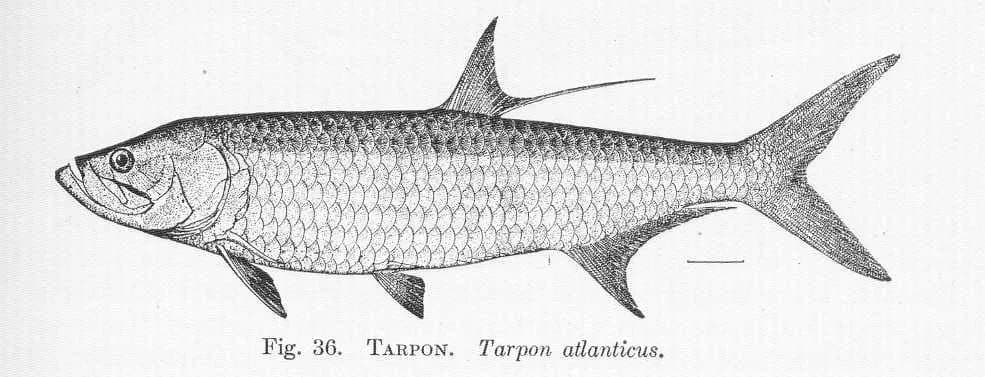
- Tarpon have a dark blue-green or greenish-black back that turns bright silver on the sides.[1]
What the source says
“Back is dark blue-green or greenish-black, becoming bright silver on the sides”
- The last ray of the single dorsal fin extends into a long filament; the scales are very large and the large mouth points upward.[1]
What the source says
“One dorsal fin; last ray of dorsal fin extended into a long filament Very large scales Mouth large and points upward”
Habitat and range
- In Florida, tarpon are found along the whole coast in summer; in winter, falling water temperatures concentrate them in South Florida.[1]
What the source says
“Tarpon are found throughout Florida’s coastal environment during the summer months. During the winter months, coastal water temperatures in much of the state drop significantly and cause tarpon to concentrate in South Florida.”
- Tarpon tolerate a wide range of salinity, juveniles are often found in fresh water, and tarpon gulp air at the surface.[1]
What the source says
“Tolerate a wide range of salinity. Juveniles commonly found in freshwater. Gulp air at the surface.”
- South Carolina DNR notes tarpon may be cold stunned and die in water below 50°F.[2]
What the source says
“Tarpon inhabit temperate to tropical waters and may be cold stunned and die in water less than 50degF.”
Life history
- Tarpon grow slowly and mature at 7 to 13 years. They spawn between May and September, females may lay more than 12 million eggs, and the young pass through a ribbon-like larval stage.[1]
What the source says
“Slow-growing, matures at 7 to 13 years of age. Spawn between May and September. Females may lay more than 12 million eggs. Develop into a ribbon-like larval stage.”
Status, protections and rules
Legal status and rules as the agency stated them on the date read. Rules change: check the current regulations for the water.
- Florida (FWC rule): tarpon is a catch-and-release only fishery. One tarpon tag per person per year may be bought only when pursuing a Florida state or world record.[3]
What the source says
“Daily Bag Limit: Tarpon is a catch-and-release only fishery. One tarpon tag per person per year may be purchased when in pursuit of a Florida state or world record. Vessel, transport and shipment limited to one fish.”
- Florida (FWC rule): tarpon over 40 inches must stay in the water unless you are pursuing a state or world record with a tarpon tag. Keep the fish, especially its gills, in as much water as is safely possible.[3]
What the source says
“Minimum Size Limit: None. Tarpon over 40 inches MUST remain in the water unless in pursuit of a state or world record using a tarpon tag. Keep tarpon, especially the gills, in as much water as is safely possible.”
- Belize: tarpon fall under the catch-and-release fishing law that also covers bonefish and permit (as stated by the Belize City Council).[4]
What the source says
“the catch and release fishing law which pertains to bonefish, tarpon and permit fish. These 3 species have been protected since 2008”
Fishing for it: what the agencies say
What agencies and extension services say about catching it, with the source for each line.
- Tarpon can be caught on flies, streamers, floating and diving lures, jigs, and live or dead bait.[1]
What the source says
“Tarpon can be caught on flies, streamers, floating and diving lures, jigs, live bait and dead bait.”
- For large tarpon on fly, FWC suggests 10- to 12-weight rods and line with a 15- to 25-pound break section in the leader.[3]
What the source says
“Example: If targeting large tarpon, use 10 to 12-weight class rods and line with a break section of 15 to 25-pound test in the leader.”
- FWC recommends a no-touch release: remove the hook with a long-handled dehooking tool, or cut the line as close to the hook as possible.[3]
What the source says
“Aim for a no-touch release by either using a long-handled dehooking tool to remove the hook or cut the line as close as possible to the hook.”
- Saltwater rules (slots, seasons, tags, handling) are set by the state or country and change often: read the current rules before each trip.
- A local guide will know the tides and where the fish are feeding this week.
Where to fish for tarpon
Our 45 water pages whose agency species list names tarpon (each list links to the agency page it comes from). A species missing from a list does not mean it is absent: many agencies publish no list for a water.
United States 33 waters
Florida 32
Tarpon in FloridaAll Florida waters
- Florida Keys flatsAgency list: Florida Fish and Wildlife Conservation Commission
- Biscayne BayAgency list: National Park Service (Biscayne National Park)
- Mosquito LagoonAgency list: Florida Fish and Wildlife Conservation Commission
- Alligator HarborAgency list: Florida Fish and Wildlife Conservation Commission
- Apalachicola BayAgency list: Florida Fish and Wildlife Conservation Commission
- Boca Ciega BayAgency list: Florida Fish and Wildlife Conservation Commission
- Charlotte HarborAgency list: Florida Fish and Wildlife Conservation Commission
- Cockroach BayAgency list: Florida Fish and Wildlife Conservation Commission
- Lemon BayAgency list: Florida Fish and Wildlife Conservation Commission
- Matlacha PassAgency list: Florida Fish and Wildlife Conservation Commission
- Pine Island SoundAgency list: U.S. Fish and Wildlife Service
- Rocky BayouAgency list: Florida Fish and Wildlife Conservation Commission
- Rookery BayAgency list: Florida Fish and Wildlife Conservation Commission
- Saint Andrew BayAgency list: Florida Fish and Wildlife Conservation Commission
- Saint Joseph BayAgency list: Florida Fish and Wildlife Conservation Commission
- Terra Ceia BayAgency list: Florida Fish and Wildlife Conservation Commission
- Big LagoonAgency list: Florida Fish and Wildlife Conservation Commission
- Bishop HarborAgency list: Florida Fish and Wildlife Conservation Commission
- Boca Grande PassAgency list: Florida Fish and Wildlife Conservation Commission
- Cedar KeysAgency list: U.S. Fish and Wildlife Service
- Choctawhatchee BayAgency list: Florida Fish and Wildlife Conservation Commission
- Escambia BayAgency list: Florida Fish and Wildlife Conservation Commission
- Joe's BayouAgency list: Florida Fish and Wildlife Conservation Commission
- John's PassAgency list: Florida Fish and Wildlife Conservation Commission
- Jupiter InletAgency list: Florida Fish and Wildlife Conservation Commission
- Lake WorthAgency list: Florida Fish and Wildlife Conservation Commission
- Longboat PassAgency list: Florida Fish and Wildlife Conservation Commission
- Matanzas InletAgency list: Florida Fish and Wildlife Conservation Commission
- Ponce de Leon InletAgency list: Florida Fish and Wildlife Conservation Commission
- Tampa BayAgency list: Florida Fish and Wildlife Conservation Commission
- Tarpon BayAgency list: U.S. Fish and Wildlife Service
- Venice InletAgency list: Florida Fish and Wildlife Conservation Commission
The Bahamas 7 waters
Abaco 1
Andros 1
Bimini 1
Exuma 1
Grand Bahama 1
Long Island 1
Mexico 4 waters
Quintana Roo 4
- Bahía de la AscensiónAgency list: Comisión Nacional de Áreas Naturales Protegidas (CONANP)
- Bahía del Espíritu SantoAgency list: Comisión Nacional de Áreas Naturales Protegidas (CONANP)
- Laguna Boca PailaAgency list: Comisión Nacional de Áreas Naturales Protegidas (CONANP)
- Laguna ConilAgency list: CONANP
Belize 1 water
Belize 1
Destination hubs
Hubs that list one of these waters, or that a water page is near: each has guides, shops, licences and trip planning for the area.
- Boca Grande & Charlotte Harbor, Florida7 tarpon waters
- Ascension Bay & Sian Ka'an, Quintana Roo3 tarpon waters
- Florida Keys, Florida2 tarpon waters
- Titusville & Mosquito Lagoon, Florida2 tarpon waters
- Belize flats: Ambergris Caye, Turneffe & Placencia, Belize1 tarpon water
- Homosassa & the Nature Coast, Florida1 tarpon water
Sources
Every fact on this page is our paraphrase of the page cited beside it, read on the date shown. Rules and seasons change: check the agency's current regulations before you fish.
- Tarpon | FWC (species profile) Florida Fish and Wildlife Conservation Commission, read Oct 24, 2026.
- SCDNR - Marine - Species - Tarpon South Carolina Department of Natural Resources, read Oct 24, 2026.
- Tarpon | FWC (recreational regulations) Florida Fish and Wildlife Conservation Commission, read Oct 24, 2026.
- Sign Installation For Catch and Release Fishing Law Belize City Council, read Oct 24, 2026.
1 state or region has a page of tarpon waters of its own (five or more waters).