Legendary Species · Saltwater and flats
Snook
Centropomus undecimalis[1] · also Common snook
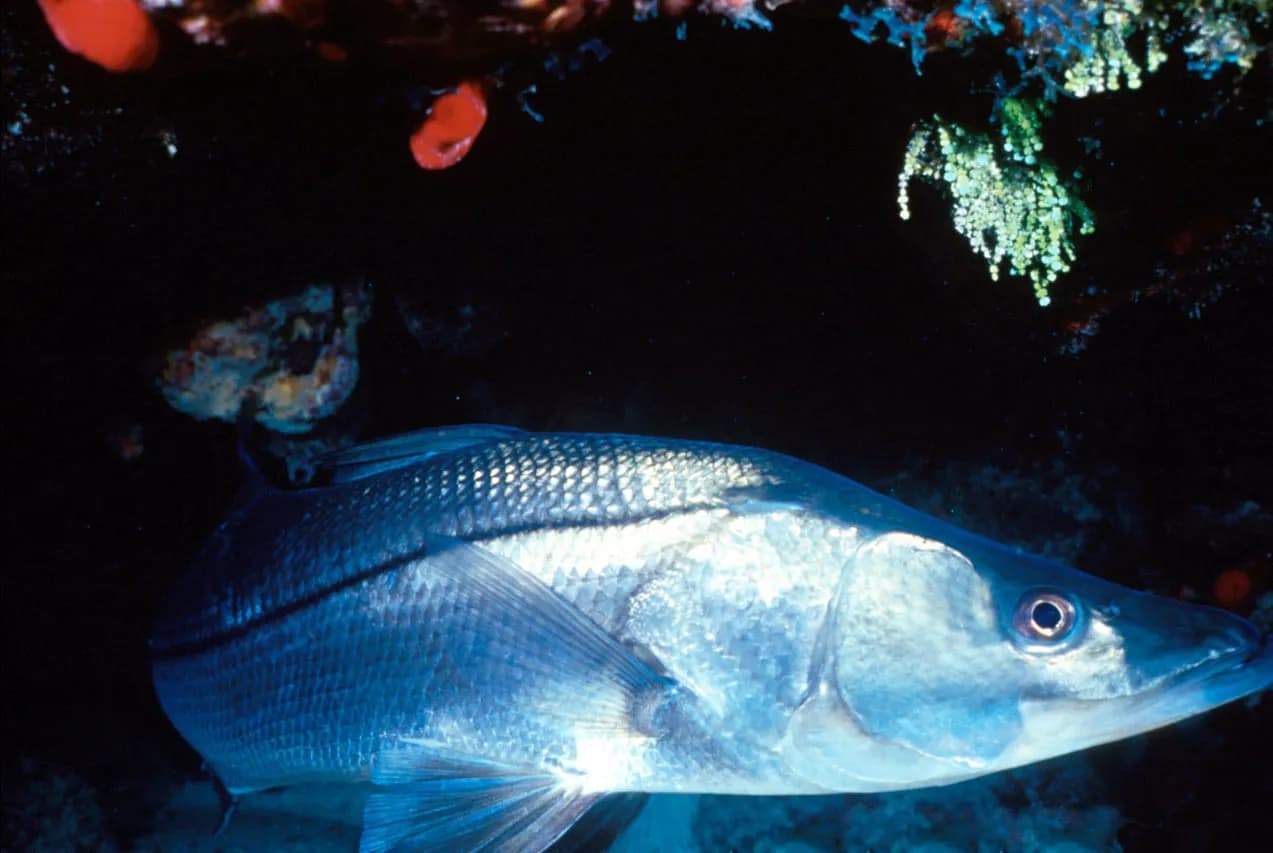
Snook have a large mouth with a protruding lower jaw reaching below the rear of the eye, a sloping forehead, and a high, divided dorsal fin.[1]
- 30waters list it
- 5states and regions
- 2agency sources
Identification
- Snook have a large mouth with a protruding lower jaw reaching below the rear of the eye, a sloping forehead, and a high, divided dorsal fin.[1]
What the source says
“Large mouth with a protruding lower jaw Jaw reaches below the rear portion of the eye Sloping forehead High dorsal fin that is divided”
- Look for a black lateral line that runs onto the tail, and yellow pelvic fins.[1]
What the source says
“Black lateral line extends onto tail Pelvic fin yellow in color”
- Common snook reach up to 48 inches (50 pounds) and grow much larger than Florida's other snook species.[1]
What the source says
“Similar Species: Other snook species Size: Up to 48 inches (50 pounds); grow much larger than other snook species”
Habitat and range
- Inshore coastal waters, including mangrove shorelines, seagrass beds, beaches and around structure.[1]
What the source says
“Inshore in coastal waters, including mangrove shorelines, seagrass beds, beaches and around structure.”
- Snook cannot tolerate water below 60°F, and they can tolerate fresh water.[1]
What the source says
“Cannot tolerate water temperatures below 60° F. Can tolerate freshwater.”
Life history
- Snook start life as males; some become females at 18 to 22 inches. They school during spawning season and eat fish and large crustaceans.[1]
What the source says
“Begin life as males, but between 18 and 22 inches long some become females. Form schools during spawning season. Feed on fish and large crustaceans.”
Status, protections and rules
Legal status and rules as the agency stated them on the date read. Rules change: check the current regulations for the water.
- Florida (FWC rule, Gulf regions such as Big Bend, Tampa Bay and Sarasota Bay): closed December 1 to the end of February and May 1 to August 31; 28- to 33-inch slot; one fish per person per day.[2]
What the source says
“Closed Season: December 1 – end of February, and May 1 – August 31 Slot Limit: Not less than 28” or more than 33” total length Bag Limit: One fish per person per day”
- Florida (FWC rule, Atlantic regions such as Indian River Lagoon and Northeast): closed December 15 to January 31 and June 1 to August 31; 28- to 32-inch slot; one fish per person per day.[2]
What the source says
“Closed Season: December 15 – January 31, and June 1 – August 31 Slot Limit: Not less than 28” or more than 32” total length Bag Limit: One fish per person per day”
- Florida (FWC rule): commercial harvest or sale of snook is not allowed, gear is hook and line only, and anglers need a snook permit plus a recreational fishing license.[2]
What the source says
“No commercial harvest or sale of snook is permitted. Must remain in whole condition until landed ashore. When on a for-hire trip, captain and crew may not retain a bag limit. Allowable Gear: Hook and line only License Requirements: Snook permit and recreational fishing license.”
Fishing for it: what the agencies say
What agencies and extension services say about catching it, with the source for each line.
- Snook face into moving water and wait for the current to carry prey to them.[1]
What the source says
“They orient themselves to face moving water and wait for prey to be carried down the current.”
- Handle snook carefully: their gill covers are razor-sharp.[1]
What the source says
“Beware of the snook’s razor-sharp gill covers!”
- Saltwater rules (slots, seasons, tags, handling) are set by the state or country and change often: read the current rules before each trip.
- A local guide will know the tides and where the fish are feeding this week.
Where to fish for snook
Our 30 water pages whose agency species list names snook (each list links to the agency page it comes from). A species missing from a list does not mean it is absent: many agencies publish no list for a water.
United States 25 waters
Florida 24
Snook in FloridaAll Florida waters
- Florida Keys flatsAgency list: Florida Fish and Wildlife Conservation Commission
- Biscayne BayAgency list: National Park Service (Biscayne National Park)
- Ten Thousand IslandsAgency list: U.S. Fish and Wildlife Service
- Boca Ciega BayAgency list: Florida Fish and Wildlife Conservation Commission
- Charlotte HarborAgency list: Florida Fish and Wildlife Conservation Commission
- Cockroach BayAgency list: Florida Fish and Wildlife Conservation Commission
- Lemon BayAgency list: Florida Fish and Wildlife Conservation Commission
- Matlacha PassAgency list: Florida Fish and Wildlife Conservation Commission
- Pine Island SoundAgency list: U.S. Fish and Wildlife Service
- Rookery BayAgency list: Florida Fish and Wildlife Conservation Commission
- Terra Ceia BayAgency list: Florida Fish and Wildlife Conservation Commission
- Bishop HarborAgency list: Florida Fish and Wildlife Conservation Commission
- Boca Grande PassAgency list: Florida Fish and Wildlife Conservation Commission
- Fort Island Gulf BeachAgency list: Florida Fish and Wildlife Conservation Commission
- Fort Pierce InletAgency list: Florida Fish and Wildlife Conservation Commission
- Hillsboro InletAgency list: Florida Fish and Wildlife Conservation Commission
- John's PassAgency list: Florida Fish and Wildlife Conservation Commission
- Jupiter InletAgency list: Florida Fish and Wildlife Conservation Commission
- Lake WorthAgency list: Florida Fish and Wildlife Conservation Commission
- Longboat PassAgency list: Florida Fish and Wildlife Conservation Commission
- Sebastian InletAgency list: Florida Fish and Wildlife Conservation Commission
- Tampa BayAgency list: Florida Fish and Wildlife Conservation Commission
- Tarpon BayAgency list: U.S. Fish and Wildlife Service
- Venice InletAgency list: Florida Fish and Wildlife Conservation Commission
Texas 1
- South Baylisted as “Common Snook”Agency list: Texas Parks and Wildlife Department
Mexico 5 waters
Quintana Roo 3
Campeche 1
Yucatán 1
Destination hubs
Hubs that list one of these waters, or that a water page is near: each has guides, shops, licences and trip planning for the area.
- Boca Grande & Charlotte Harbor, Florida7 snook waters
- Ascension Bay & Sian Ka'an, Quintana Roo3 snook waters
- Florida Keys, Florida2 snook waters
- Homosassa & the Nature Coast, Florida1 snook water
- Port Mansfield & the Lower Laguna Madre, Texas1 snook water
Sources
Every fact on this page is our paraphrase of the page cited beside it, read on the date shown. Rules and seasons change: check the agency's current regulations before you fish.
- Snook | FWC (species profile) Florida Fish and Wildlife Conservation Commission, read Oct 24, 2026.
- Snook | FWC (recreational regulations) Florida Fish and Wildlife Conservation Commission, read Oct 24, 2026.
1 state or region has a page of snook waters of its own (five or more waters).