Legendary Species · Florida
Tarpon in Florida
Megalops atlanticus[1]
32 Florida waters whose agency species list names tarpon. Each links to its water page (gauge, regulations, access map, guides and shops) and to the agency list it comes from.
- 32waters list it
- 4destination hubs
Florida waters
Most fished first. A species missing from an agency list does not mean it is absent; this page lists only waters whose list names it (at least 5 are needed for a page).
- Florida Keys flatsAgency list: Florida Fish and Wildlife Conservation Commission
- Biscayne BayAgency list: National Park Service (Biscayne National Park)
- Mosquito LagoonAgency list: Florida Fish and Wildlife Conservation Commission
- Alligator HarborAgency list: Florida Fish and Wildlife Conservation Commission
- Apalachicola BayAgency list: Florida Fish and Wildlife Conservation Commission
- Boca Ciega BayAgency list: Florida Fish and Wildlife Conservation Commission
- Charlotte HarborAgency list: Florida Fish and Wildlife Conservation Commission
- Cockroach BayAgency list: Florida Fish and Wildlife Conservation Commission
- Lemon BayAgency list: Florida Fish and Wildlife Conservation Commission
- Matlacha PassAgency list: Florida Fish and Wildlife Conservation Commission
- Pine Island SoundAgency list: U.S. Fish and Wildlife Service
- Rocky BayouAgency list: Florida Fish and Wildlife Conservation Commission
- Rookery BayAgency list: Florida Fish and Wildlife Conservation Commission
- Saint Andrew BayAgency list: Florida Fish and Wildlife Conservation Commission
- Saint Joseph BayAgency list: Florida Fish and Wildlife Conservation Commission
- Terra Ceia BayAgency list: Florida Fish and Wildlife Conservation Commission
- Big LagoonAgency list: Florida Fish and Wildlife Conservation Commission
- Bishop HarborAgency list: Florida Fish and Wildlife Conservation Commission
- Boca Grande PassAgency list: Florida Fish and Wildlife Conservation Commission
- Cedar KeysAgency list: U.S. Fish and Wildlife Service
- Choctawhatchee BayAgency list: Florida Fish and Wildlife Conservation Commission
- Escambia BayAgency list: Florida Fish and Wildlife Conservation Commission
- Joe's BayouAgency list: Florida Fish and Wildlife Conservation Commission
- John's PassAgency list: Florida Fish and Wildlife Conservation Commission
- Jupiter InletAgency list: Florida Fish and Wildlife Conservation Commission
- Lake WorthAgency list: Florida Fish and Wildlife Conservation Commission
- Longboat PassAgency list: Florida Fish and Wildlife Conservation Commission
- Matanzas InletAgency list: Florida Fish and Wildlife Conservation Commission
- Ponce de Leon InletAgency list: Florida Fish and Wildlife Conservation Commission
- Tampa BayAgency list: Florida Fish and Wildlife Conservation Commission
- Tarpon BayAgency list: U.S. Fish and Wildlife Service
- Venice InletAgency list: Florida Fish and Wildlife Conservation Commission
Identification
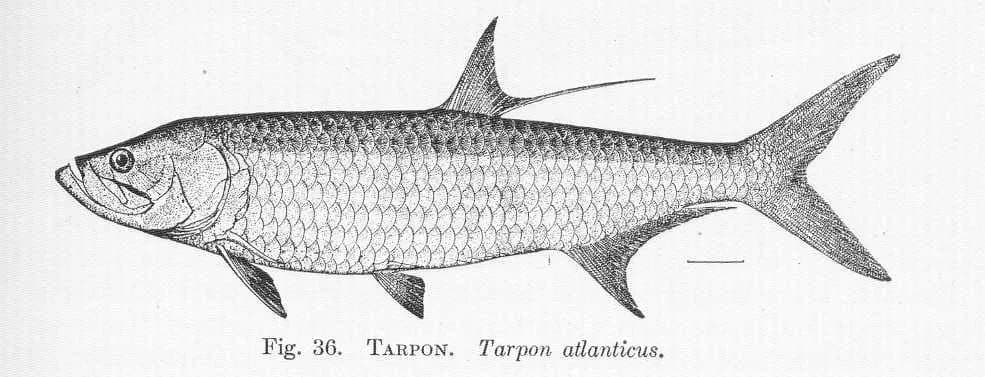
- Tarpon have a dark blue-green or greenish-black back that turns bright silver on the sides.[1]
What the source says
“Back is dark blue-green or greenish-black, becoming bright silver on the sides”
- The last ray of the single dorsal fin extends into a long filament; the scales are very large and the large mouth points upward.[1]
What the source says
“One dorsal fin; last ray of dorsal fin extended into a long filament Very large scales Mouth large and points upward”
Status, protections and rules
As each agency stated them on the date read; a rule applies only where its agency says so. Check the current regulations for the water before you fish.
- Florida (FWC rule): tarpon is a catch-and-release only fishery. One tarpon tag per person per year may be bought only when pursuing a Florida state or world record.[2]
What the source says
“Daily Bag Limit: Tarpon is a catch-and-release only fishery. One tarpon tag per person per year may be purchased when in pursuit of a Florida state or world record. Vessel, transport and shipment limited to one fish.”
- Florida (FWC rule): tarpon over 40 inches must stay in the water unless you are pursuing a state or world record with a tarpon tag. Keep the fish, especially its gills, in as much water as is safely possible.[2]
What the source says
“Minimum Size Limit: None. Tarpon over 40 inches MUST remain in the water unless in pursuit of a state or world record using a tarpon tag. Keep tarpon, especially the gills, in as much water as is safely possible.”
- Belize: tarpon fall under the catch-and-release fishing law that also covers bonefish and permit (as stated by the Belize City Council).[3]
What the source says
“the catch and release fishing law which pertains to bonefish, tarpon and permit fish. These 3 species have been protected since 2008”
Destination hubs
Hubs that list one of these waters, or that a water page is near: each has guides, shops, licences and trip planning for the area.
- Boca Grande & Charlotte Harbor, Florida7 tarpon waters
- Florida Keys, Florida2 tarpon waters
- Titusville & Mosquito Lagoon, Florida2 tarpon waters
- Homosassa & the Nature Coast, Florida1 tarpon water
Sources
Every fact on this page is our paraphrase of the page cited beside it, read on the date shown. Rules and seasons change: check the agency's current regulations before you fish.
- Tarpon | FWC (species profile) Florida Fish and Wildlife Conservation Commission, read Oct 24, 2026.
- Tarpon | FWC (recreational regulations) Florida Fish and Wildlife Conservation Commission, read Oct 24, 2026.
- Sign Installation For Catch and Release Fishing Law Belize City Council, read Oct 24, 2026.