Photo credit
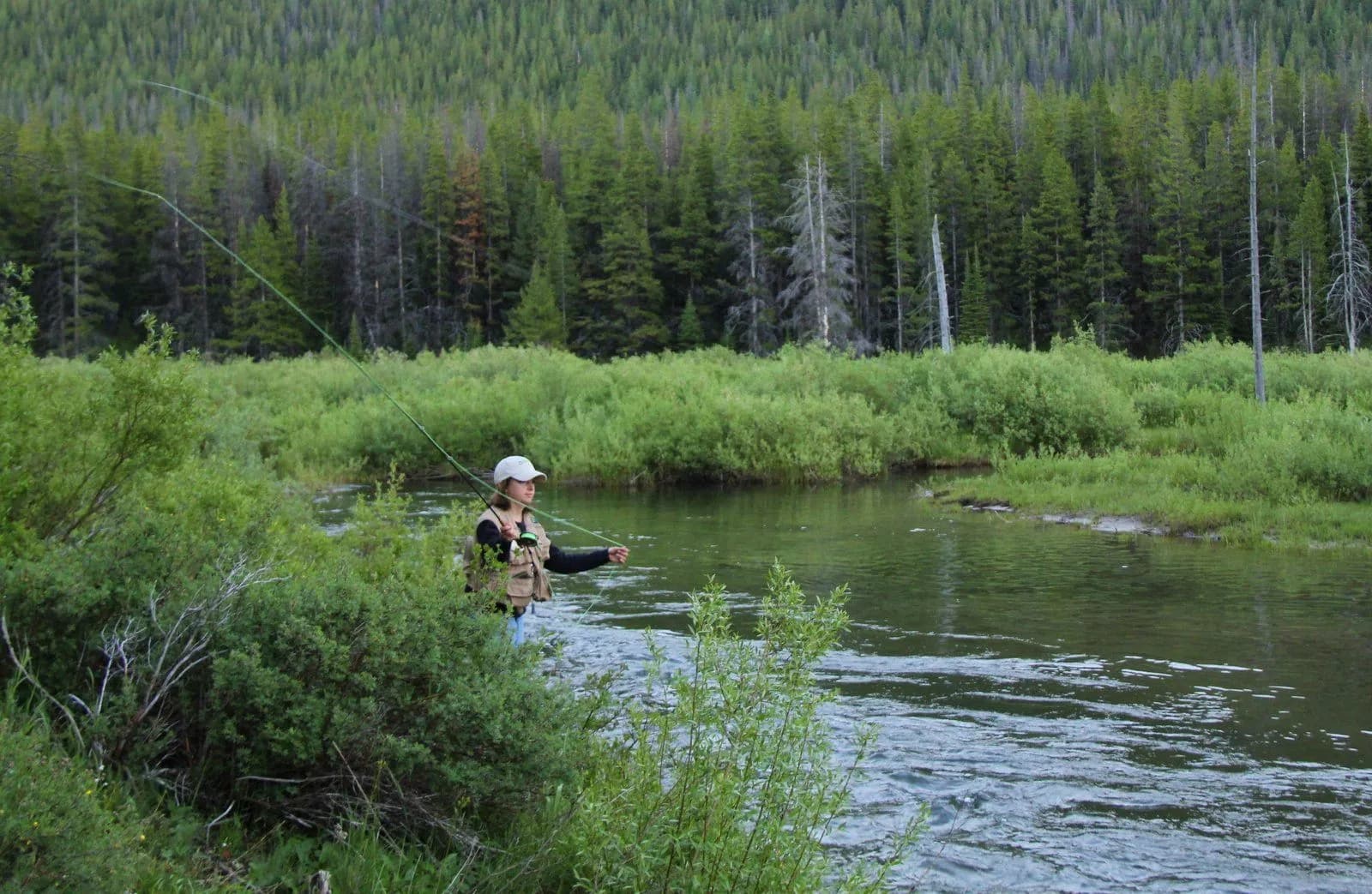
Fly fishing Meadow Creek in the Scapegoat Wilderness, Montana. Photo: Brandan W. Schulze, US Forest Service, public domain, via Wikimedia Commons
Fly fishing words, in plain English.
54 terms you'll meet on river, hatch and gear pages.
Water & flows
- cfs · also ft³/s, cubic feet per second
Cubic feet per second: the volume of water passing a point in the river each second. ft³/s is the same unit written another way. A bigger number means more water, but what counts as high or low depends on the river, so compare it with that gauge's usual flow for the date.
- Gauge height · also stage
The height of the water surface at a gauge, measured in feet above a fixed local reference point. Also called stage. It is not the depth of the river: a gauge height of 3 ft can be over water much deeper or shallower than that.
- USGS gauge · also streamgage, gauging station
A monitoring station run by the U.S. Geological Survey that records a river's water level, usually every 15 minutes, and turns it into a flow in cfs. Many also read water temperature. Each has a site number, which is how our pages name it.
- Provisional data
Recent readings that USGS has not yet reviewed. They are usually close, but ice, debris or equipment problems can make them wrong, and USGS may revise them later.
- Percentile (flow) · also normal for the date
How a flow compares with the daily average flows recorded on the same calendar date in past years at that gauge. The 50th percentile is the middle. A flow at the 90th percentile is higher than nine in ten of those past days. Our "normal for the date" range is the middle half: the 25th to 75th percentile.
- Action stage · also NWS flood categories
A river level, set by the National Weather Service for a forecast point, at which local officials and people near the river should start preparing for possible flooding. It is below flood stage. Above it come minor, moderate and major flood stages. Rising water near these levels is no time to wade.
- Tailwater
The stretch of river below a dam. Its flow and temperature are set by the dam's releases rather than by the weather, so it is often cold and steady through the year, and can rise quickly when the release goes up. Check the release schedule before you wade.
- Dam release · also generation
Water let out of a dam, through turbines (generation) or gates. Operators such as TVA and the U.S. Army Corps of Engineers publish schedules or readings for many dams. When the release rises the river below can come up fast, so know the schedule and keep a way out.
- Freestone river · also freestone
A river fed mainly by rain and snowmelt running off the land, rather than by a dam or springs. Its flow and temperature rise and fall with the seasons and the weather: high and cloudy in spring runoff, lower and warmer by late summer.
- Spring creek
A stream fed mostly by groundwater springs. Its flow and temperature stay fairly steady all year, the water is often very clear and weedy, and it usually holds plenty of insects and wary fish.
- Riffle, run and pool · also riffle, run, pool
Three kinds of water you will hear about. A riffle is shallow, fast water with a broken surface. A run is deeper, with a steady current and a smoother surface. A pool is deep and slow. Trout often feed at the edges where one meets the next.
- Reach
A stretch of river between two points. Agency rules and designations often apply to one reach, "from the dam to the highway bridge", not to the whole river.
Flies & bugs
- Fly
The lure in fly fishing: a hook dressed with thread, fur, feathers or synthetic materials to look like an insect, a small fish or other food. It weighs almost nothing, so the weight of the fly line is what carries it when you cast.
- Dry fly
A fly that floats on the surface, usually to copy an adult insect sitting on the water. You watch it drift and set the hook when a fish takes it.
- Nymph
The young, underwater stage of insects such as mayflies and stoneflies, which live among the stones on the bottom. Also the fly that copies one, fished below the surface, often with a strike indicator or by tight-line (Euro) nymphing. Trout eat far more nymphs than adult insects.
- Emerger
A fly that copies an insect as it rises and breaks through the surface to hatch into an adult. It sits in or just under the surface film.
- Streamer
A larger fly made to look like a small fish, a leech or a crayfish. You cast it and pull it back in short strips, or let the current swing it, so it moves like something alive.
- Wet fly · also soft hackle
A fly fished just under the surface, often cast across the river and swung downstream on a tight line. Soft hackles are a simple, traditional kind.
- Hatch
When many aquatic insects of one kind leave the water as winged adults at about the same time. Fish often feed hard on them, and "matching the hatch" means choosing a fly of similar size, shape and color.
- Mayfly
An aquatic insect whose adults have upright, sail-like wings and two or three long tails. Mayflies hatch from spring to fall on many trout streams and are among the most copied insects in fly fishing.
- Caddis · also caddisfly
An aquatic insect whose adults fold their wings in a tent over the body, like a small moth. Many larvae build cases of sand or plant bits. A common trout food through the warmer months.
- Stonefly
An aquatic insect, often large, whose nymphs live under stones in fast, clean water and crawl out onto the bank or rocks to hatch. Large stonefly hatches can bring big trout to the surface.
- Midge
A tiny, two-winged insect, much like a small mosquito that does not bite. Midges hatch all year, including winter, and are a staple on tailwaters. Their flies are among the smallest, often #18 to #24.
- BWO · also Blue-Winged Olive
Blue-Winged Olive: the common name for several small mayflies with olive bodies and grey wings. They often hatch in spring and fall, and many anglers find the best hatches on cool, overcast days.
- PMD · also Pale Morning Dun
Pale Morning Dun: a small mayfly with a pale yellow body that hatches in summer on many western rivers, often from late morning.
- Terrestrial
A land insect that ends up in the water: grasshoppers, ants, beetles and crickets. Most important in summer along grassy and wooded banks.
- Hook size (#) · also #16, #16–20
Fly hooks are sized by number, written with #. The bigger the number, the smaller the hook: a #20 is tiny, a #12 is mid-sized, a #6 is big. Sizes usually go in even steps. A range such as #16–20 means any size from 16 down to 20. Past #1 the scale turns around: 1/0, 2/0 and up get larger.
Gear & casting
- Rod weight · also 5-weight, wt
A number, such as 5-weight (5 wt), that matches a rod to the fly line it is built to cast. Lower numbers are lighter, for small flies and small fish; higher numbers handle bigger flies, wind and bigger fish. A 9-foot 5-weight is the usual all-round trout rod.
- Fly line
The thick, colored line on the reel. In fly casting the line's own weight is what you cast, and it carries the nearly weightless fly. Most beginners start with a floating line that matches the rod's weight.
- Leader
A clear length of nylon or fluorocarbon that tapers from thick, where it joins the fly line, to thin at the end. It lets the fly land softly away from the bright fly line. Trout leaders are often 7½ to 9 feet.
- Tippet
The thinnest, last section of line, where you tie the fly. Each fly change uses a little up, so you add new tippet from a small spool with a surgeon's knot instead of buying a new leader.
- X size (4X, 5X) · also 4X, 5X, 6X
How tippet and leader thickness is labelled. The higher the number, the thinner and weaker the line: 5X is thinner than 4X. By the usual scale, 0X is 0.011 inch and each step is 0.001 inch thinner, so 5X is 0.006 inch. A common starting rule: divide the hook size by three. A #12 fly goes on about 4X, a #18 on about 6X.
- Backing
Thin, strong line wound onto the reel first, under the fly line. It fills the reel and gives extra length if a big fish runs a long way.
- Strike indicator · also indicator
A small float fixed to the leader when fishing nymphs below the surface. It drifts with the current, and when it twitches, pauses or dips, set the hook: a fish may have taken the fly.
- Dead drift
A fly drifting at exactly the speed of the current, with nothing pulling it, as a real insect would. Most dry fly and nymph fishing aims for it.
- Drag · also mending
When the current pulls on your line and makes the fly move faster or slower than the water around it, leaving a small wake. Fish notice. Mending, lifting and flipping the line upstream or down while it drifts, removes the pull.
- Roll cast
A cast with no line behind you: you slide the line back toward you on the water, then push the rod forward so the line rolls out in a loop. Useful with trees or a steep bank at your back.
- Euro nymphing · also tight-line nymphing
A way of fishing weighted nymphs close by, on a tight line and a long, thin leader with no float. A brightly colored section of leader, the sighter, shows when a fish takes. Usually done with a longer rod and a light line.
- Spey casting · also Spey, Skagit
A family of casts, often with a long two-handed rod, that keep the line in front of you and use the water's grip on the line to load the rod. There is no full back cast, so you can cast far with trees behind you. Common for steelhead and salmon. A Skagit line is a short, heavy line head for Spey casting that throws big flies and sinking tips.
- Tenkara
A Japanese style of fly fishing with a long, light rod and a line tied directly to the rod tip, with no reel. Simple and light to carry, well suited to small mountain streams.
Regulations
- Fishing license
A permit from a state's wildlife agency that lets you fish in that state's waters. Each state sells its own, usually online, by phone or at fly shops and sporting goods stores. Ages, prices and free fishing days vary by state; some states add a trout stamp or permit.
- Trout stamp · also trout permit
An extra permit some states require, on top of the fishing license, to fish for or keep trout, or to fish designated trout waters. Georgia and Arkansas are two that do. The state agency's license page says whether you need one.
- Special regulation · also special-regulation water
Water where the agency sets its own rules, different from and usually stricter than the state's general ones: artificial lures or flies only, single barbless hooks, a size limit, a lower bag limit or catch and release. The agency's rules page for that water is the authority.
- Catch and release
Every fish you catch must be released. Keep it in the water as much as you can, wet your hands before touching it, and use a net with a soft rubber bag.
- Fly-fishing only
Water where the agency allows only fly fishing tackle. What counts (for example, whether weight or indicators are allowed) is in the agency's rules for that water.
- Delayed Harvest
A state program, mostly in the East and South, on trout water the agency stocks: for part of the year, often from fall to late spring, every fish must be released and usually only artificial lures or flies are allowed. After that, anglers may keep fish under the general rules. Dates and rules differ by state.
- Gold Medal Water
Colorado's highest trout-water designation, given by Colorado Parks and Wildlife to rivers and lakes that hold large numbers of big trout. It says nothing about access or crowds.
- Blue Ribbon · also Red Ribbon
A top-class trout stream rating used by some state agencies; Montana's is the best known. Some states rank streams one step lower as Red Ribbon. Like other designations, it covers the listed reach and says nothing about access.
- Class A Wild Trout
Pennsylvania's rating for streams that hold plenty of wild trout, born in the stream rather than stocked. The state generally does not stock them.
- Wild trout
Trout born and grown in the water, not raised in a hatchery and released. Many states name and protect wild trout streams.
- Stocked water · also stocking
Water where the state agency releases fish raised in a hatchery, often trout, on a schedule it publishes. Stocked water near towns is a common place to catch a first fish. Our water pages show the agency's stocking records where we have them.
- Bag limit · also creel limit, slot limit
The number of fish you may keep in a day, also called a creel limit. A slot limit sets a range of sizes: depending on the rule, fish inside the slot must be released, or only fish inside it may be kept.
- Barbless hook
A hook with no barb, the small backward point that holds a hook in. Some waters require them; you can pinch the barb flat with pliers. They make releasing fish, and unhooking yourself, much easier.
- Public access
Places where the public may legally reach and fish the water: fishing access sites, public land and easements. Whether you may walk the bank or the riverbed past private land differs from state to state. Use the agency's access map, and don't cross private land without permission.
New to fly fishing?
Gear, license, where to go, guides and knots, in five steps.