
Legendary Species · Saltwater and flats
Striped bass
Morone saxatilis[1]
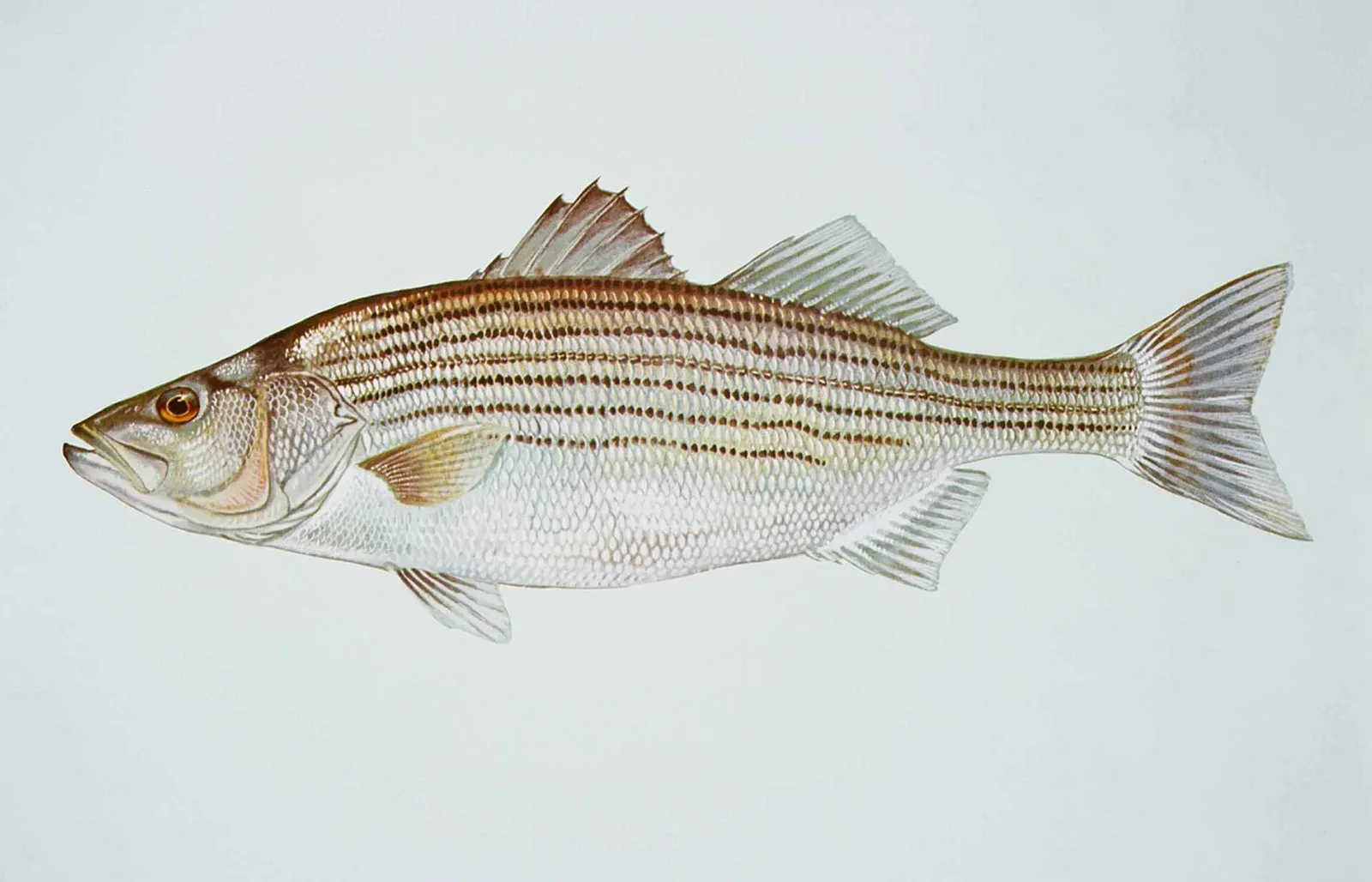
Striped bass have stout bodies with seven to eight unbroken horizontal stripes on each side, running from the gills to the tail.[1]
- 27waters list it
- 11states and regions
- 4agency sources
Identification
- Striped bass have stout bodies with seven to eight unbroken horizontal stripes on each side, running from the gills to the tail.[1]
What the source says
“Striped bass have stout bodies with seven to eight continuous horizontal stripes on each side, from their gills to their tail.”
- The back is light green, olive, steel blue, black or brown, over a white or silvery iridescent belly.[1]
What the source says
“They are light green, olive, steel blue, black, or brown on top, with a white or silver iridescent underside.”
Habitat and range
- Native along the East Coast from Canada's St. Lawrence River to Florida's St. Johns River, and in the Gulf from Florida to Louisiana.[1]
What the source says
“Striped bass live along the East Coast from the St. Lawrence River in Canada to St. John’s River in Florida, and in the Gulf of America (formerly Gulf of Mexico) from Florida to Louisiana.”
- Striped bass are anadromous: they live in the ocean but return to fresh water to spawn.[1]
What the source says
“Striped bass are anadromous (they live in the ocean but return to freshwater to spawn).”
Life history
- Mature females (age six and older) release large numbers of eggs in river spawning areas, where mature males (age two and older) fertilize them.[2]
What the source says
“Mature females (age six and older) produce large quantities of eggs, which are fertilized by mature males (age two and older) as they are released into riverine spawning areas.”
- Adults eat fish, along with some invertebrates, especially crabs and squid.[1]
What the source says
“Adults are piscivorous (fish-eating) and eat almost any kind of small fish as well as several invertebrates, particularly crabs and squid.”
Status, protections and rules
Legal status and rules as the agency stated them on the date read. Rules change: check the current regulations for the water.
- NOAA Fisheries: the Atlantic stock is overfished but not subject to overfishing, based on the 2024 stock assessment.[1]
What the source says
“The Atlantic striped bass stock is overfished, but not subject to overfishing (supported by 2024 stock assessment).”
- ASMFC rule (Addendum II to Amendment 7): the ocean recreational fishery has a 28- to 31-inch slot and a 1-fish bag limit, keeping the 2022 season dates.[2]
What the source says
“For the ocean recreational fishery, the Addendum implements a 28” to 31” slot limit, 1-fish bag limit, and maintains 2022 season dates for all fishery participants”
- ASMFC rule (Addendum II to Amendment 7): the Chesapeake Bay recreational fishery has a 19- to 24-inch slot and a 1-fish bag limit.[2]
What the source says
“For the Chesapeake Bay recreational fishery, the Addendum implements a 19” to 24” slot limit, 1-fish bag limit, and maintains 2022 season dates for all fishery participants.”
- Federal waters (3 to 200 miles offshore) are closed to all commercial and recreational fishing for Atlantic striped bass.[1]
What the source says
“Federal waters (between 3 and 200 miles offshore) remain closed to all commercial and recreational fishing for Atlantic striped bass.”
- Maryland (DNR rule): anglers using bait to target striped bass must use non-offset circle hooks.[3]
What the source says
“Maryland regulations require that anglers use non-offset circle hooks when using bait to target striped bass.”
Fishing for it: what the agencies say
What agencies and extension services say about catching it, with the source for each line.
- Maryland DNR advises against catching and releasing medium and large striped bass in brackish Bay water above 80 degrees or when the air is above 95 degrees.[4]
What the source says
“Avoid catch and release of medium and large striped bass in brackish Bay water warmer than 80 degrees and in air temperatures warmer than 95 degrees.”
- Maryland DNR says the best option is not to take striped bass out of the water at all.[3]
What the source says
“However, the best option is to not remove striped bass from the water at all.”
- Saltwater rules (slots, seasons, tags, handling) are set by the state or country and change often: read the current rules before each trip.
- A local guide will know the tides and where the fish are feeding this week.
Where to fish for striped bass
Our 27 water pages whose agency species list names striped bass (each list links to the agency page it comes from). A species missing from a list does not mean it is absent: many agencies publish no list for a water.
United States 27 waters
Alabama 7
Striped bass in AlabamaAll Alabama waters
- Sipsey ForkAgency list: Alabama Department of Conservation and Natural Resources, Wildlife and Freshwater Fisheries Division
- Alabama RiverAgency list: Alabama Department of Conservation and Natural Resources, Wildlife and Freshwater Fisheries Division
- Coosa RiverAgency list: Alabama Department of Conservation and Natural Resources, Wildlife and Freshwater Fisheries Division
- Pea RiverAgency list: Alabama Department of Conservation and Natural Resources, Wildlife and Freshwater Fisheries Division
- Tallapoosa RiverAgency list: Alabama Department of Conservation and Natural Resources, Wildlife and Freshwater Fisheries Division
- Terrapin CreekAgency list: Alabama Department of Conservation and Natural Resources, Wildlife and Freshwater Fisheries Division
- Tennessee RiverAgency list: Alabama Department of Conservation and Natural Resources, Wildlife and Freshwater Fisheries Division
North Carolina 4
- Pamlico SoundAgency list: U.S. Fish and Wildlife Service
- Oregon InletAgency list: U.S. Fish and Wildlife Service
- Alligator RiverAgency list: U.S. Fish and Wildlife Service
- Pea IslandAgency list: U.S. Fish and Wildlife Service
Rhode Island 4
Massachusetts 3
Arizona 1
California 1
Kentucky 1
Maine 1
Utah 1
Destination hubs
Hubs that list one of these waters, or that a water page is near: each has guides, shops, licences and trip planning for the area.
- Cape Cod, Massachusetts3 striped bass waters
- Manteo & the Outer Banks, North Carolina3 striped bass waters
- Charleston & the Lowcountry, South Carolina1 striped bass water
- Redding & the Lower Sacramento, California1 striped bass water
- The Forks & the upper Kennebec, Maine1 striped bass water
Sources
Every fact on this page is our paraphrase of the page cited beside it, read on the date shown. Rules and seasons change: check the agency's current regulations before you fish.
- Atlantic Striped Bass | NOAA Fisheries NOAA Fisheries, read Oct 24, 2026.
- Atlantic Striped Bass - Atlantic States Marine Fisheries Commission Atlantic States Marine Fisheries Commission, read Oct 24, 2026.
- Safe Catch-and-Release and Avoiding High Temperatures Helps Protect Striped Bass, Research Shows (March 9, 2026) Maryland Department of Natural Resources, read Oct 24, 2026.
- Catch and Release Maryland Department of Natural Resources, read Oct 24, 2026.
1 state or region has a page of striped bass waters of its own (five or more waters).