Legendary Species · Bass, carp, pike and panfish
Common carp
Cyprinus carpio[1] · also Carp
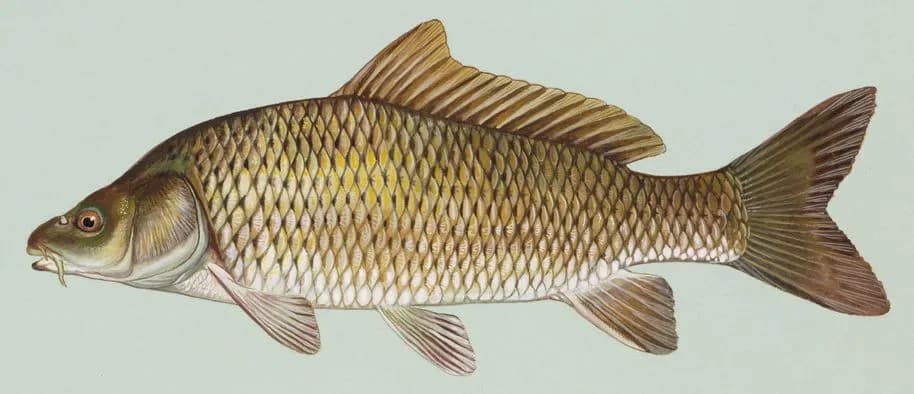
Common carp have a long dorsal fin, a saw-toothed spine at the front of the dorsal and anal fins, and two barbels on each side of the upper jaw.[1]
- 15waters list it
- 4states and regions
- 3agency sources
Identification
- Common carp have a long dorsal fin, a saw-toothed spine at the front of the dorsal and anal fins, and two barbels on each side of the upper jaw.[1]
What the source says
“The common carp is a heavy-bodied fish with a long dorsal fin containing 17–21 rays, a stout, saw-toothed spine at the front of both dorsal and anal fins, and two barbels on each side of upper jaw.”
- The body is brassy olive with dark-edged scales that make a crosshatched look; the tail fin is often tinged red.[1]
What the source says
“The back and sides are brassy olive, and the belly is yellowish white. The scales of the back and sides are prominently dark-edged, creating a crosshatched effect. The fins are dusky, often overlain by red on the tail fin and by yellow or orange on the lower fins.”
Habitat and range
- Carp are native to Eurasia.[2]
What the source says
“Native Range: Eurasia (Page and Burr 1991; Balon 1995).”
- Carp prefer large streams, natural lakes and impoundments, especially productive water, and are least common in clear, steep Ozark streams.[1]
What the source says
“It is highly adaptable to different habitats but is least abundant in clear, high-gradient streams of the central Ozarks. Large streams, natural lakes, and impoundments are preferred, especially in highly productive waters. In streams, adults prefer deeper pools.”
Life history
- Most spawning is March to June; eggs are scattered over logs, rocks and other submerged objects with no nest or parental care.[1]
What the source says
“Most spawning occurs from March to June but can continue through early fall. No nest is prepared, and no parental care is given. Eggs are broadcast over logs, rocks, and other submerged objects.”
- Carp eat both animal and plant material, mostly aquatic insects, feeding most in late evening or early morning and sometimes in very shallow water.[1]
What the source says
“These omnivores eat a variety of animal and plant material, with aquatic insects forming the most important food source. Feeding peaks in late evening or early morning, sometimes in very shallow water.”
Status, protections and rules
Legal status and rules as the agency stated them on the date read. Rules change: check the current regulations for the water.
- Missouri lists the common carp as nonnative and one of the state's most widespread large fishes.[1]
What the source says
“One of the most widespread and abundant large fishes in the state. Nonnative.”
- USGS records the carp in every US state except Alaska.[2]
What the source says
“Status: Recorded in all states except Alaska.”
- USGS notes that carp feeding stirs up sediment and uproots plants, which can disturb native fish spawning and nursery areas.[2]
What the source says
“Silt resuspension and uprooting of aquatic plants caused by feeding activities can disturb spawning and nursery areas of native fishes (Ross 2001) as well as disrupt feeding of sight-oriented predators, such as bass and sunfish (Panek 1987).”
Fishing for it: what the agencies say
What agencies and extension services say about catching it, with the source for each line.
- An Illinois DNR journal article says sight fishing for carp with a fly rod takes stealth and accurate, delicate casts, and compares it to bonefish.[3]
What the source says
“Like saltwater’s bonefish, red fish and permit, catching a carp requires stealth, persistence and good casting skills for accurate and delicate presentations of the fly.”
- The same article suggests hook sizes #16 to #6 and patterns such as Woolly Buggers, Clouser Minnows, small crayfish and yarn eggs.[3]
What the source says
“For common carp, use hook sizes ranging from #16 to #6. Patterns you may already have would include Wooly Buggers, Clouser Minnows, small crayfish, yarn eggs, soft hackle wet flies and dries for top water fishing.”
- In most of Illinois the article puts the best time to fly fish for carp at March through November, or water of about 50-75 F.[3]
What the source says
“Beyond “when you can” mantra, the ideal time to flyfish for carp in most of Illinois would be from March through November, or when the water temperatures are between about 50 to 75 degrees Fahrenheit.”
- Ask a local shop which flies are working on that lake or river this month.
- Check the state's size, possession and transport rules before you keep or move a fish.
Where to fish for common carp
Our 15 water pages whose agency species list names common carp (each list links to the agency page it comes from). A species missing from a list does not mean it is absent: many agencies publish no list for a water.
United States 13 waters
Montana 8
Common carp in MontanaAll Montana waters
- Madison RiverAgency list: Montana Fish, Wildlife & Parks
- Yellowstone RiverAgency list: Montana Fish, Wildlife & Parks
- Beaverhead RiverAgency list: Montana Fish, Wildlife & Parks
- Jefferson RiverAgency list: Montana Fish, Wildlife & Parks
- Big Hole RiverAgency list: Montana Fish, Wildlife & Parks
- Smith RiverAgency list: Montana Fish, Wildlife & Parks
- Ruby RiverAgency list: Montana Fish, Wildlife & Parks
- Bighorn Lakelisted as “Carp”Agency list: National Park Service (Bighorn Canyon National Recreation Area)
Utah 4
North Carolina 1
- French Broad Riverlisted as “carp”Agency list: USDA Forest Service (Cherokee National Forest)
Slovenia 2 waters
Jugovzhodna Slovenija 2
All Jugovzhodna Slovenija waters
- Krkalisted as “Carp”Agency list: Ribiška družina Novo mesto (via ribiskekarte.si, the clubs' official permit shop)
- Kolpalisted as “Carp”Agency list: Ribiška družina Metlika (via ribiskekarte.si, the clubs' official permit shop)
Destination hubs
Hubs that list one of these waters, or that a water page is near: each has guides, shops, licences and trip planning for the area.
- Ennis & the Madison Valley, Montana5 common carp waters
- Bozeman & Livingston, Montana3 common carp waters
- Asheville & Western North Carolina, North Carolina1 common carp water
- Island Park & the Henry's Fork, Idaho1 common carp water
Sources
Every fact on this page is our paraphrase of the page cited beside it, read on the date shown. Rules and seasons change: check the agency's current regulations before you fish.
- Common Carp | Missouri Department of Conservation Missouri Department of Conservation, read Oct 24, 2026.
- Common Carp (Cyprinus carpio) - Species Profile U.S. Geological Survey, Nonindigenous Aquatic Species Program, read Oct 24, 2026.
- Outdoor Illinois Journal: Illinois’ Prairie Bonefish – Carp on the Fly Illinois Department of Natural Resources (Outdoor Illinois Journal), read Oct 24, 2026.
1 state or region has a page of common carp waters of its own (five or more waters).