
Legendary Species · Montana
Common carp in Montana
Cyprinus carpio[1]
8 Montana waters whose agency species list names common carp. Each links to its water page (gauge, regulations, access map, guides and shops) and to the agency list it comes from.
- 8waters list it
- 3destination hubs
Montana waters
Most fished first. A species missing from an agency list does not mean it is absent; this page lists only waters whose list names it (at least 5 are needed for a page).
- Madison RiverAgency list: Montana Fish, Wildlife & Parks
- Yellowstone RiverAgency list: Montana Fish, Wildlife & Parks
- Beaverhead RiverAgency list: Montana Fish, Wildlife & Parks
- Jefferson RiverAgency list: Montana Fish, Wildlife & Parks
- Big Hole RiverAgency list: Montana Fish, Wildlife & Parks
- Smith RiverAgency list: Montana Fish, Wildlife & Parks
- Ruby RiverAgency list: Montana Fish, Wildlife & Parks
- Bighorn Lakelisted as “Carp”Agency list: National Park Service (Bighorn Canyon National Recreation Area)
Identification
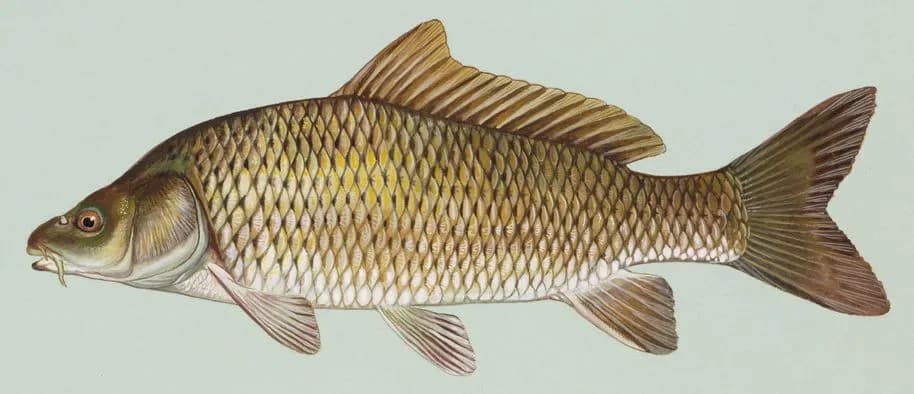
- Common carp have a long dorsal fin, a saw-toothed spine at the front of the dorsal and anal fins, and two barbels on each side of the upper jaw.[1]
What the source says
“The common carp is a heavy-bodied fish with a long dorsal fin containing 17–21 rays, a stout, saw-toothed spine at the front of both dorsal and anal fins, and two barbels on each side of upper jaw.”
- The body is brassy olive with dark-edged scales that make a crosshatched look; the tail fin is often tinged red.[1]
What the source says
“The back and sides are brassy olive, and the belly is yellowish white. The scales of the back and sides are prominently dark-edged, creating a crosshatched effect. The fins are dusky, often overlain by red on the tail fin and by yellow or orange on the lower fins.”
Status, protections and rules
As each agency stated them on the date read; a rule applies only where its agency says so. Check the current regulations for the water before you fish.
- Missouri lists the common carp as nonnative and one of the state's most widespread large fishes.[1]
What the source says
“One of the most widespread and abundant large fishes in the state. Nonnative.”
- USGS records the carp in every US state except Alaska.[2]
What the source says
“Status: Recorded in all states except Alaska.”
- USGS notes that carp feeding stirs up sediment and uproots plants, which can disturb native fish spawning and nursery areas.[2]
What the source says
“Silt resuspension and uprooting of aquatic plants caused by feeding activities can disturb spawning and nursery areas of native fishes (Ross 2001) as well as disrupt feeding of sight-oriented predators, such as bass and sunfish (Panek 1987).”
Destination hubs
Hubs that list one of these waters, or that a water page is near: each has guides, shops, licences and trip planning for the area.
- Ennis & the Madison Valley, Montana5 common carp waters
- Bozeman & Livingston, Montana3 common carp waters
- Island Park & the Henry's Fork, Idaho1 common carp water
Sources
Every fact on this page is our paraphrase of the page cited beside it, read on the date shown. Rules and seasons change: check the agency's current regulations before you fish.
- Common Carp | Missouri Department of Conservation Missouri Department of Conservation, read Oct 24, 2026.
- Common Carp (Cyprinus carpio) - Species Profile U.S. Geological Survey, Nonindigenous Aquatic Species Program, read Oct 24, 2026.