Legendary Species · Salmon, steelhead and sea trout
Atlantic salmon
Salmo salar[1] · also Landlocked salmon (Maine)
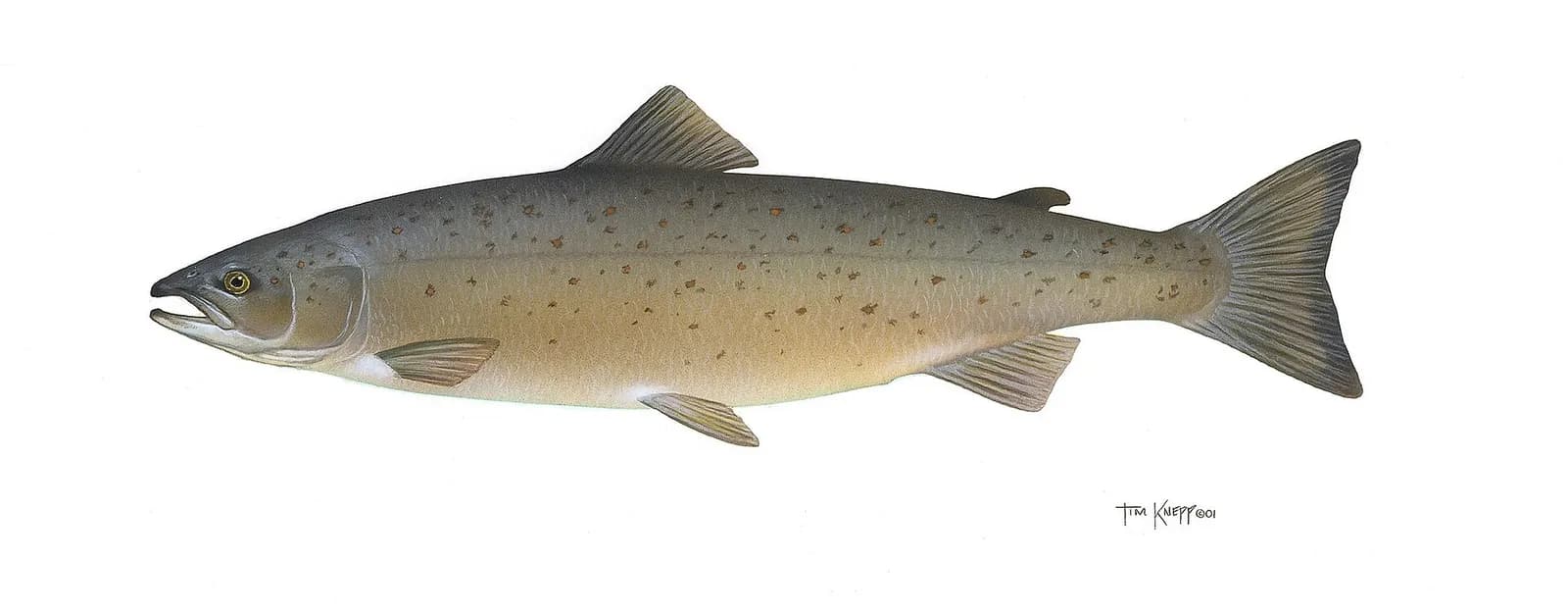
Michigan describes adult Atlantic salmon as having black spots on the sides, mostly above the lateral line, dark pectoral fins and a tail that may be slightly forked.[2]
- 251waters list it
- 34states and regions
- 4agency sources
Identification
- Michigan describes adult Atlantic salmon as having black spots on the sides, mostly above the lateral line, dark pectoral fins and a tail that may be slightly forked.[2]
What the source says
“Adults have black spots on sides, mostly above lateral line. Dark pectoral fins, caudal fin may be slightly forked, nine or 10 rays in anal fin.”
- Adults are very bright silver when they come back to fresh water, darken to bronze before spawning in the fall, and after spawning can darken further into "black salmon."[1]
What the source says
“When adults return to freshwater to spawn, they are very bright silver. After entering the river, they will again darken to a bronze color before spawning in the fall. After spawning, adults can darken further and are often referred to as black salmon.”
- Landlocked salmon (Maine) are generally silvery with a slightly forked tail and small X-shaped marks on the back and upper sides.[3]
What the source says
“Adults are generally silvery with a slightly forked tail and small X-shaped markings on the back and upper sides.”
Habitat and range
- River-specific Atlantic salmon populations still persist in Maine's Sheepscot, Penobscot (with the Ducktrap), Narraguagus, Pleasant, Machias, East Machias and Dennys.[1]
What the source says
“River-specific populations in Maine still persist in the Sheepscot, Penobscot (including the Ducktrap), Narraguagus, Pleasant, Machias, East Machias, and Dennys rivers.”
- Maine says landlocked salmon prefer water below 65 degrees and depend on smelt.[3]
What the source says
“A coldwater fish, landlocked salmon prefer water temperatures below 65 degrees and rely on smelt to thrive.”
Life history
- A typical Atlantic salmon returning to US waters is 4 years old, having spent 2 years in fresh water and 2 at sea.[1]
What the source says
“Typically, an Atlantic salmon returning to U.S. waters will be 4 years old, having spent 2 years in freshwater and 2 years at sea.”
- After 1 to 3 years at sea, adults return to their home rivers between May and October and spawn in October-November.[1]
What the source says
“After 1 to 3 years at sea, adult Atlantic salmon return to the streams and rivers between May and October where they were born to spawn in October-November).”
Status, protections and rules
Legal status and rules as the agency stated them on the date read. Rules change: check the current regulations for the water.
- The remaining US wild populations make up the Gulf of Maine DPS, listed as endangered under the ESA.[1]
What the source says
“Currently, the only remaining wild populations of U.S. Atlantic salmon are found in rivers in central and eastern Maine. These remaining populations comprise the Gulf of Maine distinct population segment (DPS), which is listed as endangered under the Endangered Species Act.”
- Maine IF&W: it is illegal to fish for or possess wild sea-run Atlantic salmon, and landlocked salmon in rivers and streams have a 25-inch maximum length limit to protect returning sea-run adults.[3]
What the source says
“Gulf of Maine Atlantic Salmon are a federally endangered species. It is illegal to fish for or possess wild sea-run Atlantic salmon. The General Fishing Laws for landlocked salmon in rivers and streams include a 25” maximum length limit to protect returning sea-run adults from accidental harvest (average size of sea-run adults is >25”).”
Fishing for it: what the agencies say
What agencies and extension services say about catching it, with the source for each line.
- Maine landlocked salmon: in spring and fall they feed near the surface close to shore and can be caught by fly fishing, casting or trolling; streamer flies and smelt-like lures work well.[3]
What the source says
“During the spring and fall, you are likely to find them feeding near the surface and close to shore, and can catch them by fly fishing, casting, or trolling with lures or bait. Streamer flies and lures resembling smelt are very effective.”
- In Michigan's Great Lakes fishery (Lake Huron, St. Marys River, St. Clair River), anglers mostly troll with downriggers; some drift below the rapids casting streamers or soft-plastic jerk baits.[2]
What the source says
“Atlantic salmon can be caught in Lake Huron, the St. Marys River and even the St. Clair River by Port Huron. Fall returns of spawning fish occur at each location, primarily in Oct.-Dec. Anglers troll for them using downriggers, though some anglers drift in current below the rapids, casting with streamers or soft-plastic jerk baits.”
- Check the agency's run timing, emergency orders and in-season changes before you travel: openings are set by water, section and date.
- Confirm which fish you may keep and how to tell wild from hatchery fish on that water.
- A local guide or shop will know where the fish are in the run this week.
Water temperature
Warm water stresses trout, char and salmon. These are the published temperature lines we show on every gauge, chosen state first: the state agency's own where it publishes one, otherwise federal guidance (said so). Each water page applies them to the gauge's live reading; the flow and temperature checker does the same for any gauge.
| State | Whose lines | Sources |
|---|---|---|
| Maine | Maine IF&W (the state's own) | Maine Department of Inland Fisheries and Wildlife |
| Connecticut | Federal guidance (the National Park Service); no Connecticut line found | National Park Service · U.S. Fish and Wildlife Service · Connecticut Department of Energy and Environmental Protection |
| Michigan | Federal guidance (the National Park Service); no Michigan line found | National Park Service · U.S. Fish and Wildlife Service |
| New York | New York DEC (the state's own) | New York State Department of Environmental Conservation |
Where to fish for atlantic salmon
Our 251 water pages whose agency species list names atlantic salmon (each list links to the agency page it comes from). A species missing from a list does not mean it is absent: many agencies publish no list for a water.
United States 10 waters
Maine 7
Atlantic salmon in MaineAll Maine waters
- Kennebec Riverlisted as “landlocked salmon”Agency list: Maine Department of Inland Fisheries and Wildlife
- Magalloway Riverlisted as “landlocked salmon”Agency list: Maine Department of Inland Fisheries and Wildlife
- Rapid Riverlisted as “landlocked salmon”Agency list: Maine Department of Inland Fisheries and Wildlife
- West Branch Penobscot Riverlisted as “landlocked salmon”Agency list: Maine Department of Inland Fisheries and Wildlife
- Kennebago Riverlisted as “landlocked salmon”Agency list: Maine Department of Inland Fisheries and Wildlife
- Rangeley Lakelisted as “landlocked salmon”Agency list: Maine Department of Inland Fisheries and Wildlife
- Mooselookmeguntic Lakelisted as “landlocked salmon”Agency list: Maine Department of Inland Fisheries and Wildlife
Michigan 1
New York 1
United Kingdom 76 waters
Scotland 29
Atlantic salmon in ScotlandAll Scotland waters
- River TayAgency list: Scottish Government Marine Directorate
- River TweedAgency list: Scottish Government Marine Directorate
- River NessAgency list: Scottish Government Marine Directorate
- River SpeyAgency list: Scottish Government Marine Directorate
- River ThursoAgency list: Scottish Government Marine Directorate
- River DeveronAgency list: Scottish Government Marine Directorate
- River DonAgency list: Scottish Government Marine Directorate
- River ClydeAgency list: Scottish Government Marine Directorate
- River FindhornAgency list: Scottish Government Marine Directorate
- Border EskAgency list: Environment Agency
- Halladale RiverAgency list: Scottish Government Marine Directorate
- River AnnanAgency list: Scottish Government Marine Directorate
- River AweAgency list: Scottish Government Marine Directorate
- River BeaulyAgency list: Scottish Government Marine Directorate
- River BladnochAgency list: Scottish Government Marine Directorate
- River BroraAgency list: Scottish Government Marine Directorate
- River CononAgency list: Scottish Government Marine Directorate
- River CreeAgency list: Scottish Government Marine Directorate
- River Dee (Aberdeenshire)Agency list: Scottish Government Marine Directorate
- River DoonAgency list: Scottish Government Marine Directorate
- River EweAgency list: Scottish Government Marine Directorate
- River ForthAgency list: Scottish Government Marine Directorate
- River HelmsdaleAgency list: Scottish Government Marine Directorate
- River LaxfordAgency list: Scottish Government Marine Directorate
- River LochyAgency list: Scottish Government Marine Directorate
- River NairnAgency list: Scottish Government Marine Directorate
- River NithAgency list: Scottish Government Marine Directorate
- River North EskAgency list: Scottish Government Marine Directorate
- River South EskAgency list: Scottish Government Marine Directorate
England 26
Atlantic salmon in EnglandAll England waters
- River ItchenAgency list: Environment Agency
- River TestAgency list: Environment Agency
- River Avon (Hampshire)Agency list: Environment Agency
- River Frome (Dorset)Agency list: Environment Agency
- River SevernAgency list: Environment Agency
- River ExeAgency list: Environment Agency
- River TyneAgency list: Environment Agency
- River EdenAgency list: Environment Agency
- River AxeAgency list: Environment Agency
- River CamelAgency list: Environment Agency
- River CoquetAgency list: Environment Agency
- River DartAgency list: Environment Agency
- River Derwent (Cumbria)Agency list: Environment Agency
- River Esk (Cumbria)Agency list: Environment Agency
- River Esk (Yorkshire)Agency list: Environment Agency
- River FoweyAgency list: Environment Agency
- River KentAgency list: Environment Agency
- River Leven (Cumbria)Agency list: Environment Agency
- River LuneAgency list: Environment Agency
- River RibbleAgency list: Environment Agency
- River TamarAgency list: Environment Agency
- River TawAgency list: Environment Agency
- River TeesAgency list: Environment Agency
- River TeignAgency list: Environment Agency
- River TorridgeAgency list: Environment Agency
- River WearAgency list: Environment Agency
Wales 21
Atlantic salmon in WalesAll Wales waters
- River TaffAgency list: Environment Agency
- River TeifiAgency list: Environment Agency
- River WyeAgency list: Environment Agency
- River DeeAgency list: Environment Agency
- River UskAgency list: Environment Agency
- River ClwydAgency list: Environment Agency
- River ConwyAgency list: Environment Agency
- River DwyforAgency list: Environment Agency
- River DyfiAgency list: Environment Agency
- River GlaslynAgency list: Environment Agency
- River MawddachAgency list: Environment Agency
- River OgwenAgency list: Environment Agency
- River RheidolAgency list: Environment Agency
- River SeiontAgency list: Environment Agency
- River CleddauAgency list: Environment Agency
- River OgmoreAgency list: Environment Agency
- River TafAgency list: Environment Agency
- River TaweAgency list: Environment Agency
- River TywiAgency list: Environment Agency
- River YstwythAgency list: Environment Agency
- River NevernAgency list: Environment Agency
Norway 51 waters
Finnmark 11
Atlantic salmon in FinnmarkAll Finnmark waters
- TanaelvaAgency list: Statistisk sentralbyrå (SSB)
- AltaelvaAgency list: Statistisk sentralbyrå (SSB)
- KomagelvaAgency list: Statistisk sentralbyrå (SSB)
- KongsfjordelvaAgency list: Statistisk sentralbyrå (SSB)
- LakselvaAgency list: Statistisk sentralbyrå (SSB)
- LangfjordelvaAgency list: Statistisk sentralbyrå (SSB)
- NeidenelvaAgency list: Statistisk sentralbyrå (SSB)
- RepparfjordelvaAgency list: Statistisk sentralbyrå (SSB)
- StabburselvaAgency list: Statistisk sentralbyrå (SSB)
- SyltefjordelvaAgency list: Statistisk sentralbyrå (SSB)
- Vestre JakobselvAgency list: Statistisk sentralbyrå (SSB)
Trøndelag 8
Atlantic salmon in TrøndelagAll Trøndelag waters
- ÅrgårdsvassdragetAgency list: Statistisk sentralbyrå (SSB)
- GaulaAgency list: Statistisk sentralbyrå (SSB)
- NamsenAgency list: Statistisk sentralbyrå (SSB)
- NidelvaAgency list: Statistisk sentralbyrå (SSB)
- OrklaAgency list: Statistisk sentralbyrå (SSB)
- SteinsdalselvaAgency list: Statistisk sentralbyrå (SSB)
- StjørdalselvaAgency list: Statistisk sentralbyrå (SSB)
- VerdalselvaAgency list: Statistisk sentralbyrå (SSB)
Rogaland 7
Atlantic salmon in RogalandAll Rogaland waters
- ÅrdalselvaAgency list: Statistisk sentralbyrå (SSB)
- BjerkreimselvaAgency list: Statistisk sentralbyrå (SSB)
- FiggjoAgency list: Statistisk sentralbyrå (SSB)
- HåelvaAgency list: Statistisk sentralbyrå (SSB)
- OgnaAgency list: Statistisk sentralbyrå (SSB)
- SokndalselvaAgency list: Statistisk sentralbyrå (SSB)
- SuldalslågenAgency list: Statistisk sentralbyrå (SSB)
Vestland 7
Atlantic salmon in VestlandAll Vestland waters
- AurlandselvaAgency list: Statistisk sentralbyrå (SSB)
- EtneelvaAgency list: Statistisk sentralbyrå (SSB)
- GaulaAgency list: Statistisk sentralbyrå (SSB)
- GloppenelvaAgency list: Statistisk sentralbyrå (SSB)
- LærdalselviAgency list: Statistisk sentralbyrå (SSB)
- NaustaAgency list: Statistisk sentralbyrå (SSB)
- StryneelvaAgency list: Statistisk sentralbyrå (SSB)
Agder 5
Atlantic salmon in AgderAll Agder waters
- AudnaAgency list: Statistisk sentralbyrå (SSB)
- MandalselvaAgency list: Statistisk sentralbyrå (SSB)
- NidelvaAgency list: Statistisk sentralbyrå (SSB)
- OtraAgency list: Statistisk sentralbyrå (SSB)
- TovdalselvaAgency list: Statistisk sentralbyrå (SSB)
Nordland 4
- BeiarelvaAgency list: Statistisk sentralbyrå (SSB)
- RoksdalsvassdragetAgency list: Statistisk sentralbyrå (SSB)
- SaltdalselvaAgency list: Statistisk sentralbyrå (SSB)
- VefsnaAgency list: Statistisk sentralbyrå (SSB)
Møre og Romsdal 3
- BævraAgency list: Statistisk sentralbyrå (SSB)
- EiraAgency list: Statistisk sentralbyrå (SSB)
- SurnaAgency list: Statistisk sentralbyrå (SSB)
Troms 2
- MålselvaAgency list: Statistisk sentralbyrå (SSB)
- ReisaelvaAgency list: Statistisk sentralbyrå (SSB)
Buskerud 1
Østfold 1
- GlommaAgency list: Statistisk sentralbyrå (SSB)
Telemark 1
Vestfold 1
Canada 50 waters
Newfoundland and Labrador 15
Atlantic salmon in Newfoundland and LabradorAll Newfoundland and Labrador waters
- Gander RiverAgency list: Fisheries and Oceans Canada
- Eagle RiverAgency list: Fisheries and Oceans Canada
- Exploits RiverAgency list: Fisheries and Oceans Canada
- Humber RiverAgency list: Fisheries and Oceans Canada
- Conne RiverAgency list: Fisheries and Oceans Canada
- Great Codroy RiverAgency list: Fisheries and Oceans Canada
- Grey RiverAgency list: Fisheries and Oceans Canada
- Harry's RiverAgency list: Fisheries and Oceans Canada
- Pinware RiverAgency list: Fisheries and Oceans Canada
- Portland CreekAgency list: Fisheries and Oceans Canada
- River of PondsAgency list: Fisheries and Oceans Canada
- Salmonier RiverAgency list: Fisheries and Oceans Canada
- Sand Hill RiverAgency list: Fisheries and Oceans Canada
- Terra Nova RiverAgency list: Fisheries and Oceans Canada
- Torrent RiverAgency list: Fisheries and Oceans Canada
Quebec 15
Atlantic salmon in QuebecAll Quebec waters
- Rivière CascapédiaAgency list: Government of Canada (Justice Laws) / Gouvernement du Québec
- Rivière PatapédiaAgency list: Government of Canada (Justice Laws) / Gouvernement du Québec
- Rivière BonaventureAgency list: Government of Canada (Justice Laws) / Gouvernement du Québec
- Rivière CausapscalAgency list: Government of Canada (Justice Laws) / Gouvernement du Québec
- Rivière DartmouthAgency list: Government of Canada (Justice Laws) / Gouvernement du Québec
- Rivière GodboutAgency list: Government of Canada (Justice Laws) / Gouvernement du Québec
- Rivière Jacques-CartierAgency list: Government of Canada (Justice Laws) / Gouvernement du Québec
- Rivière MataneAgency list: Government of Canada (Justice Laws) / Gouvernement du Québec
- Rivière MatapédiaAgency list: Government of Canada (Justice Laws) / Gouvernement du Québec
- Rivière MitisAgency list: Government of Canada (Justice Laws) / Gouvernement du Québec
- Rivière MoisieAgency list: Government of Canada (Justice Laws) / Gouvernement du Québec
- Rivière NatashquanAgency list: Government of Canada (Justice Laws) / Gouvernement du Québec
- Rivière Saint-JeanAgency list: Government of Canada (Justice Laws) / Gouvernement du Québec
- Rivière Sainte-MargueriteAgency list: Government of Canada (Justice Laws) / Gouvernement du Québec
- Rivière YorkAgency list: Government of Canada (Justice Laws) / Gouvernement du Québec
New Brunswick 11
Atlantic salmon in New BrunswickAll New Brunswick waters
- Main Southwest Miramichi RiverAgency list: Government of New Brunswick
- Restigouche RiverAgency list: Government of New Brunswick
- Kedgwick RiverAgency list: Government of New Brunswick
- Nepisiguit RiverAgency list: Government of New Brunswick
- Cains RiverAgency list: Government of New Brunswick
- Dungarvon RiverAgency list: Government of New Brunswick
- Little Southwest Miramichi RiverAgency list: Government of New Brunswick
- Northwest Miramichi RiverAgency list: Government of New Brunswick
- Renous RiverAgency list: Government of New Brunswick
- Sevogle RiverAgency list: Government of New Brunswick
- Upsalquitch RiverAgency list: Government of New Brunswick
Nova Scotia 8
Atlantic salmon in Nova ScotiaAll Nova Scotia waters
- Margaree RiverAgency list: Government of Nova Scotia / Fisheries and Oceans Canada (Maritimes Region)
- Baddeck RiverAgency list: Government of Nova Scotia / Fisheries and Oceans Canada (Maritimes Region)
- Middle RiverAgency list: Government of Nova Scotia / Fisheries and Oceans Canada (Maritimes Region)
- North RiverAgency list: Government of Nova Scotia / Fisheries and Oceans Canada (Maritimes Region)
- River PhilipAgency list: Government of Nova Scotia / Fisheries and Oceans Canada (Maritimes Region)
- South River (Antigonish County)Agency list: Government of Nova Scotia / Fisheries and Oceans Canada (Maritimes Region)
- Wallace RiverAgency list: Government of Nova Scotia / Fisheries and Oceans Canada (Maritimes Region)
- West River (Pictou County)Agency list: Government of Nova Scotia / Fisheries and Oceans Canada (Maritimes Region)
Ontario 1
Iceland 46 waters
Western Region 13
Atlantic salmon in Western RegionAll Western Region waters
- Laxá í DölumAgency list: Hafrannsóknastofnun (Marine and Freshwater Research Institute)
- NorðuráAgency list: Hafrannsóknastofnun (Marine and Freshwater Research Institute)
- Þverá og KjarráAgency list: Hafrannsóknastofnun (Marine and Freshwater Research Institute)
- GrímsáAgency list: Hafrannsóknastofnun (Marine and Freshwater Research Institute)
- AndakílsáAgency list: Landssamband veiðifélaga
- FlókadalsáAgency list: Landssamband veiðifélaga
- GljúfuráAgency list: Landssamband veiðifélaga
- HaffjarðaráAgency list: Landssamband veiðifélaga
- HaukadalsáAgency list: Landssamband veiðifélaga
- HítaráAgency list: Landssamband veiðifélaga
- LangáAgency list: Hafrannsóknastofnun (Marine and Freshwater Research Institute)
- Laxá í LeirársveitAgency list: Landssamband veiðifélaga
- StraumfjarðaráAgency list: Landssamband veiðifélaga
Southern Region 10
Atlantic salmon in Southern RegionAll Southern Region waters
- SogAgency list: Hafrannsóknastofnun (Marine and Freshwater Research Institute)
- Stóra-LaxáAgency list: Hafrannsóknastofnun (Marine and Freshwater Research Institute)
- AffallAgency list: Hafrannsóknastofnun (Marine and Freshwater Research Institute)
- Þverá í FljótshlíðAgency list: Hafrannsóknastofnun (Marine and Freshwater Research Institute)
- Eystri-RangáAgency list: Hafrannsóknastofnun (Marine and Freshwater Research Institute)
- GeirlandsáAgency list: Hafrannsóknastofnun (Marine and Freshwater Research Institute)
- HólsáAgency list: Landssamband veiðifélaga
- TungufljótAgency list: Landssamband veiðifélaga
- Urriðafoss í ÞjórsáAgency list: Landssamband veiðifélaga
- Ytri-RangáAgency list: Hafrannsóknastofnun (Marine and Freshwater Research Institute)
Northeastern Region 8
Atlantic salmon in Northeastern RegionAll Northeastern Region waters
- Laxá í AðaldalAgency list: Hafrannsóknastofnun (Marine and Freshwater Research Institute)
- OrmarsáAgency list: Hafrannsóknastofnun (Marine and Freshwater Research Institute)
- SkjálfandafljótAgency list: Hafrannsóknastofnun (Marine and Freshwater Research Institute)
- SvalbarðsáAgency list: Hafrannsóknastofnun (Marine and Freshwater Research Institute)
- FnjóskáAgency list: Landssamband veiðifélaga
- HafralónsáAgency list: Landssamband veiðifélaga
- MýrarkvíslAgency list: Landssamband veiðifélaga
- Sandá í ÞistilfirðiAgency list: Landssamband veiðifélaga
Northwestern Region 6
Atlantic salmon in Northwestern RegionAll Northwestern Region waters
- Laxá á ÁsumAgency list: Hafrannsóknastofnun (Marine and Freshwater Research Institute)
- MiðfjarðaráAgency list: Hafrannsóknastofnun (Marine and Freshwater Research Institute)
- HrútafjarðaráAgency list: Landssamband veiðifélaga
- BlandaAgency list: Hafrannsóknastofnun (Marine and Freshwater Research Institute)
- VatnsdalsáAgency list: Hafrannsóknastofnun (Marine and Freshwater Research Institute)
- VíðidalsáAgency list: Hafrannsóknastofnun (Marine and Freshwater Research Institute)
Capital Region 4
Eastern Region 4
Westfjords 1
Chile 14 waters
Los Lagos 12
Atlantic salmon in Los LagosAll Los Lagos waters
- Río PetrohuéAgency list: SERNAPESCA
- Lago LlanquihueAgency list: SERNAPESCA
- Lago YelchoAgency list: SERNAPESCA
- Río FutaleufúAgency list: Subsecretaría de Pesca y Acuicultura, Dirección Zonal de Pesca Región de Los Lagos
- Río MaullínAgency list: SERNAPESCA
- Río PueloAgency list: Subsecretaría de Pesca y Acuicultura, Dirección Zonal de Pesca Región de Los Lagos
- Lago RupancoAgency list: SERNAPESCA
- Lago Todos los SantosAgency list: SERNAPESCA
- Río MansoAgency list: SERNAPESCA
- Río PalenaAgency list: Subsecretaría de Pesca y Acuicultura, Dirección Zonal de Pesca Región de Los Lagos
- Río RahueAgency list: SERNAPESCA
- Río YelchoAgency list: SERNAPESCA
Los Ríos 2
- Río LlanquihueAgency list: SERNAPESCA
- Río San PedroAgency list: SERNAPESCA
Australia 4 waters
Tasmania 4
Destination hubs
Hubs that list one of these waters, or that a water page is near: each has guides, shops, licences and trip planning for the area.
- West Iceland salmon rivers, Western Region6 atlantic salmon waters
- Gaula & the Trøndelag salmon rivers, Trøndelag5 atlantic salmon waters
- Rangeley Lakes, Maine5 atlantic salmon waters
- Puerto Varas & the Puelo, Los Lagos4 atlantic salmon waters
- Speyside: Grantown-on-Spey & Aberlour, Scotland4 atlantic salmon waters
- Laxá í Aðaldal & North Iceland, Northeastern Region3 atlantic salmon waters
- The Test & Itchen: Hampshire chalk streams, England3 atlantic salmon waters
- Northwest Connecticut: the Farmington & the Housatonic, Connecticut1 atlantic salmon water
- Pulaski & the Salmon River, New York1 atlantic salmon water
- The Forks & the upper Kennebec, Maine1 atlantic salmon water
Sources
Every fact on this page is our paraphrase of the page cited beside it, read on the date shown. Rules and seasons change: check the agency's current regulations before you fish.
- Atlantic Salmon | NOAA Fisheries NOAA Fisheries, read Oct 24, 2026.
- Atlantic salmon | Michigan DNR Michigan Department of Natural Resources, read Oct 24, 2026.
- Landlocked Salmon: Species Information, Maine Dept of Inland Fisheries and Wildlife Maine Department of Inland Fisheries and Wildlife, read Oct 24, 2026.
- Landlocked Salmon: Species Information, Maine Dept of Inland Fisheries and Wildlife Maine Department of Inland Fisheries and Wildlife, read Oct 24, 2026.
18 states and regions have a page of atlantic salmon waters of its own (five or more waters).