Legendary Species · Saltwater and flats
False albacore
Euthynnus alletteratus[1] · also Little tunny
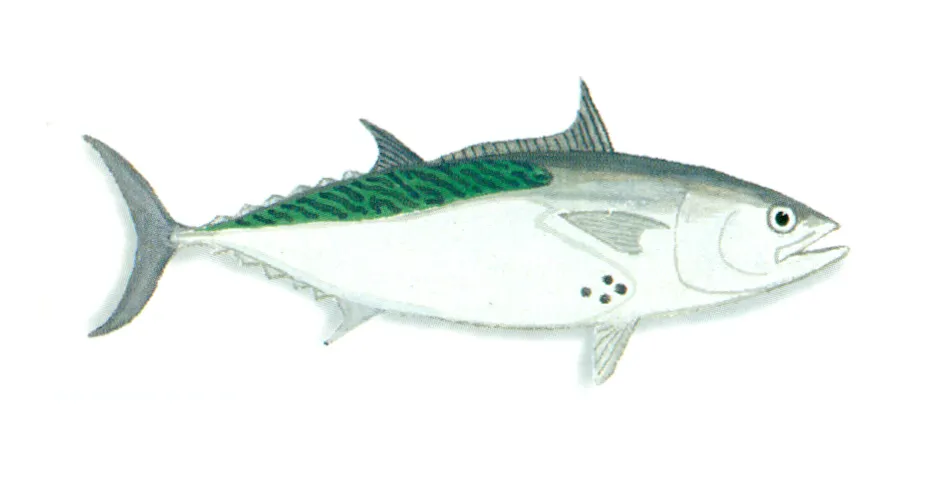
Little tunny have broken, wavy, diagonal dark stripes on the back, 3 to 7 dark spots under each pectoral fin, no dark stripes on the belly, and fairly short pectoral fins.[1]
- 1water list it
- 1state or region
- 4agency sources
Identification
- Little tunny have broken, wavy, diagonal dark stripes on the back, 3 to 7 dark spots under each pectoral fin, no dark stripes on the belly, and fairly short pectoral fins.[1]
What the source says
“Broken, wavy, diagonal dark stripes on back 3 to 7 dark spots under each pectoral fin Lack dark stripes on belly Relatively short pectoral fins”
- Atlantic bonito look similar but have no spots below the pectoral fin, and their back stripes are mostly straight.[1]
What the source says
“Similar Species: Atlantic bonito, S. sarda (lack spots below pectoral fin; dark stripes on back are mostly straight)”
- On an Atlantic bonito the wavy-line patch on the back reaches forward to the front of the dorsal fin; on a little tunny it starts about halfway back along the fin.[2]
What the source says
“Besides lacking the belly spots, the patch of wavy lines on the back of the Atlantic bonito extends further forward, to a point equal to the front of the dorsal fin. In the little tunny, the patch of lines begins at a point about halfway back from the beginning of the fin.”
Habitat and range
- Found in tropical to temperate waters of the Atlantic, Gulf of Mexico and Caribbean, and also in the Mediterranean and Black seas. It schools and migrates north in spring and south in fall and winter.[3]
What the source says
“False Albacore is typically found in tropical to temperate waters of the Atlantic Ocean, Gulf of Mexico, and Caribbean Sea; it is also found in the Mediterranean and Black seas. False Albacore is a schooling species that migrates north in the spring and south in the fall and winter”
- Little tunny come closer to shore than any other tuna.[2]
What the source says
“It comes closer to shore than any other tuna species.”
Life history
- False albacore spawn April through November in the Atlantic. Most studies put their maximum age at 5 years.[3]
What the source says
“False Albacore spawn April through November in the Atlantic Ocean (Collette and Nuan 1983). Most studies estimate the maximum age of False Albacore at 5 years”
- They feed mostly on fish such as herrings, sardines and scads, and also readily take squid and crustaceans.[2]
What the source says
“They feed most heavily on fishes such as herrings, sardines and scads, but they will also readily take squid and crustaceans.”
Status, protections and rules
Legal status and rules as the agency stated them on the date read. Rules change: check the current regulations for the water.
- North Carolina DMF: stock status is unknown, but there appears to be no biological concern because there is no sign of size truncation and most fish caught are well above the size at which half are mature.[3]
What the source says
“The stock status of False Albacore is unknown; however, there appears to be no biological concern for the stock since there is no evidence of size truncation in the commercial and recreational fisheries, and the majority are well above the size at 50% mature (L50).”
- North Carolina (DMF rule): the Fisheries Director may manage the fishery by proclamation, with Marine Fisheries Commission consent, if landings exceed a set threshold. No management measures are in place because landings are below it.[3]
What the source says
“This rule delegates proclamation authority to the Fisheries Director to issue a proclamation to manage the False Albacore fishery if landings exceed a predetermined threshold, with prior consent by the Marine Fisheries Commission. There are no management measures in place for False Albacore due to the landings being below the threshold.”
- According to NC DMF, false albacore had not been managed at the state or federal level anywhere on the Atlantic coast, except recently by Massachusetts.[3]
What the source says
“Until now, False Albacore has not been managed at the state or federal level in North Carolina or in any Atlantic waters on the east coast except only recently by Massachusetts.”
Fishing for it: what the agencies say
What agencies and extension services say about catching it, with the source for each line.
- In North Carolina, recreational anglers mainly use hook and line, most often sight casting or trolling, and most fish are released alive.[4]
What the source says
“The predominant gear for the recreational fishery is hook-and-line, and the most popular methods are either sight casting or trolling. While most fish are released alive”
- In North Carolina most are caught in fall and early winter, with landings and trips peaking in September and October.[4]
What the source says
“Most fish are caught in the fall and early winter, with landings and trips peaking in September and October”
- A large feeding school is very noisy, keeping the water splashing and foaming.[2]
What the source says
“When a large school is actively feeding, they are very noisy, keeping the water splashing and foaming.”
- Saltwater rules (slots, seasons, tags, handling) are set by the state or country and change often: read the current rules before each trip.
- A local guide will know the tides and where the fish are feeding this week.
Where to fish for false albacore
Our 1 water page whose agency species list names false albacore (each list links to the agency page it comes from). A species missing from a list does not mean it is absent: many agencies publish no list for a water.
United States 1 water
Alabama 1
- Mobile Baylisted as “Little Tunny”Agency list: Alabama Department of Conservation and Natural Resources, Marine Resources Division
Sources
Every fact on this page is our paraphrase of the page cited beside it, read on the date shown. Rules and seasons change: check the agency's current regulations before you fish.
- Little Tunny | FWC (species profile) Florida Fish and Wildlife Conservation Commission, read Oct 24, 2026.
- Louisiana Fisheries - Little Tunny Louisiana Sea Grant / LSU AgCenter (Louisiana Fisheries), read Oct 24, 2026.
- State Managed Species - False Albacore: Fishery Management Plan Update (August 2026) North Carolina Division of Marine Fisheries (NC DEQ), read Oct 24, 2026.
- False Albacore Information Paper Update (February 2, 2023) North Carolina Division of Marine Fisheries (NC DEQ), read Oct 24, 2026.