
Legendary Species · Saltwater and flats
Spotted seatrout
Cynoscion nebulosus[1]
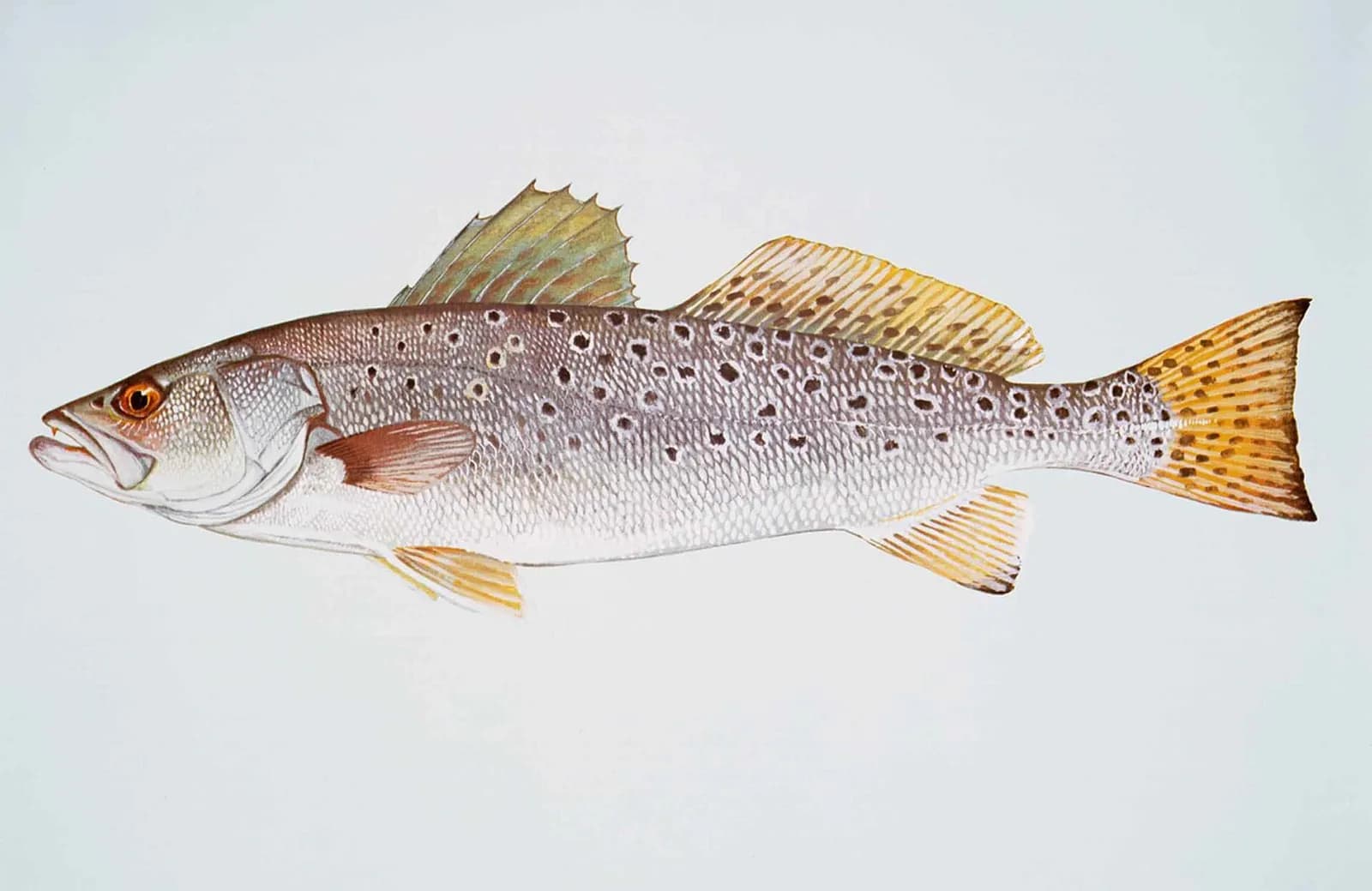
Spotted seatrout have a dark gray or green back, a silvery-white underside and distinct round spots on the back, fins and tail. The tail has a black edge, the soft dorsal fin has no scales, and one or two prominent canine teeth usually sit at the tip of the upper jaw.[2]
- 67waters list it
- 5states and regions
- 6agency sources
Identification
- Spotted seatrout have a dark gray or green back, a silvery-white underside and distinct round spots on the back, fins and tail. The tail has a black edge, the soft dorsal fin has no scales, and one or two prominent canine teeth usually sit at the tip of the upper jaw.[2]
What the source says
“Distinguishing characteristics include a dark gray or green back and silvery-white below, with distinct round spots on back, fins and tail; black margin along the edge of tail; soft dorsal (back) fin with no scales; and one or two prominent canine teeth usually present at the tip of the upper jaw.”
- Weakfish look similar but have irregular wavy lines instead of spots.[1]
What the source says
“Similar Species: Weakfish, C. regalis (has irregular wavy lines instead of spots)”
Habitat and range
- Coastal waters over sand bottoms or seagrass beds.[1]
What the source says
“Coastal waters over sand bottoms or seagrass beds”
- Seatrout are most abundant in water less than ten feet deep and prefer 60 to 80°F; water below 45°F appears to cause large die-offs.[3]
What the source says
“They are most abundant in depths of less than ten feet and prefer temperatures between 60 and 80° F. Water temperatures below 45° F appear to cause large-scale mortalities.”
- Spotted seatrout generally do not migrate and spend their whole lives within five to ten miles of the estuary where they were born.[3]
What the source says
“In general, spotted seatrout appear to be non-migratory and spend their entire life within five to ten miles of their natal estuary”
Life history
- In Florida, seatrout spawn inshore from March through November, move to deeper, still water in cold months, and eat baitfish, mullet, shrimp and crabs.[1]
What the source says
“Spawning occurs inshore from March through November. Move into deeper, still waters during colder months. Feed on baitfish, mullet, shrimp and crabs.”
Status, protections and rules
Legal status and rules as the agency stated them on the date read. Rules change: check the current regulations for the water.
- Florida (FWC rule, Tampa Bay region shown): open year-round, 15- to 19-inch slot with one fish over 19 inches allowed per vessel (or per person from shore), and 3 per person per day.[4]
What the source says
“Season: Open year-round Slot limit: Not less than 15” or more than 19” total length May possess one fish over 19 inches per vessel or, if fishing from shore, one fish over 19 inches per person, included in the bag limit. Bag limit: Three fish per person per day”
- Florida (FWC rule, Indian River Lagoon region): closed November 1 to December 31, 15- to 19-inch slot with no fish over 19 inches, and 2 per person per day.[4]
What the source says
“Closed season: November 1 – December 31 Open season: Jan. 1 – Oct. 31 Slot limit: Not less than 15” or more than 19” total length May not possess fish larger than 19 inches total length Bag limit: Two fish per person per day”
- Texas (TPWD rule): spotted seatrout daily bag of 3, minimum 15 inches and maximum 20 inches; one fish over 28 inches per license year may be kept with a Spotted Seatrout Tag.[5]
What the source says
“Spotted Daily Bag: 3 Min Length: 15 inches Max Length: 20 inches Possession Limit: Double the daily bag limit Clarification: During a license year, one spotted seatrout over 28” may be retained when affixed with a properly completed Spotted Seatrout Tag”
- North Carolina (DMF action): widespread cold stun events led the Division of Marine Fisheries to close all coastal and joint waters to commercial and recreational seatrout harvest at 4 p.m. on February 6, 2026.[6]
What the source says
“The N.C. Department of Environmental Quality’s Division of Marine Fisheries will close all Coastal and Joint fishing waters in North Carolina to both commercial and recreational Spotted Seatrout harvest at 4 p.m. Friday, Feb. 6, 2026, due to widespread cold stun events.”
- North Carolina (DMF rule): Amendment 1 to the state's seatrout management plan says that after a significant cold stun event, all seatrout harvest closes through the spring.[6]
What the source says
“Amendment 1 to the N.C. Spotted Seatrout Fishery Management Plan specifies that if a significant cold stun event occurs, the Division of Marine Fisheries will close all Spotted Seatrout harvests through the spring.”
Fishing for it: what the agencies say
What agencies and extension services say about catching it, with the source for each line.
- In warm weather, fish the shallows early and late in the day, and move to deeper drop-offs around grass flats, channels or oyster reefs in the heat of the day.[2]
What the source says
“During warm weather, fish shallow areas early in the morning and late in the evening. In the heat of the day, move to deeper areas such as the dropoffs around grass flats, channels or around oyster reefs.”
- Seatrout are delicate, so return unwanted or illegal fish to the water promptly.[1]
What the source says
“Trout are very delicate, so returning unwanted or illegal fish promptly to the water is necessary to maintain a healthy population.”
- Saltwater rules (slots, seasons, tags, handling) are set by the state or country and change often: read the current rules before each trip.
- A local guide will know the tides and where the fish are feeding this week.
Where to fish for spotted seatrout
Our 67 water pages whose agency species list names spotted seatrout (each list links to the agency page it comes from). A species missing from a list does not mean it is absent: many agencies publish no list for a water.
United States 67 waters
Florida 35
Spotted seatrout in FloridaAll Florida waters
- Florida BayAgency list: National Park Service (Everglades National Park)
- Mosquito LagoonAgency list: Florida Fish and Wildlife Conservation Commission
- Ten Thousand IslandsAgency list: U.S. Fish and Wildlife Service
- Alligator HarborAgency list: Florida Fish and Wildlife Conservation Commission
- Apalachee BayAgency list: U.S. Fish and Wildlife Service
- Apalachicola BayAgency list: Florida Fish and Wildlife Conservation Commission
- Banana RiverAgency list: U.S. Fish and Wildlife Service
- Boca Ciega BayAgency list: Florida Fish and Wildlife Conservation Commission
- Charlotte HarborAgency list: Florida Fish and Wildlife Conservation Commission
- Cockroach BayAgency list: Florida Fish and Wildlife Conservation Commission
- Indian River LagoonAgency list: U.S. Fish and Wildlife Service
- Lemon BayAgency list: Florida Fish and Wildlife Conservation Commission
- Matlacha PassAgency list: Florida Fish and Wildlife Conservation Commission
- Pine Island SoundAgency list: U.S. Fish and Wildlife Service
- Rocky BayouAgency list: Florida Fish and Wildlife Conservation Commission
- Saint Andrew BayAgency list: Florida Fish and Wildlife Conservation Commission
- Saint Joseph BayAgency list: Florida Fish and Wildlife Conservation Commission
- Terra Ceia BayAgency list: Florida Fish and Wildlife Conservation Commission
- Big LagoonAgency list: Florida Fish and Wildlife Conservation Commission
- Bishop HarborAgency list: Florida Fish and Wildlife Conservation Commission
- Boca Grande PassAgency list: Florida Fish and Wildlife Conservation Commission
- Cedar KeysAgency list: U.S. Fish and Wildlife Service
- Choctawhatchee BayAgency list: Florida Fish and Wildlife Conservation Commission
- Escambia BayAgency list: Florida Fish and Wildlife Conservation Commission
- Fort Island Gulf BeachAgency list: Florida Fish and Wildlife Conservation Commission
- Fort Pierce InletAgency list: Florida Fish and Wildlife Conservation Commission
- Joe's BayouAgency list: Florida Fish and Wildlife Conservation Commission
- John's PassAgency list: Florida Fish and Wildlife Conservation Commission
- Longboat PassAgency list: Florida Fish and Wildlife Conservation Commission
- Matanzas InletAgency list: Florida Fish and Wildlife Conservation Commission
- Ponce de Leon InletAgency list: Florida Fish and Wildlife Conservation Commission
- Sebastian InletAgency list: Florida Fish and Wildlife Conservation Commission
- Tampa BayAgency list: Florida Fish and Wildlife Conservation Commission
- Tarpon BayAgency list: U.S. Fish and Wildlife Service
- Venice InletAgency list: Florida Fish and Wildlife Conservation Commission
Texas 23
Spotted seatrout in TexasAll Texas waters
- Laguna MadreAgency list: Texas Parks and Wildlife Department
- San Antonio BayAgency list: Texas Parks and Wildlife Department
- Baffin BayAgency list: Texas Parks and Wildlife Department
- Corpus Christi BayAgency list: Texas Parks and Wildlife Department
- Redfish BayAgency list: Texas Parks and Wildlife Department
- Alazan BayAgency list: Texas Parks and Wildlife Department
- Arroyo ColoradoAgency list: U.S. Fish and Wildlife Service
- Bastrop BayouAgency list: U.S. Fish and Wildlife Service
- Cayo del GrulloAgency list: Texas Parks and Wildlife Department
- Cedar Lake CreekAgency list: U.S. Fish and Wildlife Service
- Christmas BayAgency list: Texas Parks and Wildlife Department
- Cow Trap LakeAgency list: U.S. Fish and Wildlife Service
- Espiritu Santo BayAgency list: Texas Parks and Wildlife Department
- Guadalupe BayAgency list: Texas Parks and Wildlife Department
- Laguna SaladaAgency list: Texas Parks and Wildlife Department
- Lost LakeAgency list: U.S. Fish and Wildlife Service
- Mission LakeAgency list: Texas Parks and Wildlife Department
- Nicks LakeAgency list: U.S. Fish and Wildlife Service
- Oso BayAgency list: Texas Parks and Wildlife Department
- Powderhorn LakeAgency list: Texas Parks and Wildlife Department
- Salt LakeAgency list: U.S. Fish and Wildlife Service
- South BayAgency list: Texas Parks and Wildlife Department
- Tres Palacios BayAgency list: Texas Parks and Wildlife Department
North Carolina 4
- Pamlico SoundAgency list: U.S. Fish and Wildlife Service
- Oregon InletAgency list: U.S. Fish and Wildlife Service
- Alligator RiverAgency list: U.S. Fish and Wildlife Service
- Pea IslandAgency list: U.S. Fish and Wildlife Service
South Carolina 3
- Wando RiverAgency list: South Carolina Department of Natural Resources, Marine Resources Division (Marine Stocking Research Program)
- Ashley RiverAgency list: South Carolina Department of Natural Resources, Marine Resources Division (Marine Stocking Research Program)
- Charleston HarborAgency list: South Carolina Department of Natural Resources, Marine Resources Division (Marine Stocking Research Program)
Destination hubs
Hubs that list one of these waters, or that a water page is near: each has guides, shops, licences and trip planning for the area.
- Boca Grande & Charlotte Harbor, Florida7 spotted seatrout waters
- Rockport & Aransas Bay, Texas7 spotted seatrout waters
- Titusville & Mosquito Lagoon, Florida4 spotted seatrout waters
- Charleston & the Lowcountry, South Carolina3 spotted seatrout waters
- Manteo & the Outer Banks, North Carolina3 spotted seatrout waters
- Port Mansfield & the Lower Laguna Madre, Texas3 spotted seatrout waters
- Homosassa & the Nature Coast, Florida2 spotted seatrout waters
- Florida Keys, Florida1 spotted seatrout water
Sources
Every fact on this page is our paraphrase of the page cited beside it, read on the date shown. Rules and seasons change: check the agency's current regulations before you fish.
- Spotted Seatrout | FWC (species profile) Florida Fish and Wildlife Conservation Commission, read Oct 24, 2026.
- Spotted Seatrout (Cynoscion nebulosus) Texas Parks and Wildlife Department, read Oct 24, 2026.
- Spotted Seatrout - Atlantic States Marine Fisheries Commission Atlantic States Marine Fisheries Commission, read Oct 24, 2026.
- Spotted Seatrout | FWC (recreational regulations) Florida Fish and Wildlife Conservation Commission, read Oct 24, 2026.
- Seatrout Bag & Length Limits Texas Parks and Wildlife Department, read Oct 24, 2026.
- Waters to close to commercial and recreational Spotted Seatrout harvest | NC DEQ North Carolina Department of Environmental Quality, Division of Marine Fisheries, read Oct 24, 2026.
2 states and regions have a page of spotted seatrout waters of its own (five or more waters).