
Legendary Species · Texas
Spotted seatrout in Texas
Cynoscion nebulosus[1]
23 Texas waters whose agency species list names spotted seatrout. Each links to its water page (gauge, regulations, access map, guides and shops) and to the agency list it comes from.
- 23waters list it
- 2destination hubs
Texas waters
Most fished first. A species missing from an agency list does not mean it is absent; this page lists only waters whose list names it (at least 5 are needed for a page).
- Laguna MadreAgency list: Texas Parks and Wildlife Department
- San Antonio BayAgency list: Texas Parks and Wildlife Department
- Baffin BayAgency list: Texas Parks and Wildlife Department
- Corpus Christi BayAgency list: Texas Parks and Wildlife Department
- Redfish BayAgency list: Texas Parks and Wildlife Department
- Alazan BayAgency list: Texas Parks and Wildlife Department
- Arroyo ColoradoAgency list: U.S. Fish and Wildlife Service
- Bastrop BayouAgency list: U.S. Fish and Wildlife Service
- Cayo del GrulloAgency list: Texas Parks and Wildlife Department
- Cedar Lake CreekAgency list: U.S. Fish and Wildlife Service
- Christmas BayAgency list: Texas Parks and Wildlife Department
- Cow Trap LakeAgency list: U.S. Fish and Wildlife Service
- Espiritu Santo BayAgency list: Texas Parks and Wildlife Department
- Guadalupe BayAgency list: Texas Parks and Wildlife Department
- Laguna SaladaAgency list: Texas Parks and Wildlife Department
- Lost LakeAgency list: U.S. Fish and Wildlife Service
- Mission LakeAgency list: Texas Parks and Wildlife Department
- Nicks LakeAgency list: U.S. Fish and Wildlife Service
- Oso BayAgency list: Texas Parks and Wildlife Department
- Powderhorn LakeAgency list: Texas Parks and Wildlife Department
- Salt LakeAgency list: U.S. Fish and Wildlife Service
- South BayAgency list: Texas Parks and Wildlife Department
- Tres Palacios BayAgency list: Texas Parks and Wildlife Department
Identification
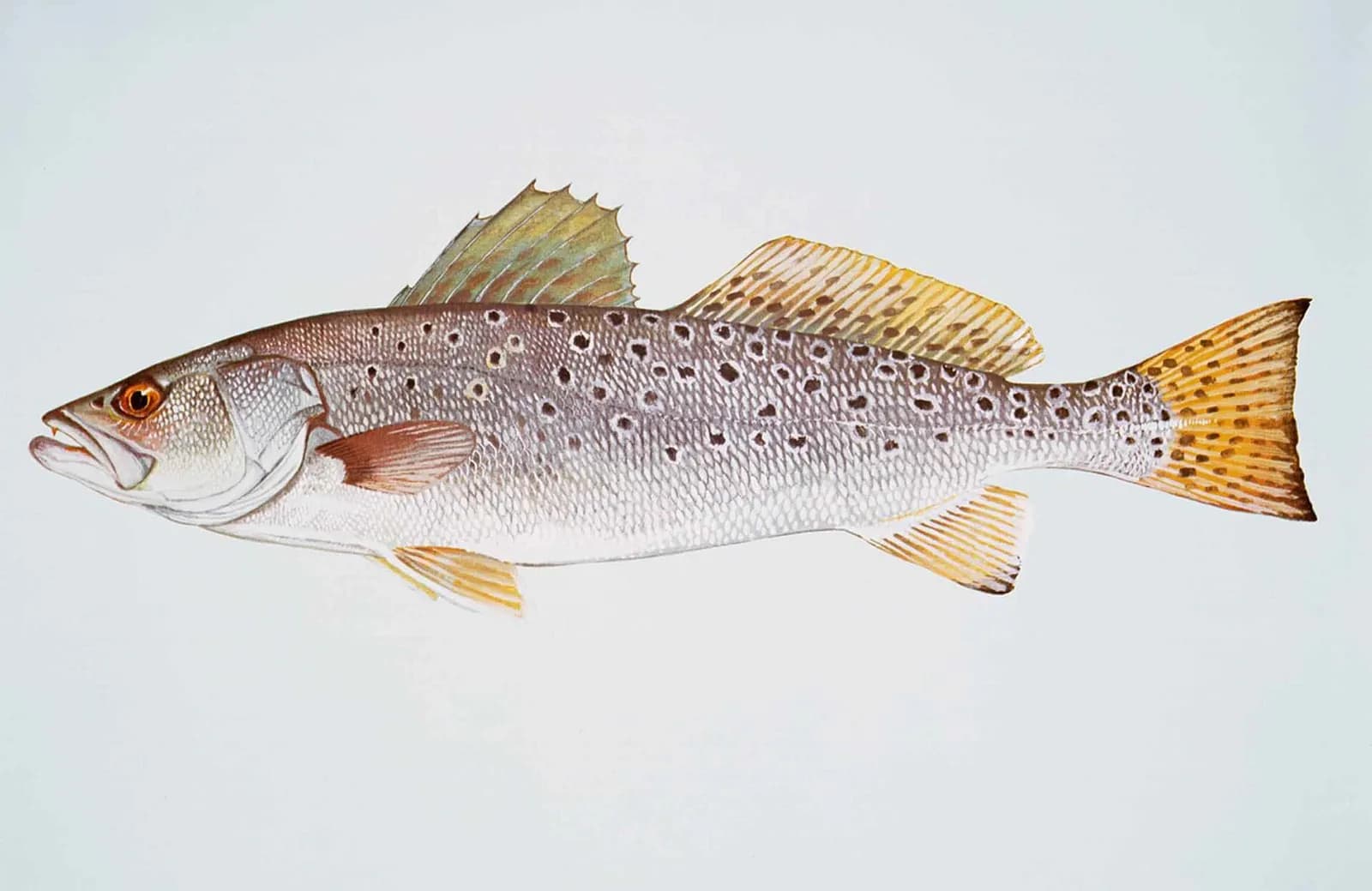
- Spotted seatrout have a dark gray or green back, a silvery-white underside and distinct round spots on the back, fins and tail. The tail has a black edge, the soft dorsal fin has no scales, and one or two prominent canine teeth usually sit at the tip of the upper jaw.[2]
What the source says
“Distinguishing characteristics include a dark gray or green back and silvery-white below, with distinct round spots on back, fins and tail; black margin along the edge of tail; soft dorsal (back) fin with no scales; and one or two prominent canine teeth usually present at the tip of the upper jaw.”
- Weakfish look similar but have irregular wavy lines instead of spots.[1]
What the source says
“Similar Species: Weakfish, C. regalis (has irregular wavy lines instead of spots)”
Status, protections and rules
As each agency stated them on the date read; a rule applies only where its agency says so. Check the current regulations for the water before you fish.
- Florida (FWC rule, Tampa Bay region shown): open year-round, 15- to 19-inch slot with one fish over 19 inches allowed per vessel (or per person from shore), and 3 per person per day.[3]
What the source says
“Season: Open year-round Slot limit: Not less than 15” or more than 19” total length May possess one fish over 19 inches per vessel or, if fishing from shore, one fish over 19 inches per person, included in the bag limit. Bag limit: Three fish per person per day”
- Florida (FWC rule, Indian River Lagoon region): closed November 1 to December 31, 15- to 19-inch slot with no fish over 19 inches, and 2 per person per day.[3]
What the source says
“Closed season: November 1 – December 31 Open season: Jan. 1 – Oct. 31 Slot limit: Not less than 15” or more than 19” total length May not possess fish larger than 19 inches total length Bag limit: Two fish per person per day”
- Texas (TPWD rule): spotted seatrout daily bag of 3, minimum 15 inches and maximum 20 inches; one fish over 28 inches per license year may be kept with a Spotted Seatrout Tag.[4]
What the source says
“Spotted Daily Bag: 3 Min Length: 15 inches Max Length: 20 inches Possession Limit: Double the daily bag limit Clarification: During a license year, one spotted seatrout over 28” may be retained when affixed with a properly completed Spotted Seatrout Tag”
- North Carolina (DMF action): widespread cold stun events led the Division of Marine Fisheries to close all coastal and joint waters to commercial and recreational seatrout harvest at 4 p.m. on February 6, 2026.[5]
What the source says
“The N.C. Department of Environmental Quality’s Division of Marine Fisheries will close all Coastal and Joint fishing waters in North Carolina to both commercial and recreational Spotted Seatrout harvest at 4 p.m. Friday, Feb. 6, 2026, due to widespread cold stun events.”
- North Carolina (DMF rule): Amendment 1 to the state's seatrout management plan says that after a significant cold stun event, all seatrout harvest closes through the spring.[5]
What the source says
“Amendment 1 to the N.C. Spotted Seatrout Fishery Management Plan specifies that if a significant cold stun event occurs, the Division of Marine Fisheries will close all Spotted Seatrout harvests through the spring.”
Destination hubs
Hubs that list one of these waters, or that a water page is near: each has guides, shops, licences and trip planning for the area.
- Rockport & Aransas Bay, Texas7 spotted seatrout waters
- Port Mansfield & the Lower Laguna Madre, Texas3 spotted seatrout waters
Sources
Every fact on this page is our paraphrase of the page cited beside it, read on the date shown. Rules and seasons change: check the agency's current regulations before you fish.
- Spotted Seatrout | FWC (species profile) Florida Fish and Wildlife Conservation Commission, read Oct 24, 2026.
- Spotted Seatrout (Cynoscion nebulosus) Texas Parks and Wildlife Department, read Oct 24, 2026.
- Spotted Seatrout | FWC (recreational regulations) Florida Fish and Wildlife Conservation Commission, read Oct 24, 2026.
- Seatrout Bag & Length Limits Texas Parks and Wildlife Department, read Oct 24, 2026.
- Waters to close to commercial and recreational Spotted Seatrout harvest | NC DEQ North Carolina Department of Environmental Quality, Division of Marine Fisheries, read Oct 24, 2026.