
Legendary Species · Alaska
Sockeye salmon in Alaska
Oncorhynchus nerka[1]
15 Alaska waters whose agency species list names sockeye salmon. Each links to its water page (gauge, regulations, access map, guides and shops) and to the agency list it comes from.
- 15waters list it
- 4destination hubs
Alaska waters
Most fished first. A species missing from an agency list does not mean it is absent; this page lists only waters whose list names it (at least 5 are needed for a page).
- Russian RiverAgency list: Alaska Department of Fish and Game, Division of Sport Fish
- Kenai Riverlisted as “sockeye”Agency list: Alaska Department of Fish and Game
- Alagnak RiverAgency list: Alaska Department of Fish and Game, Division of Sport Fish
- Aniak RiverAgency list: Alaska Department of Fish and Game, Division of Sport Fish
- Ward CreekAgency list: Alaska Department of Fish and Game, Division of Sport Fish
- Kvichak RiverAgency list: Alaska Department of Fish and Game, Division of Sport Fish
- Hatchery CreekAgency list: Alaska Department of Fish and Game, Division of Sport Fish
- Ketchikan CreekAgency list: Alaska Department of Fish and Game, Division of Sport Fish
- Reflection LakeAgency list: Alaska Department of Fish and Game, Division of Sport Fish
- Sweetwater LakeAgency list: Alaska Department of Fish and Game, Division of Sport Fish
- Windfall LakeAgency list: Alaska Department of Fish and Game, Division of Sport Fish
- Unalakleet RiverAgency list: Alaska Department of Fish and Game, Division of Sport Fish
- Chilkoot RiverAgency list: Alaska Department of Fish and Game, Division of Sport Fish
- Eyak RiverAgency list: Alaska Department of Fish and Game, Division of Sport Fish
- Redoubt LakeAgency list: Alaska Department of Fish and Game, Division of Sport Fish
Identification
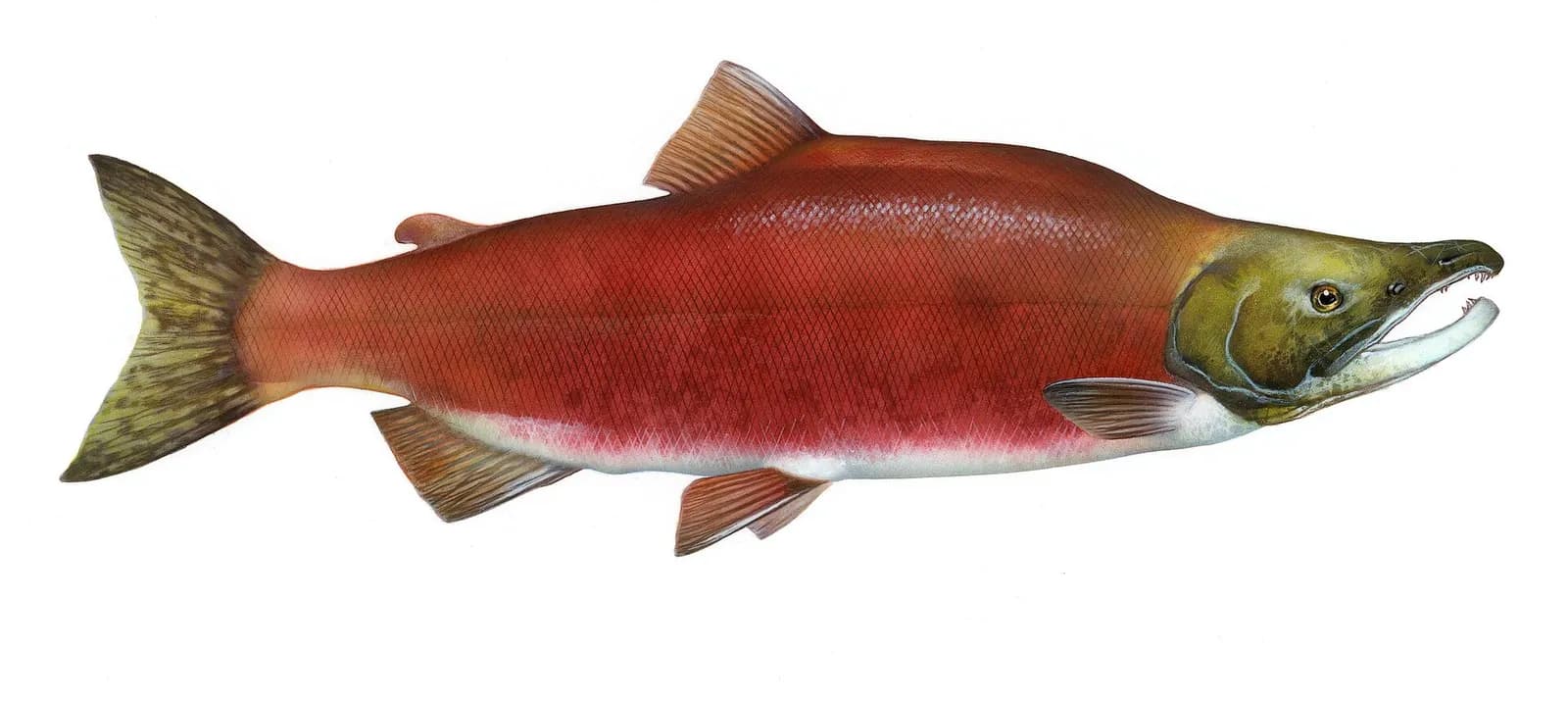
- Sockeye lack the large spots of other Pacific salmon: at most there is fine black speckling on the back, and no spots on the fins or tail.[1]
What the source says
“Some fine black speckling may occur on the back, but the large spots typical of other Pacific salmon are absent. There are no spots on the fins, including the tail.”
- Spawning colour: returning sockeye turn bright red with green heads, which is why Alaskans call them "red" salmon. Spawning males get a humped back and hooked jaws.[1]
What the source says
“As sockeye salmon return to their freshwater spawning grounds, their heads turn green and their bodies turn bright red, hence their other common name in Alaska is “red” salmon. Spawning males develop a humped back and hooked jaws filled with tiny, visible teeth.”
- Alaska's angler tip: spawning sockeye are deep red with a greenish head, but the tail stays without much colour. Sockeye have a white mouth with a white gum line.[2]
What the source says
“Male and female spawning sockeye develop a deep red coloration on their body. Their head turns a greenish color, while their tail remains devoid of significant coloration. The male develops pronounced shoulders and a large kype. Spawning and ocean-phase sockeye have a white mouth with a white gum-line.”
Status, protections and rules
As each agency stated them on the date read; a rule applies only where its agency says so. Check the current regulations for the water before you fish.
- Under the ESA, NOAA Fisheries lists the Snake River sockeye as endangered and the Ozette Lake sockeye as threatened.[3]
What the source says
“ESA Endangered Snake River ESU ESA Threatened Ozette Lake ESU”
Water temperature in Alaska
Alaska Department of Fish and Game publishes no water-temperature line for trout anglers that we found. The lines below are the National Park Service's, federal guidance, not a Alaska rule:
- Under the federal 68°F lineThat is under the 68°F at which the National Park Service, at Grand Teton National Park, recommends anglers stop fishing in the afternoon (“cease fishing at 2 p.m. when water temperatures are likely to exceed 68°F”). Water warms through the afternoon, so check again later in the day: “Carry a pocket thermometer to monitor water temperature.”
- Stressful for troutAt 68°F the U.S. Fish and Wildlife Service says rainbow trout “start stressing”, and the National Park Service at Grand Teton recommends that anglers “cease fishing at 2 p.m. when water temperatures are likely to exceed 68°F.” Its advice: “Fish early in the morning while the water temperature is cooler”, “Play and land fish quickly to reduce exhaustion stress” and “Keep the fish in the water as much as possible.”
Sources: High water temperatures prompt fishing advisory in Grand Teton National Park (29 July 2022) (National Park Service); Up a climate-stressed creek (9 June 2023) (U.S. Fish and Wildlife Service).
Destination hubs
Hubs that list one of these waters, or that a water page is near: each has guides, shops, licences and trip planning for the area.
- Kenai Peninsula: Soldotna & the Kenai, Alaska2 sockeye salmon waters
- Ketchikan & Revillagigedo Island, Alaska2 sockeye salmon waters
- Juneau & the Mendenhall Valley, Alaska1 sockeye salmon water
- Sitka & Baranof Island, Alaska1 sockeye salmon water
Hatch & season charts
- Alaska8 sourced rows
Sources
Every fact on this page is our paraphrase of the page cited beside it, read on the date shown. Rules and seasons change: check the agency's current regulations before you fish.
- Sockeye Salmon | NOAA Fisheries NOAA Fisheries, read Oct 24, 2026.
- Alaska's Five Species of Pacific Salmon, Alaska Department of Fish and Game Alaska Department of Fish and Game, read Oct 24, 2026.
- Sockeye Salmon (Protected) | NOAA Fisheries NOAA Fisheries, read Oct 24, 2026.