
Legendary Species · Salmon, steelhead and sea trout
Sockeye salmon
Oncorhynchus nerka[1] · also Red salmon
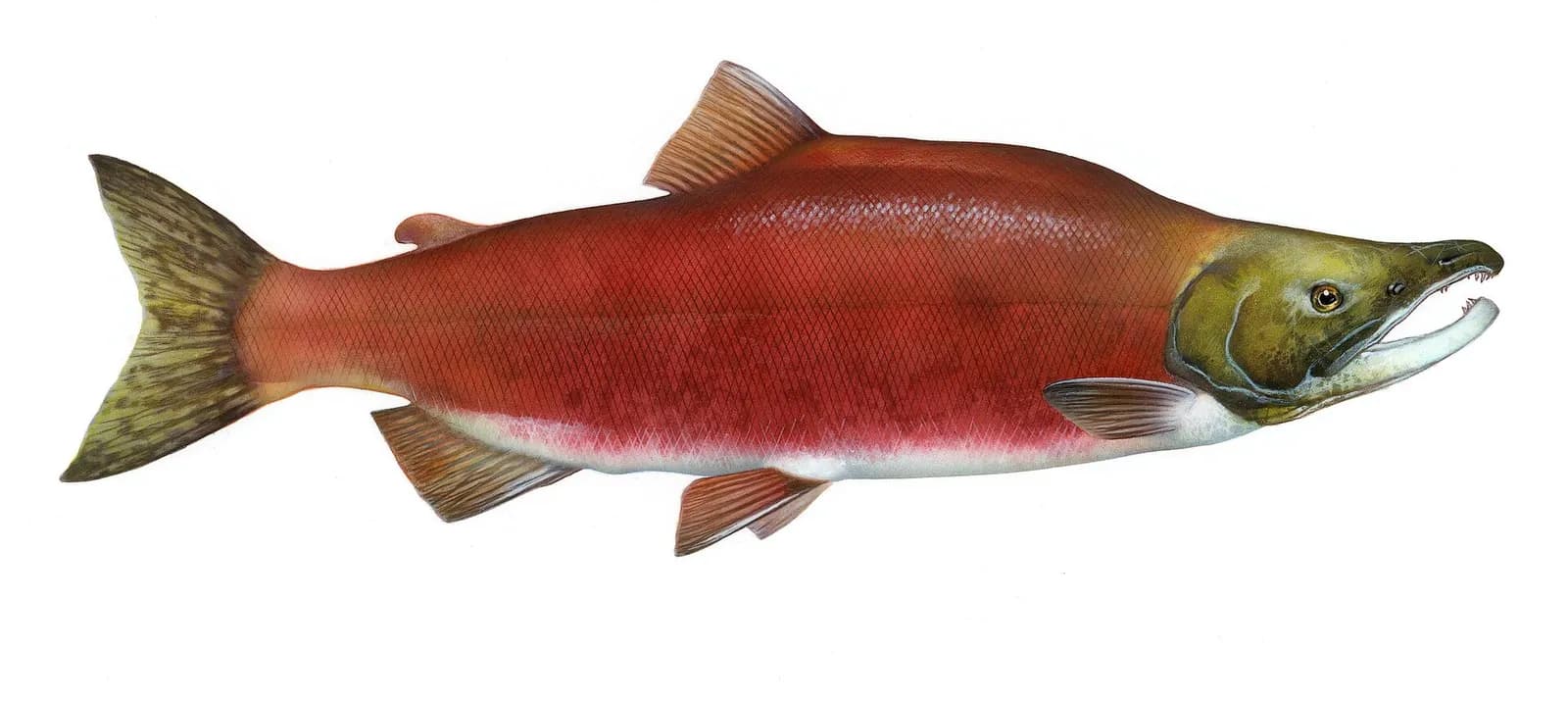
Sockeye lack the large spots of other Pacific salmon: at most there is fine black speckling on the back, and no spots on the fins or tail.[1]
- 15waters list it
- 1state or region
- 5agency sources
Identification
- Sockeye lack the large spots of other Pacific salmon: at most there is fine black speckling on the back, and no spots on the fins or tail.[1]
What the source says
“Some fine black speckling may occur on the back, but the large spots typical of other Pacific salmon are absent. There are no spots on the fins, including the tail.”
- Spawning colour: returning sockeye turn bright red with green heads, which is why Alaskans call them "red" salmon. Spawning males get a humped back and hooked jaws.[1]
What the source says
“As sockeye salmon return to their freshwater spawning grounds, their heads turn green and their bodies turn bright red, hence their other common name in Alaska is “red” salmon. Spawning males develop a humped back and hooked jaws filled with tiny, visible teeth.”
- Alaska's angler tip: spawning sockeye are deep red with a greenish head, but the tail stays without much colour. Sockeye have a white mouth with a white gum line.[2]
What the source says
“Male and female spawning sockeye develop a deep red coloration on their body. Their head turns a greenish color, while their tail remains devoid of significant coloration. The male develops pronounced shoulders and a large kype. Spawning and ocean-phase sockeye have a white mouth with a white gum-line.”
Habitat and range
- On the west coast of North America, sockeye range from the Klamath River in Oregon to Point Hope in northwest Alaska.[3]
What the source says
“On the west coast of North America, sockeye salmon range from the Klamath River in Oregon to Point Hope in northwestern Alaska.”
- Some sockeye never go to sea; in the Pacific Northwest these freshwater sockeye are called kokanee.[1]
What the source says
“Some sockeye salmon are not anadromous and spend their entire lives in freshwater. In the Pacific Northwest, non-anadromous sockeye are known as "kokanee."”
Life history
- In Alaska most sockeye return to spawn in June and July, in rivers, streams and upwelling areas along lake beaches.[3]
What the source says
“In Alaska, most sockeye salmon return to spawn in June and July in freshwater drainages that contain one or more lakes. Spawning itself usually occurs in rivers, streams, and upwelling areas along lake beaches.”
- At sea, sockeye keep eating zooplankton but also take small fish and sometimes squid.[1]
What the source says
“In the ocean, sockeye salmon continue to feed on zooplankton but also eat larval and small adult fishes and occasionally squid.”
Status, protections and rules
Legal status and rules as the agency stated them on the date read. Rules change: check the current regulations for the water.
- Under the ESA, NOAA Fisheries lists the Snake River sockeye as endangered and the Ozette Lake sockeye as threatened.[4]
What the source says
“ESA Endangered Snake River ESU ESA Threatened Ozette Lake ESU”
Fishing for it: what the agencies say
What agencies and extension services say about catching it, with the source for each line.
- Alaska's best-known sockeye sport fisheries are on the Kenai River and its tributary the Russian River; the Kasilof River, Bristol Bay rivers and Kodiak Island are also popular.[5]
What the source says
“Probably the best known sport fisheries with the greatest participation occur during the return of sockeye salmon to the Kenai River and one of its tributaries the Russian River on the Kenai Peninsula. Other popular areas include the Kasilof River on the Kenai Peninsula as well as the various river systems within Bristol Bay and Kodiak Island.”
- Check the agency's run timing, emergency orders and in-season changes before you travel: openings are set by water, section and date.
- Confirm which fish you may keep and how to tell wild from hatchery fish on that water.
- A local guide or shop will know where the fish are in the run this week.
Water temperature
Warm water stresses trout, char and salmon. These are the published temperature lines we show on every gauge, chosen state first: the state agency's own where it publishes one, otherwise federal guidance (said so). Each water page applies them to the gauge's live reading; the flow and temperature checker does the same for any gauge.
| State | Whose lines | Sources |
|---|---|---|
| Alaska | Federal guidance (the National Park Service); no Alaska line found | National Park Service · U.S. Fish and Wildlife Service |
Where to fish for sockeye salmon
Our 15 water pages whose agency species list names sockeye salmon (each list links to the agency page it comes from). A species missing from a list does not mean it is absent: many agencies publish no list for a water.
United States 15 waters
Alaska 15
Sockeye salmon in AlaskaAll Alaska waters
- Russian RiverAgency list: Alaska Department of Fish and Game, Division of Sport Fish
- Kenai Riverlisted as “sockeye”Agency list: Alaska Department of Fish and Game
- Alagnak RiverAgency list: Alaska Department of Fish and Game, Division of Sport Fish
- Aniak RiverAgency list: Alaska Department of Fish and Game, Division of Sport Fish
- Ward CreekAgency list: Alaska Department of Fish and Game, Division of Sport Fish
- Kvichak RiverAgency list: Alaska Department of Fish and Game, Division of Sport Fish
- Hatchery CreekAgency list: Alaska Department of Fish and Game, Division of Sport Fish
- Ketchikan CreekAgency list: Alaska Department of Fish and Game, Division of Sport Fish
- Reflection LakeAgency list: Alaska Department of Fish and Game, Division of Sport Fish
- Sweetwater LakeAgency list: Alaska Department of Fish and Game, Division of Sport Fish
- Windfall LakeAgency list: Alaska Department of Fish and Game, Division of Sport Fish
- Unalakleet RiverAgency list: Alaska Department of Fish and Game, Division of Sport Fish
- Chilkoot RiverAgency list: Alaska Department of Fish and Game, Division of Sport Fish
- Eyak RiverAgency list: Alaska Department of Fish and Game, Division of Sport Fish
- Redoubt LakeAgency list: Alaska Department of Fish and Game, Division of Sport Fish
Destination hubs
Hubs that list one of these waters, or that a water page is near: each has guides, shops, licences and trip planning for the area.
- Kenai Peninsula: Soldotna & the Kenai, Alaska2 sockeye salmon waters
- Ketchikan & Revillagigedo Island, Alaska2 sockeye salmon waters
- Juneau & the Mendenhall Valley, Alaska1 sockeye salmon water
- Sitka & Baranof Island, Alaska1 sockeye salmon water
Sources
Every fact on this page is our paraphrase of the page cited beside it, read on the date shown. Rules and seasons change: check the agency's current regulations before you fish.
- Sockeye Salmon | NOAA Fisheries NOAA Fisheries, read Oct 24, 2026.
- Alaska's Five Species of Pacific Salmon, Alaska Department of Fish and Game Alaska Department of Fish and Game, read Oct 24, 2026.
- Sockeye Salmon Species Profile, Alaska Department of Fish and Game Alaska Department of Fish and Game, read Oct 24, 2026.
- Sockeye Salmon (Protected) | NOAA Fisheries NOAA Fisheries, read Oct 24, 2026.
- Sockeye Salmon Uses, Alaska Department of Fish and Game Alaska Department of Fish and Game, read Oct 24, 2026.
1 state or region has a page of sockeye salmon waters of its own (five or more waters).