Legendary Species · Salmon, steelhead and sea trout
Coho salmon
Oncorhynchus kisutch[1] · also Silver
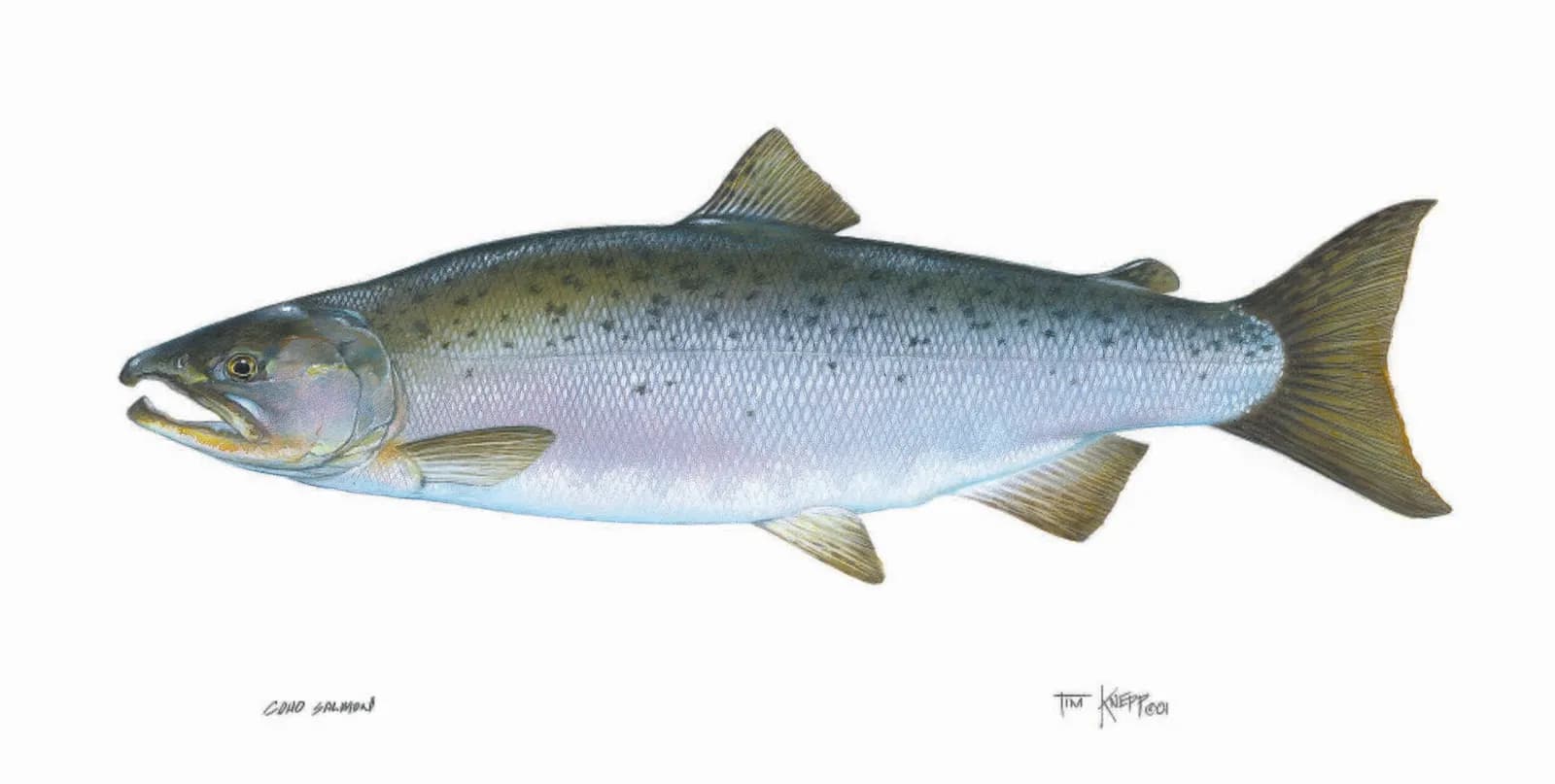
Bright coho have small black spots on the back and on the upper lobe of the tail only, and white gums. Chinook have spots on both tail lobes and black gums.[2]
- 86waters list it
- 9states and regions
- 5agency sources
Identification
- Bright coho have small black spots on the back and on the upper lobe of the tail only, and white gums. Chinook have spots on both tail lobes and black gums.[2]
What the source says
“They can be distinguished from Chinook salmon by the lack of black spots on the lower lobe of the tail and by their white gums; Chinook have small black spots on both tail fin lobes and they have black gums.”
- Alaska's angler tip: coho have a dark gray or blackish mouth with a white gum line, and spots on the back and upper tail lobe in both ocean and spawning phases.[3]
What the source says
“Ocean adults and spawning-phase coho have small black spots that run along the back and on the upper lobe of the tail. Coho also have a dark gray or blackish mouth with a white gum-line.”
- Spawning colour: spawning coho turn a deep reddish or maroon over the whole body, head and tail included.[3]
What the source says
“Spawning coho (or silver) salmon develop a deep reddish or maroon coloration that covers their entire body – head and tail included.”
Habitat and range
- Coho live throughout the North Pacific and in most coastal streams and rivers from Alaska to central California. They have also been introduced into all the Great Lakes.[1]
What the source says
“Coho salmon are found throughout the North Pacific Ocean and in most coastal streams and rivers from Alaska to central California. In North America, they're most abundant in coastal areas from southeast Alaska to central Oregon. Coho salmon have also been introduced in all the Great Lakes, as well as many other landlocked reservoirs throughout the United States.”
- Young coho live in ponds, lakes and pools, usually among sunken woody debris in quiet water away from current.[2]
What the source says
“Coho fry live in ponds, lakes, and pools within streams and rivers, usually among submerged, woody debris- in quiet areas free of current.”
Life history
- In Alaska, coho enter spawning streams from July to November, usually during high water.[2]
What the source says
“Coho salmon enter spawning streams from July to November, usually during periods of high runoff.”
- Young coho eat plankton and insects in fresh water; at sea they switch to small fish such as herring, sandlance, anchovies and sardines.[1]
What the source says
“While in fresh water, young coho salmon feed on plankton and insects. While in the ocean, they switch to a diet of small fishes such as herring, sandlance, anchovies, and sardines.”
Status, protections and rules
Legal status and rules as the agency stated them on the date read. Rules change: check the current regulations for the water.
- Under the ESA, NOAA Fisheries lists the Central California Coast coho as endangered, and the Lower Columbia River, Oregon Coast, and Southern Oregon and Northern California Coasts units as threatened.[4]
What the source says
“We listed the Central California coast ESU of coho salmon as endangered and the Lower Columbia River ESU, Oregon coast ESU, Southern Oregon & Northern California coasts ESU as threatened under the Endangered Species Act.”
- Alaska describes its coho populations as healthy.[2]
What the source says
“Coho salmon populations in Alaska are healthy.”
Fishing for it: what the agencies say
What agencies and extension services say about catching it, with the source for each line.
- In Alaska, coho are caught in fresh and salt water from July to September. In salt water anglers troll or mooch herring or fish flies or lures along shore; in fresh water coho take salmon eggs, flies, spoons and spinners.[5]
What the source says
“The coho salmon is a premier sport fish and is taken in fresh and salt water from July to September. In 2005, anglers throughout Alaska caught 1.4 million coho salmon. In salt water they are taken primarily by trolling or mooching (drifting) with herring or with flies or lures along shore. In fresh water they hit salmon eggs, flies, spoons, or spinners.”
- Check the agency's run timing, emergency orders and in-season changes before you travel: openings are set by water, section and date.
- Confirm which fish you may keep and how to tell wild from hatchery fish on that water.
- A local guide or shop will know where the fish are in the run this week.
Water temperature
Warm water stresses trout, char and salmon. These are the published temperature lines we show on every gauge, chosen state first: the state agency's own where it publishes one, otherwise federal guidance (said so). Each water page applies them to the gauge's live reading; the flow and temperature checker does the same for any gauge.
| State | Whose lines | Sources |
|---|---|---|
| Oregon | ODFW (the state's own) | Oregon Department of Fish and Wildlife · Oregon Department of Fish and Wildlife |
| Alaska | Federal guidance (the National Park Service); no Alaska line found | National Park Service · U.S. Fish and Wildlife Service |
| New York | New York DEC (the state's own) | New York State Department of Environmental Conservation |
| Idaho | Idaho Fish and Game (the state's own) | Idaho Department of Fish and Game · Idaho Department of Fish and Game |
| Michigan | Federal guidance (the National Park Service); no Michigan line found | National Park Service · U.S. Fish and Wildlife Service |
| California | CDFW (the state's own) | California Department of Fish and Wildlife |
| Wisconsin | Federal guidance (the National Park Service); no Wisconsin line found | National Park Service · U.S. Fish and Wildlife Service |
Where to fish for coho salmon
Our 86 water pages whose agency species list names coho salmon (each list links to the agency page it comes from). A species missing from a list does not mean it is absent: many agencies publish no list for a water.
United States 72 waters
Oregon 36
Coho salmon in OregonAll Oregon waters
- Columbia RiverAgency list: Oregon Department of Fish and Wildlife
- McKenzie RiverAgency list: Oregon Department of Fish and Wildlife
- Rogue Riverlisted as “hatchery coho”Agency list: Oregon Department of Fish and Wildlife
- Chetco RiverAgency list: Oregon Department of Fish and Wildlife
- Sandy RiverAgency list: Oregon Department of Fish and Wildlife
- Wilson RiverAgency list: Oregon Department of Fish and Wildlife
- John Day RiverAgency list: Oregon Department of Fish and Wildlife
- Clackamas RiverAgency list: Oregon Department of Fish and Wildlife
- Trask RiverAgency list: Oregon Department of Fish and Wildlife
- Grande Ronde RiverAgency list: Oregon Department of Fish and Wildlife
- Coast Fork Willamette RiverAgency list: Oregon Department of Fish and Wildlife
- Kilchis RiverAgency list: Oregon Department of Fish and Wildlife
- Sixes RiverAgency list: Oregon Department of Fish and Wildlife
- Hood RiverAgency list: Oregon Department of Fish and Wildlife
- Middle Fork Willamette RiverAgency list: Oregon Department of Fish and Wildlife
- South Fork Santiam RiverAgency list: Oregon Department of Fish and Wildlife
- South Fork Umpqua RiverAgency list: Oregon Department of Fish and Wildlife
- Nehalem RiverAgency list: Oregon Department of Fish and Wildlife
- Gnat CreekAgency list: Oregon Department of Fish and Wildlife
- Necanicum RiverAgency list: Oregon Department of Fish and Wildlife
- North Fork Nehalem RiverAgency list: Oregon Department of Fish and Wildlife
- Pistol RiverAgency list: Oregon Department of Fish and Wildlife
- Tenmile CreekAgency list: Oregon Department of Fish and Wildlife
- Winchuck RiverAgency list: Oregon Department of Fish and Wildlife
- Bull Run RiverAgency list: Oregon Department of Fish and Wildlife
- Estacada Lakelisted as “Coho”Agency list: Oregon Department of Fish and Wildlife
- Umatilla RiverAgency list: Oregon Department of Fish and Wildlife
- Fall CreekAgency list: Oregon Department of Fish and Wildlife
- Big Elk CreekAgency list: Oregon Department of Fish and Wildlife
- Blue RiverAgency list: Oregon Department of Fish and Wildlife
- Johnson CreekAgency list: Oregon Department of Fish and Wildlife
- Lake CreekAgency list: Oregon Department of Fish and Wildlife
- Molalla RiverAgency list: Oregon Department of Fish and Wildlife
- North Fork Santiam RiverAgency list: Oregon Department of Fish and Wildlife
- Santiam RiverAgency list: Oregon Department of Fish and Wildlife
- Tualatin RiverAgency list: Oregon Department of Fish and Wildlife
Alaska 19
Coho salmon in AlaskaAll Alaska waters
- Russian RiverAgency list: Alaska Department of Fish and Game, Division of Sport Fish
- Kenai RiverAgency list: Alaska Department of Fish and Game
- Alagnak RiverAgency list: Alaska Department of Fish and Game, Division of Sport Fish
- Aniak RiverAgency list: Alaska Department of Fish and Game, Division of Sport Fish
- Ward CreekAgency list: Alaska Department of Fish and Game, Division of Sport Fish
- Kvichak RiverAgency list: Alaska Department of Fish and Game, Division of Sport Fish
- Situk RiverAgency list: Alaska Department of Fish and Game, Division of Sport Fish
- Chilkat RiverAgency list: Alaska Department of Fish and Game, Division of Sport Fish
- Ketchikan CreekAgency list: Alaska Department of Fish and Game, Division of Sport Fish
- Little Susitna RiverAgency list: Alaska Department of Fish and Game, Division of Sport Fish
- Lost RiverAgency list: Alaska Department of Fish and Game, Division of Sport Fish
- Reflection LakeAgency list: Alaska Department of Fish and Game, Division of Sport Fish
- Campbell CreekAgency list: Alaska Department of Fish and Game, Division of Sport Fish
- Unalakleet RiverAgency list: Alaska Department of Fish and Game, Division of Sport Fish
- Chilkoot RiverAgency list: Alaska Department of Fish and Game, Division of Sport Fish
- Eyak RiverAgency list: Alaska Department of Fish and Game, Division of Sport Fish
- Monashka CreekAgency list: Alaska Department of Fish and Game, Division of Sport Fish
- Pillar CreekAgency list: Alaska Department of Fish and Game, Division of Sport Fish
- Sacramento RiverAgency list: Alaska Department of Fish and Game, Division of Sport Fish
New York 11
Coho salmon in New YorkAll New York waters
- Salmon RiverAgency list: New York State Department of Environmental Conservation
- Genesee RiverAgency list: New York State Department of Environmental Conservation (NYSDEC), Bureau of Fisheries
- Black RiverAgency list: New York State Department of Environmental Conservation (NYSDEC), Bureau of Fisheries
- Eighteenmile CreekAgency list: New York State Department of Environmental Conservation (NYSDEC), Bureau of Fisheries
- Oak Orchard CreekAgency list: New York State Department of Environmental Conservation (NYSDEC), Bureau of Fisheries
- Oswego RiverAgency list: New York State Department of Environmental Conservation (NYSDEC), Bureau of Fisheries
- Sandy CreekAgency list: New York State Department of Environmental Conservation (NYSDEC), Bureau of Fisheries
- Johnson CreekAgency list: New York State Department of Environmental Conservation (NYSDEC), Bureau of Fisheries
- Niagara RiverAgency list: New York State Department of Environmental Conservation (NYSDEC), Bureau of Fisheries
- Twelve Mile CreekAgency list: New York State Department of Environmental Conservation (NYSDEC), Bureau of Fisheries
- Marsh CreekAgency list: New York State Department of Environmental Conservation (NYSDEC), Bureau of Fisheries
Idaho 2
Michigan 2
California 1
Wisconsin 1
Chile 14 waters
Los Lagos 12
Coho salmon in Los LagosAll Los Lagos waters
- Río PetrohuéAgency list: SERNAPESCA
- Lago LlanquihueAgency list: SERNAPESCA
- Lago YelchoAgency list: SERNAPESCA
- Río FutaleufúAgency list: Subsecretaría de Pesca y Acuicultura, Dirección Zonal de Pesca Región de Los Lagos
- Río MaullínAgency list: SERNAPESCA
- Río PueloAgency list: Subsecretaría de Pesca y Acuicultura, Dirección Zonal de Pesca Región de Los Lagos
- Lago RupancoAgency list: SERNAPESCA
- Lago Todos los SantosAgency list: SERNAPESCA
- Río MansoAgency list: SERNAPESCA
- Río PalenaAgency list: Subsecretaría de Pesca y Acuicultura, Dirección Zonal de Pesca Región de Los Lagos
- Río RahueAgency list: SERNAPESCA
- Río YelchoAgency list: SERNAPESCA
Los Ríos 2
- Río LlanquihueAgency list: SERNAPESCA
- Río San PedroAgency list: SERNAPESCA
Destination hubs
Hubs that list one of these waters, or that a water page is near: each has guides, shops, licences and trip planning for the area.
- Puerto Varas & the Puelo, Los Lagos4 coho salmon waters
- Kodiak & the Kodiak road system, Alaska3 coho salmon waters
- Pulaski & the Salmon River, New York3 coho salmon waters
- Grants Pass & the Rogue, Oregon2 coho salmon waters
- Kenai Peninsula: Soldotna & the Kenai, Alaska2 coho salmon waters
- Ketchikan & Revillagigedo Island, Alaska2 coho salmon waters
- Anchorage & Eagle River, Alaska1 coho salmon water
- Bend & the Deschutes, Oregon1 coho salmon water
- Grayling & the Au Sable, Michigan1 coho salmon water
- Mat-Su: Willow & the Susitna, Alaska1 coho salmon water
- Redding & the Lower Sacramento, California1 coho salmon water
Sources
Every fact on this page is our paraphrase of the page cited beside it, read on the date shown. Rules and seasons change: check the agency's current regulations before you fish.
- Coho Salmon | NOAA Fisheries NOAA Fisheries, read Oct 24, 2026.
- Coho Salmon Species Profile, Alaska Department of Fish and Game Alaska Department of Fish and Game, read Oct 24, 2026.
- Alaska's Five Species of Pacific Salmon, Alaska Department of Fish and Game Alaska Department of Fish and Game, read Oct 24, 2026.
- Coho Salmon (Protected) | NOAA Fisheries NOAA Fisheries, read Oct 24, 2026.
- Coho Salmon Uses, Alaska Department of Fish and Game Alaska Department of Fish and Game, read Oct 24, 2026.
4 states and regions have a page of coho salmon waters of its own (five or more waters).