
Legendary Species · Salmon, steelhead and sea trout
Pink salmon
Oncorhynchus gorbuscha[1]
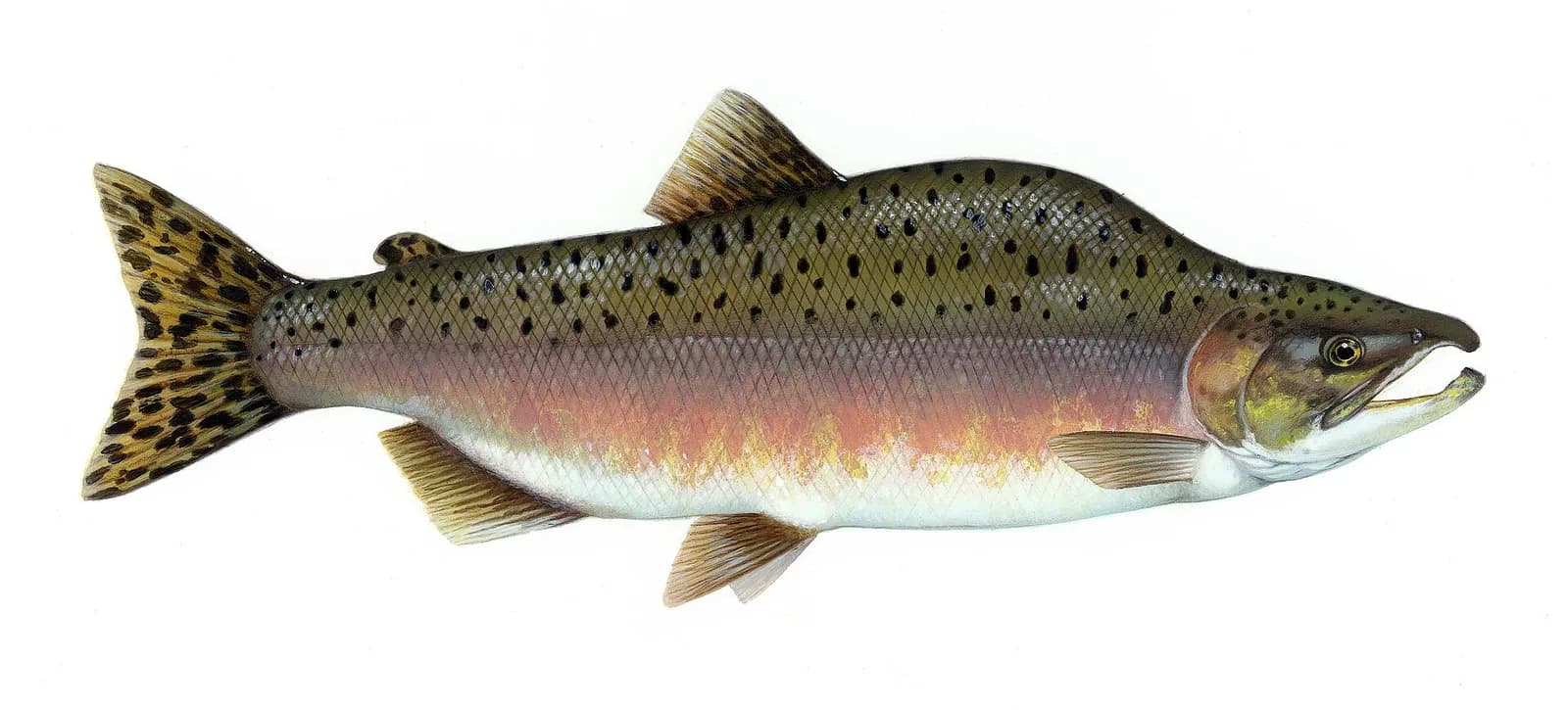
Pinks are told apart from other Pacific salmon by large dark oval spots on the back and over the whole tail fin.[1]
- 13waters list it
- 1state or region
- 5agency sources
Identification
- Pinks are told apart from other Pacific salmon by large dark oval spots on the back and over the whole tail fin.[1]
What the source says
“Pink salmon can be distinguished from other Pacific salmon by the large dark oval spots on their back and entire tail fin as well as their general coloring and form.”
- Alaska's angler tip: pinks have large oval spots on the back and both tail lobes, and a white mouth with a black gum line.[2]
What the source says
“Pinks have large, ovular spots on their backs and on both lobes of the tail. Spawning males have a very pronounced hump on their back. Their mouth is white with a black gum-line.”
- Spawning colour: near their spawning streams, males turn brown to black on the back with a bright white belly; females turn olive green with dusky bars or patches that can be lavender or dark gold. Males grow a large hump and hooked jaws.[3]
What the source says
“When pinks approach their spawning streams, males turn brown to black on their back with a bright white belly. Females have a bright white belly but turn an olive green with dusky bars or patches that can be lavender or a dark gold. By the time males enter the stream where they will spawn, they have developed a very large hump, and hooked jaws called a kype.”
Habitat and range
- Pinks spawn closer to tidewater than most Pacific salmon, generally within 30 miles of a river mouth.[1]
What the source says
“Pink salmon spawn in rivers closer to tidewater than most other Pacific salmon species, generally within 30 miles of a river mouth.”
- Pinks were accidentally introduced to Lake Superior in 1956 and that population spread through the Great Lakes, where it remains.[3]
What the source says
“An accidental introduction to Lake Superior in 1956 survived and became an established population, spread throughout the Great Lakes, and remains today.”
Life history
- Pinks have a regular two-year life cycle, so separate populations spawn in even and odd years. All pinks die after spawning.[1]
What the source says
“All pink salmon die after they spawn. They typically spawn at the age of 2. Because the pink salmon life cycle is so regular, independent populations spawn in even and odd years.”
Status, protections and rules
Legal status and rules as the agency stated them on the date read. Rules change: check the current regulations for the water.
- Alaska states that no pink salmon populations are protected under the Endangered Species Act.[3]
What the source says
“There are no pink salmon populations protected by the Endangered Species Act.”
- Inland Fisheries Ireland asks anglers to keep and freeze any pink salmon they catch and report it to IFI without delay.[4]
What the source says
“Anglers are asked to keep and freeze any pink salmon they catch and to report them to Inland Fisheries Ireland by calling 0818 34 74 24 (open 24 hours a day, 7 days a week) without delay.”
Fishing for it: what the agencies say
What agencies and extension services say about catching it, with the source for each line.
- Alaska notes that pinks just returning to spawn strike tackle and flies aggressively.[5]
What the source says
“Pinks just returning to spawn will aggressively strike tackle and flies.”
- Check the agency's run timing, emergency orders and in-season changes before you travel: openings are set by water, section and date.
- Confirm which fish you may keep and how to tell wild from hatchery fish on that water.
- A local guide or shop will know where the fish are in the run this week.
Water temperature
Warm water stresses trout, char and salmon. These are the published temperature lines we show on every gauge, chosen state first: the state agency's own where it publishes one, otherwise federal guidance (said so). Each water page applies them to the gauge's live reading; the flow and temperature checker does the same for any gauge.
| State | Whose lines | Sources |
|---|---|---|
| Alaska | Federal guidance (the National Park Service); no Alaska line found | National Park Service · U.S. Fish and Wildlife Service |
Where to fish for pink salmon
Our 13 water pages whose agency species list names pink salmon (each list links to the agency page it comes from). A species missing from a list does not mean it is absent: many agencies publish no list for a water.
United States 13 waters
Alaska 13
Pink salmon in AlaskaAll Alaska waters
- Kenai RiverAgency list: Alaska Department of Fish and Game
- Alagnak RiverAgency list: Alaska Department of Fish and Game, Division of Sport Fish
- Aniak RiverAgency list: Alaska Department of Fish and Game, Division of Sport Fish
- Ward CreekAgency list: Alaska Department of Fish and Game, Division of Sport Fish
- Kvichak RiverAgency list: Alaska Department of Fish and Game, Division of Sport Fish
- Alexander CreekAgency list: Alaska Department of Fish and Game, Division of Sport Fish
- Ketchikan CreekAgency list: Alaska Department of Fish and Game, Division of Sport Fish
- Reflection LakeAgency list: Alaska Department of Fish and Game, Division of Sport Fish
- Unalakleet RiverAgency list: Alaska Department of Fish and Game, Division of Sport Fish
- Chilkoot RiverAgency list: Alaska Department of Fish and Game, Division of Sport Fish
- Eklutna RiverAgency list: Alaska Department of Fish and Game, Division of Sport Fish
- Eyak RiverAgency list: Alaska Department of Fish and Game, Division of Sport Fish
- Indian RiverAgency list: Alaska Department of Fish and Game, Division of Sport Fish
Destination hubs
Hubs that list one of these waters, or that a water page is near: each has guides, shops, licences and trip planning for the area.
- Ketchikan & Revillagigedo Island, Alaska2 pink salmon waters
- Anchorage & Eagle River, Alaska1 pink salmon water
- Kenai Peninsula: Soldotna & the Kenai, Alaska1 pink salmon water
- Mat-Su: Willow & the Susitna, Alaska1 pink salmon water
- Sitka & Baranof Island, Alaska1 pink salmon water
Sources
Every fact on this page is our paraphrase of the page cited beside it, read on the date shown. Rules and seasons change: check the agency's current regulations before you fish.
- Pink Salmon | NOAA Fisheries NOAA Fisheries, read Oct 24, 2026.
- Alaska's Five Species of Pacific Salmon, Alaska Department of Fish and Game Alaska Department of Fish and Game, read Oct 24, 2026.
- Pink Salmon Species Profile, Alaska Department of Fish and Game Alaska Department of Fish and Game, read Oct 24, 2026.
- DiadSea Booklet: An identification guide to migratory diadromous fish at sea (PDF) Inland Fisheries Ireland, read Oct 24, 2026.
- Pink Salmon Uses, Alaska Department of Fish and Game Alaska Department of Fish and Game, read Oct 24, 2026.
1 state or region has a page of pink salmon waters of its own (five or more waters).