
Legendary Species · Alaska
Cutthroat trout in Alaska
Oncorhynchus clarkii[1]
11 Alaska waters whose agency species list names cutthroat trout. Each links to its water page (gauge, regulations, access map, guides and shops) and to the agency list it comes from.
- 11waters list it
- 2destination hubs
Alaska waters
Most fished first. A species missing from an agency list does not mean it is absent; this page lists only waters whose list names it (at least 5 are needed for a page).
- Reflection LakeAgency list: Alaska Department of Fish and Game, Division of Sport Fish
- Ella CreekAgency list: Alaska Department of Fish and Game, Division of Sport Fish
- Humpback CreekAgency list: Alaska Department of Fish and Game, Division of Sport Fish
- Naha RiverAgency list: Alaska Department of Fish and Game, Division of Sport Fish
- Turner LakeAgency list: Alaska Department of Fish and Game, Division of Sport Fish
- Distin LakeAgency list: Alaska Department of Fish and Game, Division of Sport Fish
- Hasselborg LakeAgency list: Alaska Department of Fish and Game, Division of Sport Fish
- Jims LakeAgency list: Alaska Department of Fish and Game, Division of Sport Fish
- Manzanita LakeAgency list: Alaska Department of Fish and Game, Division of Sport Fish
- Orchard LakeAgency list: Alaska Department of Fish and Game, Division of Sport Fish
- Wilson LakeAgency list: Alaska Department of Fish and Game, Division of Sport Fish
Identification
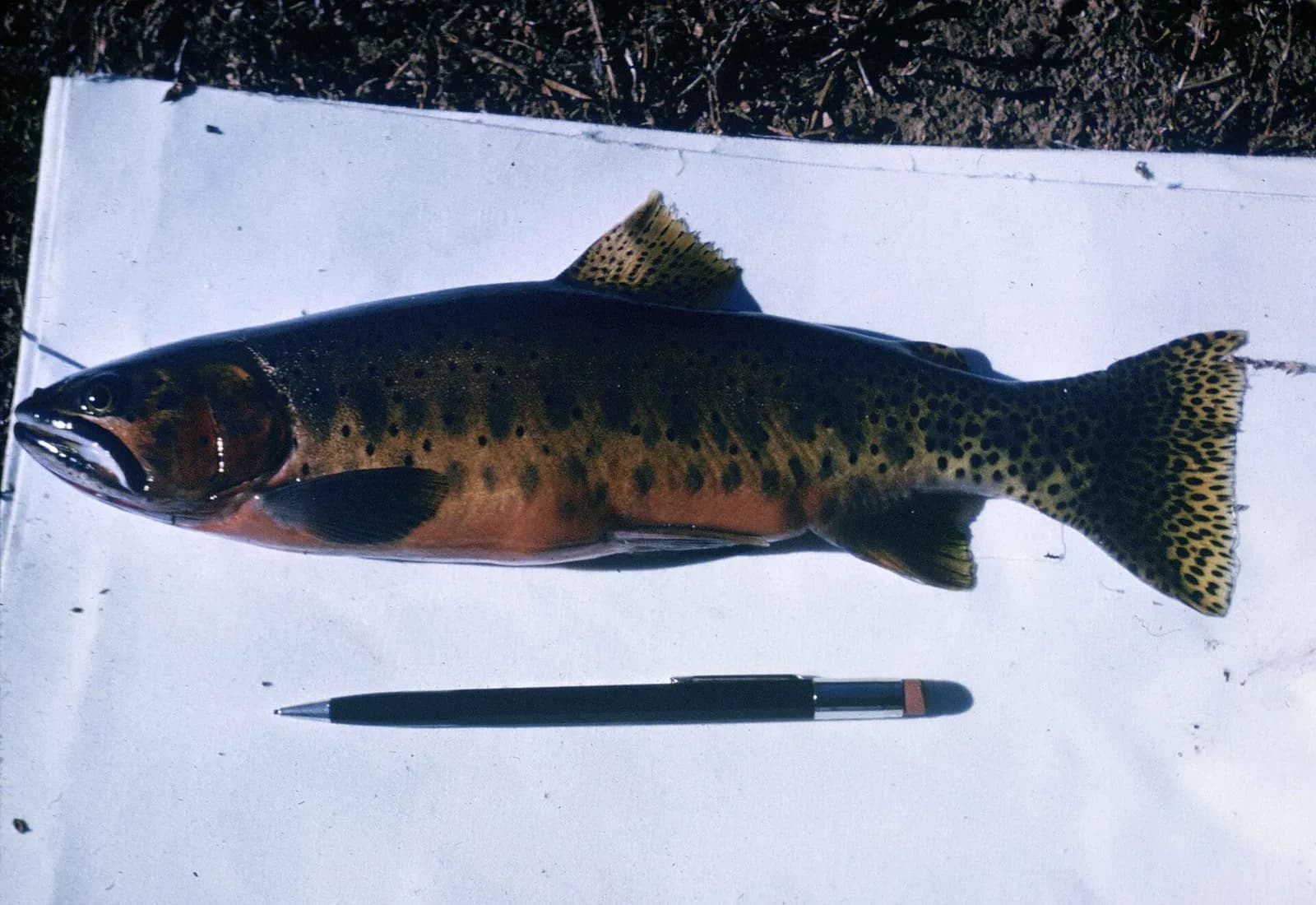
- Cutthroat trout get their name from the red slashes near the lower jaw.[2]
What the source says
“Cutthroat trout are so named for the red slashes near the lower jaws.”
- Utah DWR says that, except for the Bear Lake form, cutthroat are best told by the crimson slash along the lower jaw, and that they lack the rainbow trout's iridescent pink stripe and white-tipped pelvic and anal fins.[3]
What the source says
“Except for the Bear Lake cutthroat trout, cutthroats are best distinguished by their crimson slash along the lower jaw. Cutthroat trout lack the iridescent pink stripe or the white-tipped pelvic and anal fins of the rainbow trout.”
Status, protections and rules
As each agency stated them on the date read; a rule applies only where its agency says so. Check the current regulations for the water before you fish.
- Westslope cutthroat: Montana FWP says it has been designated a Fish of Special Concern in Montana.[2]
What the source says
“it has been designated a Fish of Special Concern in Montana.”
- Yellowstone cutthroat: non-native lake trout caused a dramatic decline in Yellowstone cutthroat in the early 2000s.[4]
What the source says
“Nonnative lake trout caused a dramatic decline in YCT in the early 2000s.”
- Colorado River cutthroat: Colorado Parks and Wildlife lists its status as State Special Concern.[5]
What the source says
“State Special Concern”
- Greenback cutthroat: Colorado Parks and Wildlife lists it as federally threatened and state threatened.[6]
What the source says
“Federally Threatened, State Threatened”
- Lahontan cutthroat: listed as threatened under the federal Endangered Species Act (CDFW).[7]
What the source says
“Lahontan cutthroat trout are a threatened species under the Federal Endangered Species Act.”
Water temperature in Alaska
Alaska Department of Fish and Game publishes no water-temperature line for trout anglers that we found. The lines below are the National Park Service's, federal guidance, not a Alaska rule:
- Under the federal 68°F lineThat is under the 68°F at which the National Park Service, at Grand Teton National Park, recommends anglers stop fishing in the afternoon (“cease fishing at 2 p.m. when water temperatures are likely to exceed 68°F”). Water warms through the afternoon, so check again later in the day: “Carry a pocket thermometer to monitor water temperature.”
- Stressful for troutAt 68°F the U.S. Fish and Wildlife Service says rainbow trout “start stressing”, and the National Park Service at Grand Teton recommends that anglers “cease fishing at 2 p.m. when water temperatures are likely to exceed 68°F.” Its advice: “Fish early in the morning while the water temperature is cooler”, “Play and land fish quickly to reduce exhaustion stress” and “Keep the fish in the water as much as possible.”
Sources: High water temperatures prompt fishing advisory in Grand Teton National Park (29 July 2022) (National Park Service); Up a climate-stressed creek (9 June 2023) (U.S. Fish and Wildlife Service).
Destination hubs
Hubs that list one of these waters, or that a water page is near: each has guides, shops, licences and trip planning for the area.
- Ketchikan & Revillagigedo Island, Alaska4 cutthroat trout waters
- Juneau & the Mendenhall Valley, Alaska1 cutthroat trout water
Hatch & season charts
- Alaska8 sourced rows
Sources
Every fact on this page is our paraphrase of the page cited beside it, read on the date shown. Rules and seasons change: check the agency's current regulations before you fish.
- Bonneville Cutthroat Trout (Oncorhynchus clarkii utah) | U.S. Fish & Wildlife Service U.S. Fish and Wildlife Service, read Oct 24, 2026.
- Westslope Cutthroat Conservation & Restoration | Montana FWP Montana Fish, Wildlife & Parks, read Oct 24, 2026.
- 2026 Utah Fishing Guidebook Utah Division of Wildlife Resources, read Oct 24, 2026.
- Fish Ecology - Yellowstone National Park (U.S. National Park Service) National Park Service, read Oct 24, 2026.
- Colorado River Cutthroat Trout | Colorado Parks and Wildlife Colorado Parks and Wildlife, read Oct 24, 2026.
- Greenback Cutthroat Trout | Colorado Parks and Wildlife Colorado Parks and Wildlife, read Oct 24, 2026.
- Lahontan Cutthroat Trout California Department of Fish and Wildlife, read Oct 24, 2026.