
Legendary Species · Alaska
Chum salmon in Alaska
Oncorhynchus keta[1]
10 Alaska waters whose agency species list names chum salmon. Each links to its water page (gauge, regulations, access map, guides and shops) and to the agency list it comes from.
- 10waters list it
- 2destination hubs
Alaska waters
Most fished first. A species missing from an agency list does not mean it is absent; this page lists only waters whose list names it (at least 5 are needed for a page).
- Alagnak RiverAgency list: Alaska Department of Fish and Game, Division of Sport Fish
- Aniak RiverAgency list: Alaska Department of Fish and Game, Division of Sport Fish
- Ward CreekAgency list: Alaska Department of Fish and Game, Division of Sport Fish
- Kvichak RiverAgency list: Alaska Department of Fish and Game, Division of Sport Fish
- Ketchikan CreekAgency list: Alaska Department of Fish and Game, Division of Sport Fish
- Reflection LakeAgency list: Alaska Department of Fish and Game, Division of Sport Fish
- Unalakleet RiverAgency list: Alaska Department of Fish and Game, Division of Sport Fish
- Chilkoot RiverAgency list: Alaska Department of Fish and Game, Division of Sport Fish
- Eklutna RiverAgency list: Alaska Department of Fish and Game, Division of Sport Fish
- Eyak RiverAgency list: Alaska Department of Fish and Game, Division of Sport Fish
Identification
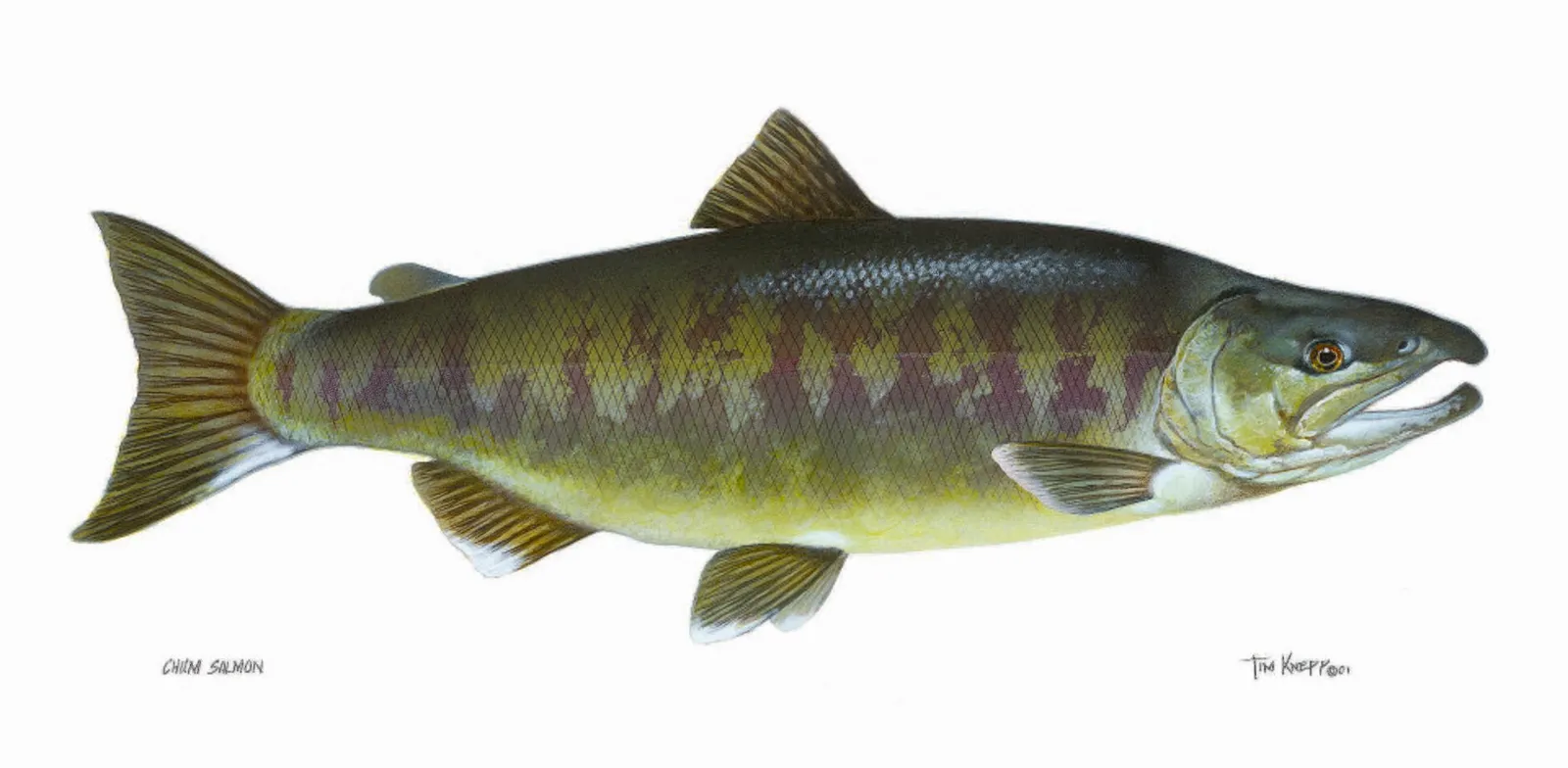
- Ocean-bright chum have no large spots. The tail is more deeply forked than in other Pacific salmon, is unspotted, and has silver streaks along the fin rays.[2]
What the source says
“The tail is highly forked, more so than other species of Pacific salmon, and is not spotted. The tail also has silver streaks along (but not between) the fin rays.”
- Alaska's angler tip: chum have a white mouth and white gum line. Unlike a bright sockeye, a chum has a white tip on the anal fin, a deeply forked tail and a large pupil.[3]
What the source says
“Spawning and ocean phase chums have a white mouth with a white gum-line. An ocean-bright chum can be difficult to differentiate from an ocean-bright sockeye. But unlike sockeye, chum salmon have a white tip on the anal fin, deeply forked tail and a large pupil.”
- Spawning colour: males turn dark olive to brown with red to purple wavy vertical stripes and grow a hooked snout with large canine-like teeth; females turn brown to grey with a broad dark bar along the lateral line.[2]
What the source says
“Males lose their silvery appearance and take on a dark olive to brown coloration with red to purple wavy vertical stripes. They develop a hooked snout (kype) lined with large canine-like teeth. Females become brown to grey colored with a broad dark horizontal bar running along the lateral line.”
Status, protections and rules
As each agency stated them on the date read; a rule applies only where its agency says so. Check the current regulations for the water before you fish.
- Under the ESA, NOAA Fisheries lists two chum units as threatened: Columbia River and Hood Canal summer-run (listed 1999).[4]
What the source says
“We listed the Columbia River and Hood Canal summer-run ESUs as threatened under the Endangered Species Act in 1999.”
Water temperature in Alaska
Alaska Department of Fish and Game publishes no water-temperature line for trout anglers that we found. The lines below are the National Park Service's, federal guidance, not a Alaska rule:
- Under the federal 68°F lineThat is under the 68°F at which the National Park Service, at Grand Teton National Park, recommends anglers stop fishing in the afternoon (“cease fishing at 2 p.m. when water temperatures are likely to exceed 68°F”). Water warms through the afternoon, so check again later in the day: “Carry a pocket thermometer to monitor water temperature.”
- Stressful for troutAt 68°F the U.S. Fish and Wildlife Service says rainbow trout “start stressing”, and the National Park Service at Grand Teton recommends that anglers “cease fishing at 2 p.m. when water temperatures are likely to exceed 68°F.” Its advice: “Fish early in the morning while the water temperature is cooler”, “Play and land fish quickly to reduce exhaustion stress” and “Keep the fish in the water as much as possible.”
Sources: High water temperatures prompt fishing advisory in Grand Teton National Park (29 July 2022) (National Park Service); Up a climate-stressed creek (9 June 2023) (U.S. Fish and Wildlife Service).
Destination hubs
Hubs that list one of these waters, or that a water page is near: each has guides, shops, licences and trip planning for the area.
- Ketchikan & Revillagigedo Island, Alaska2 chum salmon waters
- Anchorage & Eagle River, Alaska1 chum salmon water
Hatch & season charts
- Alaska8 sourced rows
Sources
Every fact on this page is our paraphrase of the page cited beside it, read on the date shown. Rules and seasons change: check the agency's current regulations before you fish.
- Chum Salmon | NOAA Fisheries NOAA Fisheries, read Oct 24, 2026.
- Chum Salmon Species Profile, Alaska Department of Fish and Game Alaska Department of Fish and Game, read Oct 24, 2026.
- Alaska's Five Species of Pacific Salmon, Alaska Department of Fish and Game Alaska Department of Fish and Game, read Oct 24, 2026.
- Chum Salmon (Protected) | NOAA Fisheries NOAA Fisheries, read Oct 24, 2026.