
Legendary Species · Alaska
Arctic char in Alaska
Salvelinus alpinus[1]
10 Alaska waters whose agency species list names arctic char. Each links to its water page (gauge, regulations, access map, guides and shops) and to the agency list it comes from.
- 10waters list it
- 1destination hub
Alaska waters
Most fished first. A species missing from an agency list does not mean it is absent; this page lists only waters whose list names it (at least 5 are needed for a page).
- Aniak Riverlisted as “Arctic char/Dolly Varden”Agency list: Alaska Department of Fish and Game, Division of Sport Fish
- Kanektok Riverlisted as “Arctic char/Dolly Varden”Agency list: Alaska Department of Fish and Game, Division of Sport Fish
- Kisaralik Riverlisted as “Arctic char/Dolly Varden”Agency list: Alaska Department of Fish and Game, Division of Sport Fish
- Goodnews Riverlisted as “Arctic char/Dolly Varden”Agency list: Alaska Department of Fish and Game, Division of Sport Fish
- Campbell Creeklisted as “Arctic char/Dolly Varden”Agency list: Alaska Department of Fish and Game, Division of Sport Fish
- Tok Riverlisted as “Arctic char/Dolly Varden”Agency list: Alaska Department of Fish and Game, Division of Sport Fish
- Arolik Riverlisted as “Arctic char/Dolly Varden”Agency list: Alaska Department of Fish and Game, Division of Sport Fish
- Chokosna Riverlisted as “Arctic char/Dolly Varden”Agency list: Alaska Department of Fish and Game, Division of Sport Fish
- Holitna Riverlisted as “Arctic char/Dolly Varden”Agency list: Alaska Department of Fish and Game, Division of Sport Fish
- Iliamna Riverlisted as “Arctic char/Dolly Varden”Agency list: Alaska Department of Fish and Game, Division of Sport Fish
Identification
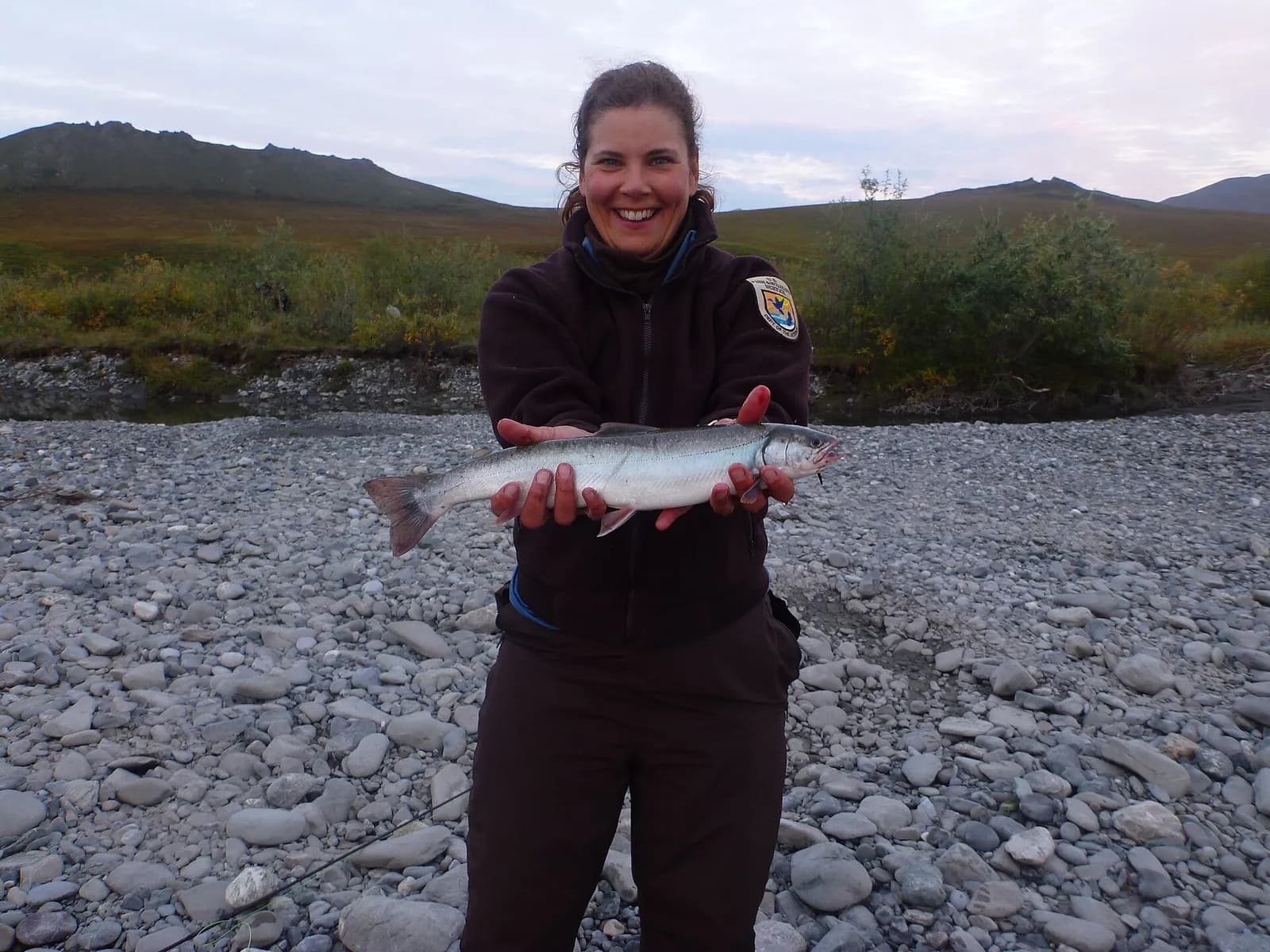
- Like other char, Arctic char have light spots on a dark background, which sets char apart from other salmon and trout.[1]
What the source says
“Char are generally distinguished from other salmonid fishes by having light spots on a dark background”
- Compared with Dolly Varden, Arctic char tend to have fewer, larger spots, a more deeply forked tail and a narrower tail wrist (caudal peduncle).[1]
What the source says
“Arctic char tend to have fewer and larger spots, a more deeply-forked tail, and a narrower caudal peduncle”
- Spawning Arctic char are usually gold, orange, yellow or rose, and only rarely red.[1]
What the source says
“Spawning Arctic char are usually gold, orange, yellow or rose and only infrequently red”
Status, protections and rules
As each agency stated them on the date read; a rule applies only where its agency says so. Check the current regulations for the water before you fish.
- ADF&G considers Alaska's Arctic char populations relatively stable throughout their Alaskan range.[1]
What the source says
“Populations of Arctic char in Alaska are considered to be relatively stable throughout their range in Alaska”
Water temperature in Alaska
Alaska Department of Fish and Game publishes no water-temperature line for trout anglers that we found. The lines below are the National Park Service's, federal guidance, not a Alaska rule:
- Under the federal 68°F lineThat is under the 68°F at which the National Park Service, at Grand Teton National Park, recommends anglers stop fishing in the afternoon (“cease fishing at 2 p.m. when water temperatures are likely to exceed 68°F”). Water warms through the afternoon, so check again later in the day: “Carry a pocket thermometer to monitor water temperature.”
- Stressful for troutAt 68°F the U.S. Fish and Wildlife Service says rainbow trout “start stressing”, and the National Park Service at Grand Teton recommends that anglers “cease fishing at 2 p.m. when water temperatures are likely to exceed 68°F.” Its advice: “Fish early in the morning while the water temperature is cooler”, “Play and land fish quickly to reduce exhaustion stress” and “Keep the fish in the water as much as possible.”
Sources: High water temperatures prompt fishing advisory in Grand Teton National Park (29 July 2022) (National Park Service); Up a climate-stressed creek (9 June 2023) (U.S. Fish and Wildlife Service).
Destination hubs
Hubs that list one of these waters, or that a water page is near: each has guides, shops, licences and trip planning for the area.
- Anchorage & Eagle River, Alaska1 arctic char water
Hatch & season charts
- Alaska8 sourced rows
Sources
Every fact on this page is our paraphrase of the page cited beside it, read on the date shown. Rules and seasons change: check the agency's current regulations before you fish.
- Arctic Char Species Profile, Alaska Department of Fish and Game Alaska Department of Fish and Game, read Oct 24, 2026.