
Legendary Species · Idaho
Northern pike in Idaho
Esox lucius[1]
7 Idaho waters whose agency species list names northern pike. Each links to its water page (gauge, regulations, access map, guides and shops) and to the agency list it comes from.
- 7waters list it
- 0destination hubs
Idaho waters
Most fished first. A species missing from an agency list does not mean it is absent; this page lists only waters whose list names it (at least 5 are needed for a page).
- Clark Fork RiverAgency list: Idaho Department of Fish and Game
- Lake Pend OreilleAgency list: Idaho Department of Fish and Game
- Saint Joe RiverAgency list: Idaho Department of Fish and Game
- Saint Maries RiverAgency list: Idaho Department of Fish and Game
- Coeur d'Alene LakeAgency list: Idaho Department of Fish and Game
- Freeman LakeAgency list: Idaho Department of Fish and Game
- Hayden LakeAgency list: Idaho Department of Fish and Game
Identification
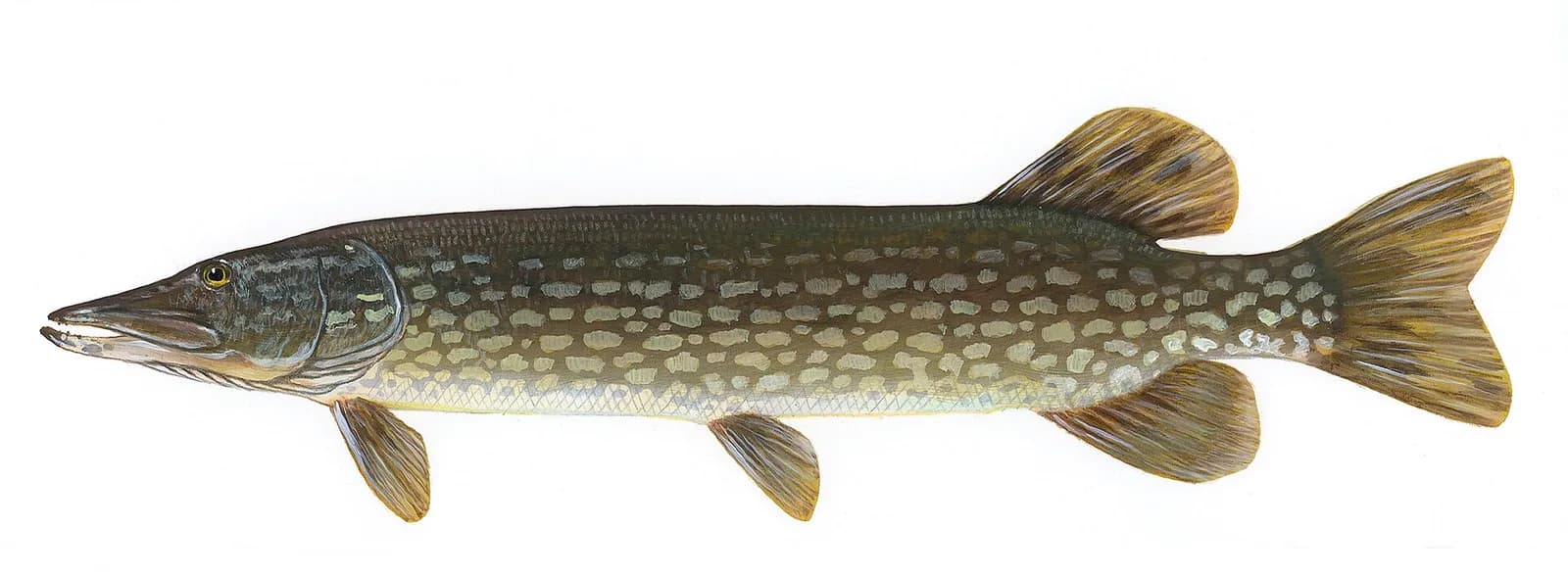
- Northern pike show light spots on a darker body: green or blue-gray above with many roundish yellow spots on the sides.[1]
What the source says
“The overall color pattern consists of light spots against a darker background. The upper parts are green or blue gray, with numerous roundish yellow spots on the sides.”
- The cheek is fully scaled but the gill cover only on its upper half, and there are 5 sensory pores along each side of the lower jaw.[1]
What the source says
“Northern pike is distinguished from other pike by having the cheek fully scaled, but the gill cover scaled only on the upper half, and in having a row of 5 sensory pores along each side of the lower jaw.”
- Minnesota DNR's foolproof test: count the pores under one side of the jaw. A muskie has six or more; a northern pike has five or fewer.[2]
What the source says
“The foolproof way to tell a muskie from a northern pike is to count the pores on one side of the underside of the jaw. A muskie has six or more. A northern has five or fewer.”
Status, protections and rules
As each agency stated them on the date read; a rule applies only where its agency says so. Check the current regulations for the water before you fish.
- Alaska Department of Fish and Game classes northern pike as an invasive species in Southcentral Alaska.[3]
What the source says
“For this reason, in Southcentral, the northern pike is an invasive species.”
- In Alaska, moving live fish, including pike, from one water to another is illegal: a Class A misdemeanor with a $10,000 penalty (ADF&G).[3]
What the source says
“You certainly cannot take fish, including pike, from one waterway and "seed" them into another. It is illegal (Class A misdemeanor with a $10,000 penalty) and can cause major problems.”
- Washington (WDFW) classes northern pike as a prohibited aquatic invasive species; keeping or moving live pike is illegal there.[4]
What the source says
“Northern pike are a prohibited species everywhere they exist in Washington. It is illegal to retain or transport live pike in our state.”
- WDFW asks anglers who catch a pike in a new area to kill it at once rather than release it, photograph it, and report it.[4]
What the source says
“If anglers catch northern pike in new areas, WDFW asks that they kill the pike immediately and do not release it, take a photo, and report it by calling 1-888-WDFW-AIS, email at ais@dfw.wa.gov”
Sources
Every fact on this page is our paraphrase of the page cited beside it, read on the date shown. Rules and seasons change: check the agency's current regulations before you fish.
- Northern Pike | Missouri Department of Conservation Missouri Department of Conservation, read Oct 24, 2026.
- Muskellunge | Minnesota DNR Minnesota Department of Natural Resources, read Oct 24, 2026.
- Invasive Northern Pike, Alaska Department of Fish and Game Alaska Department of Fish and Game, read Oct 24, 2026.
- Northern pike | Washington Department of Fish & Wildlife Washington Department of Fish and Wildlife, read Oct 24, 2026.